

TL;DR:
- Diamond ring financing involves spreading the purchase cost over time through various credit options, with the average ring costing $5,200 in 2024. Your credit score impacts available loan types and interest rates, making it crucial to match your profile with suitable financing methods like 0% APR credit cards, personal loans, store financing, or BNPL plans. Selecting the best option requires understanding terms, avoiding traps, and planning your budget to ensure affordable, predictable payments without negatively affecting your credit.
Diamond ring financing is the process of purchasing a diamond ring through structured payment plans or credit options that spread the total cost over time. The average engagement ring costs $5,200 in the US as of 2024, which means most buyers cannot or prefer not to pay in full upfront. Whether you’re considering buying diamond rings on credit, using a personal loan, or exploring a buy now, pay later plan, the right approach depends on your credit profile, timeline, and total budget. This guide covers every major financing method, their real costs, and how to choose the one that protects your finances while getting you the ring you want.
What diamond ring financing options are available?
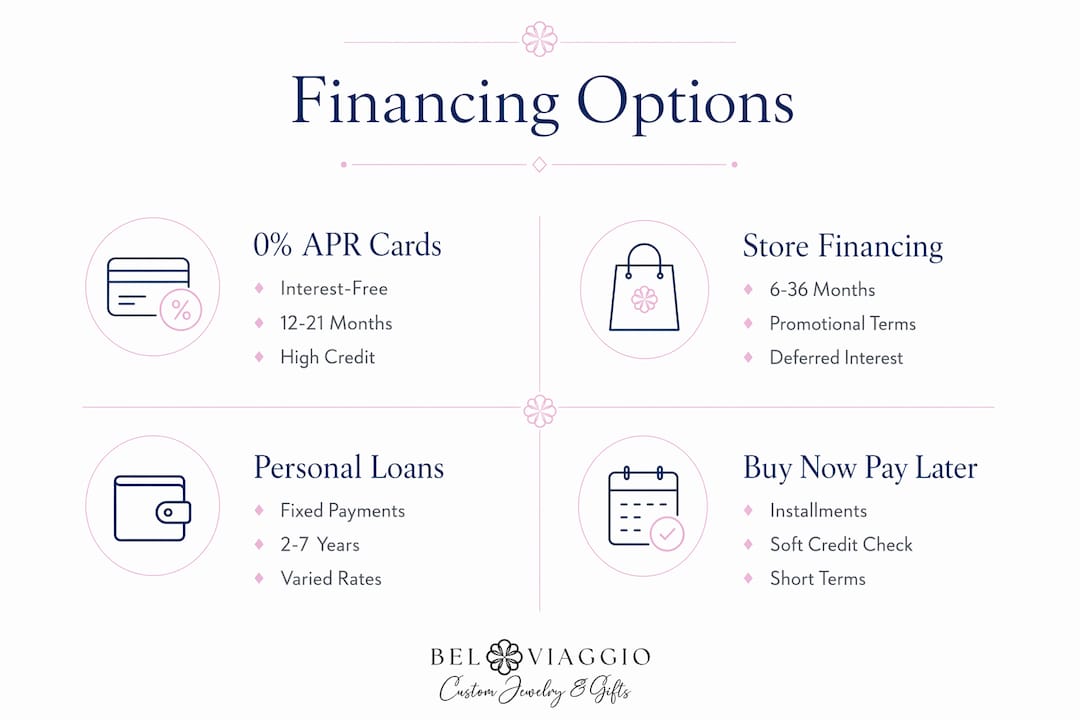
Diamond ring financing covers four primary methods, each with different terms, credit requirements, and risk profiles. Understanding how they differ is the fastest way to identify which one fits your situation.

0% APR credit cards are general-purpose cards that offer interest-free periods, typically between 12 and 21 months, on new purchases. Cards like the Chase Freedom Unlimited® or Citi Double Cash give you time to pay off the balance without accruing interest, provided you clear the full amount before the promotional window closes. These cards also earn rewards on purchases, which store-specific cards rarely offer. The catch is that 0% APR cards require good to excellent credit, generally a FICO score of 670 or above.
Personal loans are installment loans with fixed monthly payments and terms ranging from 2 to 7 years. Lenders like LightStream, SoFi, and Upstart offer personal loans specifically suited to large one-time purchases. Personal loans provide fixed rates and predictable payments, which makes budgeting straightforward. They also give you the freedom to shop at any retailer, including independent jewelers or custom designers, rather than being locked into one store’s inventory.
Jewelry store financing typically runs 6 to 36 months and is offered directly at the point of sale. The promotional terms can look attractive, but the structure is often deferred interest rather than true 0% APR. Store financing often uses deferred interest, meaning if you carry any balance past the promotional end date, retroactive interest on the full original purchase price applies immediately, often at rates between 20% and 36%.
Buy Now, Pay Later (BNPL) plans from providers like Affirm and Afterpay split your purchase into installments over 6 weeks to 36 months. Affirm offers longer 0% APR terms, performs only soft credit checks, and charges no late fees, though missed payments can still affect your credit score. BNPL is the most accessible option for buyers with limited or fair credit.
Here is a side-by-side comparison of all four methods:
| Method | Typical term | Interest rate | Credit score needed | Key risk |
|---|---|---|---|---|
| 0% APR credit card | 12 to 21 months | 0% promo, then 20%+ | Good to excellent (670+) | Balance remaining after promo period |
| Personal loan | 2 to 7 years | Fixed, varies by lender | Fair to excellent | Higher total interest over long terms |
| Store financing | 6 to 36 months | 0% promo (deferred) | Fair to good | Retroactive interest if not paid in full |
| BNPL (e.g., Affirm) | 6 weeks to 36 months | 0% to 30%+ | Soft check, accessible | Missed payments hurt credit |
Pro Tip: General-purpose 0% APR cards outperform store cards for most buyers because they carry no deferred interest risk and often include cashback or travel rewards on top.
How does your credit score affect financing costs?
Your credit score is the single biggest variable in what you pay to finance a diamond ring. It determines which products you qualify for, what interest rate you receive, and how much the ring ultimately costs you in total.
Buyers with FICO scores of 670 and above access the widest range of options, including 0% APR general credit cards and competitive personal loan rates. Scores between 580 and 669 typically limit you to store cards or BNPL plans, both of which carry higher risk if not managed carefully. Scores below 580 narrow the field to no-credit-check BNPL options or secured financing, which often come with the least favorable terms.
The credit utilization ratio is a factor many buyers overlook. High credit utilization can temporarily lower your score even when you make every payment on time. If a $5,000 ring purchase brings your card utilization above 30% of your total credit limit, your score may dip during the repayment period. This matters most if you plan to apply for a mortgage or car loan in the same window.
BNPL providers handle credit differently from traditional lenders. Affirm and Afterpay run soft credit checks that do not appear on your credit report during the application process. This makes them a practical entry point for buyers building credit or those who want to avoid a hard inquiry before a major loan application.
Pro Tip: Pull your free credit report from AnnualCreditReport.com before applying for any financing. Knowing your score in advance lets you target the right products and avoid hard inquiries on applications you are unlikely to pass.
How to choose and apply for diamond ring financing
Choosing the right payment plan for a diamond ring is a five-step process that starts well before you walk into a store or visit a product page.
-
Set your budget using a realistic timeline. Financial experts recommend calculating your ring budget based on the months you have until the planned purchase, not the outdated three-month salary rule. If you have six months before a planned proposal, divide your comfortable monthly contribution by six to find a realistic price ceiling.
-
Match your credit profile to the right product. If your score is 720 or above, target a 0% APR general credit card with a 15-to-21-month window. If your score is between 580 and 669, a personal loan with a fixed rate or a BNPL plan from Affirm will likely serve you better than a store card with deferred interest.
-
Read every term before you apply. Confirm whether a promotional offer is true 0% APR or deferred interest. Deferred interest means the retailer is holding the full interest charge in reserve and will apply it retroactively if you miss the payoff deadline. True 0% APR means interest does not accrue at all during the promotional period.
-
Use prequalification tools before submitting a full application. Most personal loan lenders and many credit card issuers offer soft-check prequalification that shows you estimated rates without affecting your score. Affirm and Afterpay also use soft checks. Only submit a hard-inquiry application once you have identified the best offer.
-
Set up automatic payments immediately after approval. Automatic payments are critical for avoiding retroactive interest charges and protecting your credit score. Schedule payments above the minimum to reduce the principal faster and pay off the balance before any promotional period ends.
Pro Tip: Monitor your monthly statements for the first three months after financing. Billing errors and misapplied payments are more common than most buyers expect, and catching them early prevents compounding problems.
Common pitfalls to avoid include: opening multiple credit accounts in the same month, which stacks hard inquiries and signals risk to lenders; using the full credit limit on a single card, which spikes your utilization ratio; and assuming a “no interest” store offer is the same as a 0% APR card. It is not. For a deeper look at jewelry payment plan pitfalls, Belviaggiodesigns covers the most common mistakes buyers make when financing through retailers.
Financing a diamond ring vs. paying cash: which is smarter?
The right answer depends entirely on your financial position, but the tradeoffs are clear and worth examining before you commit.
Financing advantages include the ability to purchase immediately without depleting savings, the option to leverage a 0% APR window to pay over time at no extra cost, and the opportunity to earn credit card rewards on a large purchase. For buyers who have the cash but want to preserve liquidity, a 0% APR card used strategically costs nothing in interest and returns value through rewards points or cashback.
The disadvantages are equally concrete. High APR rates on store cards or personal loans can add hundreds or thousands of dollars to the total cost of the ring. Deferred interest traps can turn a $3,000 ring into a $4,000 obligation if the balance is not cleared on time. Financing also adds a recurring monthly obligation that affects your debt-to-income ratio, which matters if you plan to apply for a mortgage within the next 12 to 24 months.
Cash purchases carry their own advantages. Paying outright eliminates interest entirely, gives you negotiation leverage with independent jewelers, and keeps your credit profile clean. Some custom jewelers, including those offering bespoke designs, will discount a piece for a cash buyer because it removes their processing and financing overhead.
The practical framework is straightforward. If you can pay off the balance within the 0% APR window without financial strain, financing costs you nothing and may earn you rewards. If you cannot realistically clear the balance before interest kicks in, saving for a few more months and paying cash is the less expensive path. For guidance on setting a ring budget, Belviaggiodesigns offers a practical breakdown of how to plan your purchase without overextending.
Key takeaways
Smart diamond ring financing requires matching your credit profile to the right payment method before you apply, not after.
| Point | Details |
|---|---|
| Know your credit score first | Buyers with FICO scores above 670 access the best rates and 0% APR card offers. |
| Avoid deferred interest traps | Store financing retroactively charges full interest if the balance is not cleared by the promo end date. |
| Personal loans offer flexibility | Fixed rates and shop-anywhere freedom make personal loans a strong alternative to store cards. |
| BNPL suits limited-credit buyers | Affirm and Afterpay use soft credit checks and offer accessible installment terms with no late fees. |
| Automate payments immediately | Setting up autopay protects your credit score and prevents retroactive interest charges. |
What I’ve learned from watching buyers finance rings the wrong way
I have spent years watching people make the same expensive mistake: they walk into a jewelry store, fall in love with a ring, and accept the store’s financing offer without reading the fine print. The deferred interest structure is the single most misunderstood product in retail financing. Buyers see “0% interest for 24 months” and assume it works like a 0% APR credit card. It does not. One missed payment or a remaining balance of even $50 at the end of the promotional period can trigger retroactive interest on the full original purchase price at rates that can reach 30%.
My honest recommendation is to treat store financing as a last resort, not a first option. A general-purpose 0% APR card from a major issuer gives you the same interest-free window with none of the deferred interest risk. If your credit does not qualify for that, a personal loan from a lender like LightStream or SoFi gives you a fixed rate, a predictable payoff date, and the freedom to buy from any retailer you choose, including independent designers who often offer better value than chain stores.
The rise of BNPL has genuinely changed the options available to buyers with fair or limited credit. Affirm in particular has made it possible to finance a meaningful purchase without a hard credit inquiry, which is a real advantage for buyers who are also saving for a home. That said, I always recommend reading the full repayment schedule before accepting any BNPL offer, because longer-term plans from these providers can carry APRs that rival credit cards.
Plan your financing before you start shopping. Knowing your budget ceiling and your credit profile in advance removes the emotional pressure of making a financial decision in the middle of a purchase. The ring should be the exciting part. The financing should be boring, predictable, and already handled.
— Stacy
Find your perfect ring with flexible payment options at Belviaggiodesigns
Belviaggiodesigns offers handcrafted, ethically sourced diamond rings with flexible payment plans built for real budgets. The Black Diamond Engagement Ring Halo Setting at 1.75 ctw is one of the most requested pieces in the collection, and it is available with financing options that let you spread the cost without compromising on quality or design. Every ring is custom-made, which means you are not paying a premium for mass production. You are paying for craftsmanship that lasts. Browse the full collection at Belviaggiodesigns to see current payment plan options and find a ring that fits both your vision and your budget.
FAQ
What is the average cost of a diamond engagement ring?
The average amount spent on an engagement ring in the US was $5,200 as of 2024. This figure makes financing a practical consideration for most buyers rather than a last resort.
What credit score do I need for diamond ring financing?
Buyers with FICO scores of 670 and above qualify for the best financing options, including 0% APR credit cards and competitive personal loan rates. Scores below 660 are typically limited to store cards or BNPL plans.
Is BNPL a good option for buying a diamond ring?
BNPL providers like Affirm are a strong option for buyers with limited or fair credit because they use soft credit checks and offer no-late-fee installment plans. Longer-term BNPL plans can carry high APRs, so always confirm the rate before accepting.
What is deferred interest and why does it matter?
Deferred interest means a lender holds the full interest charge in reserve and applies it retroactively to the original purchase price if the balance is not fully paid by the promotional end date. This is different from true 0% APR, where no interest accrues during the promotional period.
Can financing a ring hurt my credit score?
Financing a ring can temporarily lower your credit score if the purchase pushes your credit utilization above 30%, even with on-time payments. Paying down the balance quickly and keeping utilization low minimizes this impact.
Recommended
- Payment plan jewelry: steps, pitfalls, and smart choices – Bel Viaggio Designs, LLC
- How to Pay for an Engagement Ring: Smart Money Moves – Bel Viaggio Designs, LLC
- Design a Ring Online Free: Your Complete 2026 Guide – Bel Viaggio Designs, LLC
- Ethical engagement ring buying tips for personalized 2026 – Bel Viaggio Designs, LLC