

TL;DR:
- Paying for an engagement ring requires disciplined budgeting based on your full financial picture rather than outdated salary rules.
- Financing options like 0% APR credit cards and fixed-rate personal loans can make affordable payments if used responsibly and with full understanding of terms.
Paying for an engagement ring is a financial decision that rewards planning, not impulse. The average U.S. engagement ring cost hit $5,200 in 2024, with nearly two-thirds of buyers spending under $6,000. That number is a useful benchmark, not a mandate. You can cover the cost through 0% APR credit cards, personal loans, buy now pay later plans, or disciplined savings. Each path works under the right conditions and fails under the wrong ones. This article breaks down every option so you can choose with confidence.
How to budget for an engagement ring the right way
The first step in figuring out how to pay for an engagement ring is setting a number you can actually defend. Not a number a jewelry marketing campaign invented for you.
The old “two to three months’ salary” rule is artificial and misleading. It was popularized by De Beers in the 1980s as an advertising strategy, not financial advice. For someone earning $60,000 a year, three months’ salary means $15,000 on a ring before paying for the wedding, a honeymoon, or a down payment on a home. That math does not serve you.
A realistic budget starts with your full financial picture. Ask yourself what you owe in student loans, what your monthly rent or mortgage costs, and what you plan to spend on the wedding itself. The ring is one item in a larger financial event. Spending beyond your means on the ring can compromise every other goal that follows.
Here is a practical way to set your ring budget:
- Calculate your monthly take-home income after taxes and fixed expenses
- Identify how many months you have before the proposed purchase date
- Multiply those months by a comfortable monthly savings amount
- Cross-reference that figure against your other upcoming financial obligations
- Set a ceiling and treat it as non-negotiable
Pro Tip: Shop with your partner before setting a final budget. Knowing their style preferences and size expectations prevents you from overspending on a ring they would not have chosen anyway. Many couples find they prefer something more personal and less expensive than the default.
If your honest budget lands below $1,000, that is a legitimate choice. Research consistently shows that spending under $1,000 on an engagement ring is widely accepted and often preferred by partners who value financial stability over stone size.
What financing options are available for an engagement ring?
Once you have a budget, the next question is whether to pay cash or use financing. Most buyers use some form of credit. The key is understanding what each option actually costs you.
| Financing option | Typical APR | Promo period | Credit requirement | Main risk |
|---|---|---|---|---|
| 0% APR credit card | 0% intro, then 20%+ | 6 to 21 months | Good to excellent | Missing payoff deadline |
| Personal loan | 7% to 36% APR | 2 to 7 years | Fair to excellent | High APR on low credit |
| Jeweler financing | 0% deferred interest | 6 to 24 months | Varies | Retroactive interest trap |
| Buy now, pay later | 0% if on time | 4 payments over 6 weeks | Soft check only | Missed payment fees |
0% APR credit cards are the strongest option for buyers with good credit who can pay off the balance within the promotional window. Cards like the U.S. Bank Shield Visa offer up to 21 months of zero interest before a variable rate kicks in. Divide the ring price by the number of promo months to get your required monthly payment. If that number fits your budget, this option costs you nothing extra.
Personal loans from lenders like LightStream or SoFi offer fixed monthly payments with APRs ranging from 7% to 36% depending on your credit score. The fixed structure makes budgeting predictable, which is a real advantage over revolving credit. The downside is that even a 10% APR on a $5,000 loan over two years adds roughly $540 in interest.
Jeweler financing sounds attractive but carries the most risk. Many “no interest” offers from jewelry retailers are actually deferred-interest plans, not true 0% APR. The distinction matters enormously. With a deferred-interest plan, if you carry any balance past the promo period, the retailer charges interest retroactively from the original purchase date. One missed payment can trigger hundreds of dollars in surprise charges.
Buy now, pay later services like Affirm and Afterpay split the cost into four installments over six weeks with zero interest if paid on time. This works well for rings under $2,000 but becomes harder to manage for larger purchases. Longer-term BNPL plans through Affirm can extend to 12 or 24 months, sometimes with interest. Review the payment plan details before committing.
Pro Tip: Before signing any financing agreement, search the exact phrase “deferred interest” in the terms. If you find it, treat the offer as a high-interest loan with a grace period, not a free financing deal.
Step-by-step plan to pay for your ring without regrets
A clear process prevents the two most common mistakes: overspending upfront and mismanaging payments afterward.
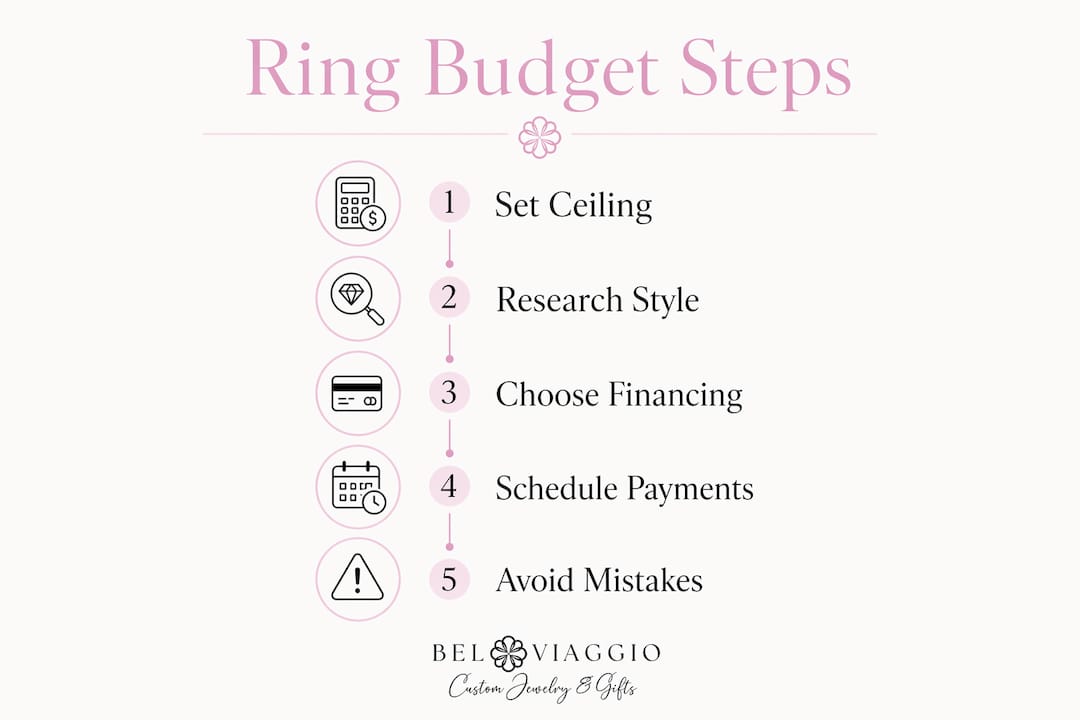
- Set your ceiling. Use your income, savings timeline, and other financial priorities to land on a firm number. Do not adjust it upward because a salesperson suggests it.
- Choose your payment method. Match the financing option to your credit score and payoff ability. If you cannot guarantee payoff within a 0% promo window, a personal loan with a fixed rate is safer.
- Shop with transparency. Look for retailers that disclose full pricing, sourcing, and financing terms upfront. Ethical sourcing and conflict-free practices often correlate with honest business practices overall.
- Calculate your exact monthly payment. Divide the total ring price by the number of months in your repayment plan. Confirm that amount fits your monthly budget before purchasing.
- Make every payment on time. Set calendar reminders or autopay the day after your paycheck clears. One late payment on a deferred-interest plan can cost you more than the interest savings you earned.
- Insure the ring immediately. Ring insurance is frequently overlooked but costs as little as $1 to $2 per $100 of value annually. A $5,000 ring costs roughly $50 to $100 per year to insure. Losing an uninsured ring while still paying off the loan is a financial double loss.
| Step | Key action |
|---|---|
| Set your ceiling | Base it on income and upcoming expenses, not salary rules |
| Choose financing | Match option to credit score and guaranteed payoff ability |
| Shop transparently | Prioritize retailers with clear pricing and ethical sourcing |
| Calculate monthly payment | Divide total cost by repayment months before committing |
| Insure immediately | Add ring to renters or homeowners policy within days of purchase |
Common financial mistakes when paying for an engagement ring
Most ring-buying regrets trace back to one of four predictable errors. Knowing them in advance is the only protection.
Falling for deferred-interest traps. The phrase “no interest if paid in full” is not the same as “0% APR.” True 0% APR means interest never accrues during the promo period. Deferred interest means it accrues silently and hits you all at once if you miss the deadline. Always verify the financing language before signing.
Overestimating your payoff speed. Many buyers calculate their promo window optimistically and miss it. A $5,200 ring on a 12-month 0% card requires $433 per month. If that number is tight, it will become impossible the moment an unexpected expense appears. The exact monthly payment calculation is price divided by promo months. Run it before you buy.
Ignoring the bigger financial picture. The ring purchase does not exist in isolation. Wedding costs, housing deposits, and emergency funds all compete for the same dollars. Experts consistently advise spending only what you can afford without accruing interest. A ring bought on high-interest debt can delay a home purchase by years.
Skipping ring insurance. This is the quiet mistake nobody warns you about until it is too late. An uninsured ring lost or stolen while you are still making loan payments means you pay twice.
The most expensive engagement ring is the one you bought on terms you did not fully understand.
Pro Tip: Set a phone reminder two months before any financing promo period ends. That gives you time to make a lump-sum payment or transfer the balance to a new 0% card if needed.
Key takeaways
Paying for an engagement ring without financial regret requires a firm personal budget, the right financing tool matched to your credit and payoff ability, and disciplined payment management from day one.
| Point | Details |
|---|---|
| Skip the salary rule | Base your budget on your full financial picture, not a marketing formula. |
| Match financing to your payoff ability | Only use 0% APR cards if you can guarantee full payoff within the promo window. |
| Deferred interest is a trap | Confirm whether your offer is true 0% APR or a deferred-interest plan before signing. |
| Calculate monthly payments first | Divide the ring price by repayment months to confirm the amount fits your budget. |
| Insure immediately after purchase | Ring insurance costs as little as $50 per year and protects against total financial loss. |
What I’ve learned about ring budgets after years of watching buyers get it wrong
I have seen the same pattern repeat more times than I can count. Someone walks in with a number in mind, a salesperson suggests “just a little more,” and suddenly a $3,000 budget becomes a $6,000 purchase on a deferred-interest plan they did not read carefully. Six months later, they are paying retroactive interest on a ring they could have bought outright with patience.
The advice I give every time is this: the ring is a symbol, not a financial statement. Your partner is not measuring your love in carats. What they are measuring, consciously or not, is your judgment and your reliability. A buyer who spends within their means and pays off their ring in six months demonstrates exactly the qualities that make a good partner.
No-interest financing is a genuinely useful tool, but only for disciplined buyers. If you know you will spend the promo period making minimum payments and hoping for the best, a personal loan with a fixed rate is the more honest choice. You pay some interest, but you never face a surprise.
I also strongly recommend exploring ethical and personalized ring options before defaulting to a traditional diamond solitaire. Lab-grown diamonds and moissanite offer the same visual impact at a fraction of the cost, which means you can buy a stunning ring outright or pay it off in months instead of years. The savings are real and the difference is invisible to anyone who is not a gemologist.
Document everything. Keep your receipt, your appraisal, and your financing agreement in one place. Get insurance within the first week. These are the habits that protect a purchase that is meant to last a lifetime.
— Stacy
Find your perfect ring with flexible payment options at Belviaggiodesigns
Bel Viaggio Designs offers custom-crafted engagement rings built around your budget, your style, and your values. Every ring is handcrafted with ethically sourced materials and backed by a lifetime warranty. Whether you are drawn to lab-grown diamonds, moissanite, or vibrant gemstone alternatives, Belviaggiodesigns gives you transparent pricing with no hidden fees. Flexible buy now, pay over time options are available through the payment plan page, so you can start with a design you love and manage payments on a schedule that works for you. Start your custom ring inquiry today.
FAQ
What is the average cost of an engagement ring in 2026?
The average U.S. engagement ring cost was $5,200 in 2024 according to The Knot, with nearly two-thirds of buyers spending under $6,000. That figure is a market average, not a spending target.
Should I buy an engagement ring on credit?
Using credit is reasonable if you choose a true 0% APR card or a fixed-rate personal loan and can guarantee full payoff within the repayment window. Avoid deferred-interest jeweler financing unless you have read and understood the full terms.
What is the difference between 0% APR and deferred interest?
True 0% APR means no interest accrues during the promotional period. Deferred interest means interest accumulates from the purchase date and is charged retroactively if any balance remains when the promo ends.
How do I calculate monthly payments for a ring?
Divide the total ring price by the number of months in your repayment plan. A $5,200 ring on a 12-month plan requires approximately $433 per month. Confirm that amount fits your budget before committing to the purchase.
Do I need to insure my engagement ring?
Ring insurance is strongly recommended and typically costs $1 to $2 per $100 of value annually. Add the ring to your renters or homeowners policy within days of purchase to protect against loss, theft, or damage.
Recommended
- Engagement Ring Finding the Perfect One - Bel Viaggio – Bel Viaggio Designs, LLC
- Engagement Ring Finding the Perfect One - Bel Viaggio – Bel Viaggio Designs, LLC
- Payment plan jewelry: steps, pitfalls, and smart choices – Bel Viaggio Designs, LLC
- Types of engagement rings: ethical, personalized choices – Bel Viaggio Designs, LLC