

TL;DR:
- Proper engagement ring sizing is crucial because it affects comfort, security, and future adjustments during wear. Accurate measurement requires the right tools, timing, and consideration of design factors, with professional fitting recommended for the best results. Choosing a design that allows resizing and verifying policies helps ensure the ring fits perfectly after purchase and reduces stress during the process.
Engagement ring sizing is the process of measuring finger circumference or ring diameter to find the size that keeps a ring comfortable, secure, and wearable every day. The average U.S. women’s ring size falls between 6 and 7, with a size 7 measuring 17.3mm in diameter, but individual variation is wide enough that you should never assume. Getting this right matters more for an engagement ring than for any other piece of jewelry because it will be worn daily, often alongside a wedding band, and may feature a design that limits future adjustments. This guide covers every method, tool, and consideration you need to size accurately, whether you are planning a surprise proposal or shopping together.
What tools do you need for accurate engagement ring sizing?
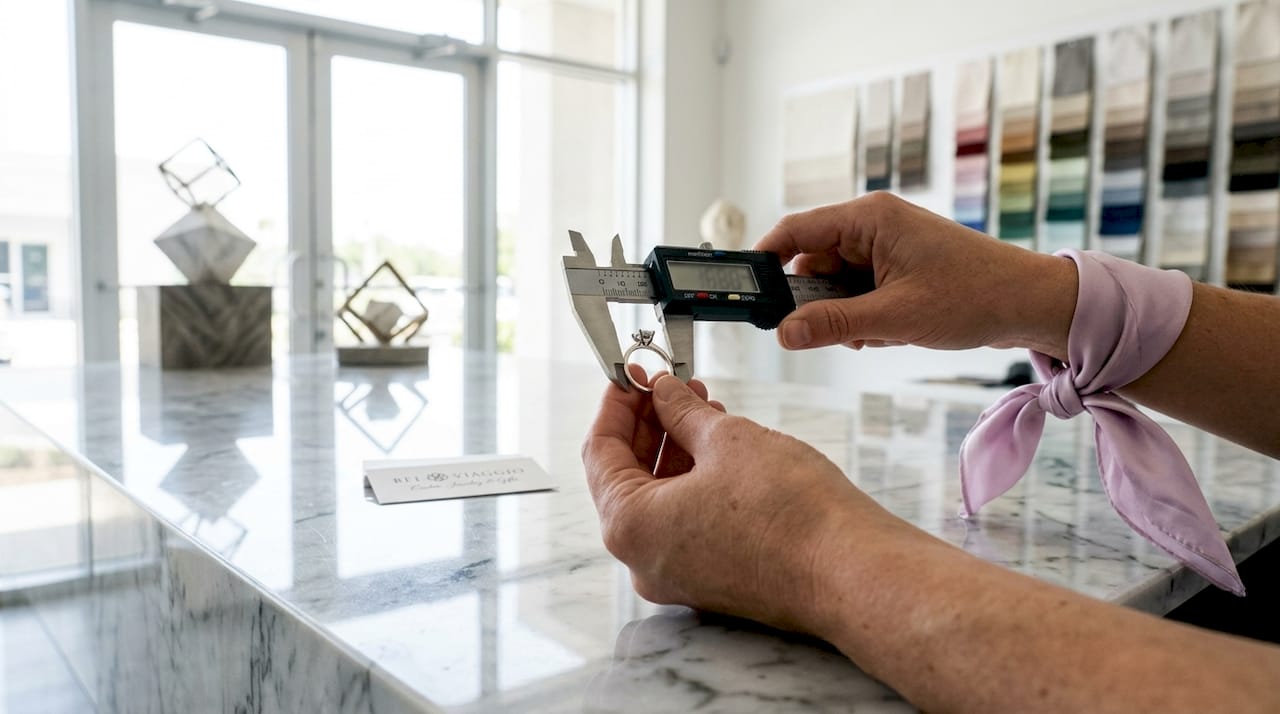
Accurate sizing starts with the right tools. The five most common options are a paper strip, a piece of string, a plastic ring sizer, a printable sizing chart, and a digital caliper. Each one measures either circumference (the distance around the finger) or diameter (the distance across the inside of a ring), and both measurements lead you to the same size on any standard ring size chart.
Measuring circumference and diameter is more reliable than relying on size labels alone, because US, UK, and EU sizing systems use different numbering conventions. A US size 6 is a UK size M and an EU size 51.5. If you ever order from an international retailer, always confirm which system they use and convert from a measurement rather than a label.
The table below compares the most common tools by precision and practicality:
| Tool | Best for | Typical precision | Limitation |
|---|---|---|---|
| Plastic ring sizer | Home use, quick check | ±0.5 size | Requires ordering in advance |
| Paper strip + ruler | Immediate home measurement | ±0.5 size | User error risk |
| Printable chart | Measuring an existing ring | ±0.25 size | Printer scaling must be verified |
| Digital caliper | Measuring existing ring diameter | ±0.1mm | Does not account for knuckle |
| Professional jeweler | Full fitting with calibrated tools | Most accurate | Requires in-person visit |
Timing matters as much as the tool you choose. Measure at midday, indoors, at room temperature for the most consistent result. Fingers shrink in cold weather and swell after exercise or heat, so a measurement taken first thing in the morning or after a workout will be off. Take at least three readings on different days and average them.
Pro Tip: Always measure at the base of the finger and at the widest point of the knuckle. If there is a noticeable difference between the two, size for the knuckle and plan to have the ring adjusted at the base after purchase.
How to measure ring size at home, step by step
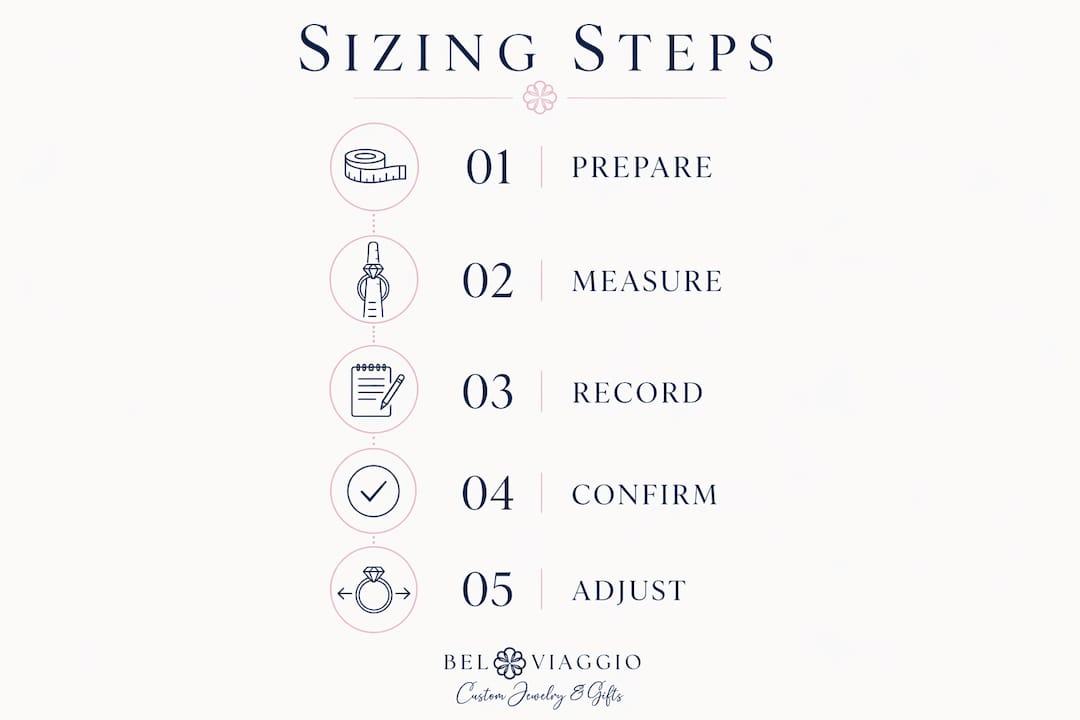
The paper strip method is the most accessible home approach and, when done carefully, delivers reliable results. Here is how to do it correctly:
- Cut a strip of paper about 6mm wide and 10cm long.
- Wrap it snugly around the base of your ring finger on the hand you plan to wear the ring on.
- Mark where the paper overlaps with a pen.
- Lay the strip flat and measure the length in millimeters with a ruler.
- Compare that circumference measurement to a standard ring size chart to find your size.
If you already own a ring that fits well, measuring its internal diameter with a ruler or digital caliper is even faster. Place the ring flat on the printable chart from Belviaggiodesigns or measure across the inside from edge to edge in millimeters, then match that number to the corresponding size.
For surprise proposals, the process gets more creative. Combining a baseline measurement with a resizable ring style is the approach experts recommend. Borrow a ring your partner wears on their ring finger, trace the inside on paper, and measure the diameter. Avoid trying to nail a perfect size with a complex design. A solitaire or simple band allows for easy adjustment after the proposal, which removes the pressure of getting it exactly right in secret.
The dominant hand often has slightly larger fingers, with the left and right ring fingers sometimes differing by up to half a size. Always measure the specific finger and hand the ring will be worn on. This is one of the most common mistakes people make when sizing remotely.
Common mistakes to avoid:
- Measuring in the morning when fingers are at their smallest
- Measuring only once and treating it as definitive
- Forgetting to account for the knuckle on fingers where it is significantly wider than the base
- Assuming both hands are the same size
- Relying on a size from a ring worn on a different finger
How ring design affects sizing and fit
Ring design has a direct and measurable impact on how a size feels. Wide bands require a larger size because they cover more skin surface area and create more friction. Bands between 5mm and 7mm typically need half a size up from your standard measurement. Bands 8mm or wider usually require a full size increase. If you are comparing a classic 2mm solitaire band to a bold 8mm statement band, the same finger needs two different sizes.
Certain design styles also limit how much a ring can be adjusted after purchase. Full eternity bands and pavé channel settings are difficult or impossible to resize without damaging the stone arrangement. These styles require precise sizing from the start. If you are planning a surprise proposal and leaning toward an eternity band, reconsider. A solitaire, a three-stone ring, or a simple halo setting gives a jeweler far more flexibility to adjust the fit later.
Pro Tip: If your partner has noticeably larger knuckles relative to the base of their finger, size for the knuckle and ask your jeweler about sizing beads or a spring insert. These small additions allow the ring to slide over the knuckle but sit snugly at the base without permanent resizing.
Finger size also shifts throughout the day and across seasons. Temperature, hydration, and physical activity all cause measurable fluctuation. This is why a single measurement taken under one set of conditions is never enough. Sizing engagement rings requires more precision than fashion rings because the design complexity and daily wear expectations are higher. A fashion ring that is slightly loose is an inconvenience. An engagement ring that is slightly loose is a real loss risk.
Designs to approach with extra sizing care:
- Full eternity bands (stones all the way around)
- Pavé and micro-pavé settings
- Channel-set bands
- Rings with very wide, flat profiles
- Tungsten and ceramic rings, which cannot be resized at all
What to do when your engagement ring doesn’t fit
A ring that does not fit correctly is not a permanent problem in most cases. Standard resizing works by cutting the band and adding or removing metal, then soldering and polishing it back to shape. Most jewelers can adjust a ring by one to two sizes in either direction without compromising the structure. Going beyond two sizes risks distorting the ring’s proportions or weakening the setting.
Most reputable jewelers offer at least one free resize within 30 to 90 days of purchase, provided the ring is returned in its original condition. Resizing typically takes 7 to 14 days depending on the complexity of the design and the metal involved. Platinum takes longer than gold because it requires more heat and specialized tools. Budget for a cost range from around $20 for a simple gold resize to over $100 for platinum or stone-heavy designs.
Some materials cannot be resized at all. Tungsten, ceramic, and titanium rings are too hard to cut and solder using standard jewelry techniques. If you or your partner is drawn to these materials, buy from a retailer with a clear exchange policy for size changes.
Pro Tip: Before purchasing, ask your jeweler directly: “What is your resize policy, and does this specific design support resizing?” Get the answer in writing. Some retailers exclude resizing for sale items or custom orders.
Signs your ring does not fit and needs attention:
- The ring spins freely on your finger throughout the day
- You cannot remove it without significant effort, especially in warm weather
- You notice redness or indentation on the skin after wearing it
- The ring slides toward your knuckle when your hand is relaxed
Temporary solutions include ring guards (small plastic or metal inserts that reduce the inner circumference), sizing beads soldered inside the band, and spring shanks. These work well as short-term fixes while you wait for a formal resize or decide whether a permanent adjustment is right.
Key takeaways
Accurate engagement ring sizing requires measuring the correct finger at the right time of day, accounting for band width and design style, and confirming your jeweler’s resize policy before purchase.
| Point | Details |
|---|---|
| Measure at midday, indoors | Fingers are most stable in size at room temperature, away from heat or cold extremes. |
| Account for band width | Bands 5 to 7mm wide need half a size up; bands 8mm or wider need a full size increase. |
| Eternity and pavé styles limit resizing | Size these designs precisely from the start, as post-purchase adjustment risks stone damage. |
| Dominant hand fingers run larger | Measure the exact finger and hand the ring will be worn on, not the opposite hand. |
| Confirm the resize policy before buying | Most jewelers offer one free resize within 30 to 90 days, but terms vary by design and metal. |
Why I stopped worrying about getting the size perfect
After years of helping couples work through the sizing process, the single biggest mistake I see is treating engagement ring sizing as a one-shot problem that must be solved perfectly before the proposal. That pressure leads to rushed measurements, wrong assumptions, and real anxiety. Here is what I have actually found works: measure carefully, choose a design that allows adjustment, and trust the resize process.
The couples who stress least are the ones who buy a solitaire or a simple halo, get close on the size, and know their jeweler has a clear policy for adjustments. The couples who stress most are the ones who locked in a full eternity band for a surprise proposal and are now discovering it cannot be resized. I have seen that scenario more than once, and it is entirely avoidable.
Sizing for a surprise proposal does not require perfection. It requires a reasonable estimate, a resizable design, and a jeweler you trust. If you are shopping together, take the time to get a professional fitting at a jeweler who uses calibrated metal sizers. That 15-minute appointment eliminates almost every sizing problem before it starts. The ring is a symbol of something lasting. The fit should be too.
— Stacy
Find your perfect fit with Belviaggiodesigns
Belviaggiodesigns makes the sizing process straightforward from the first step. You can order a free ring sizer directly from the site to measure at home before you browse. Every engagement ring in the collection comes with sizing guidance, and the customer support team is available to walk you through fit questions before and after purchase.
If you are ready to explore styles, the Black Diamond Halo engagement ring is one of the most popular choices for first-time buyers, with a solitaire-friendly shank that supports easy resizing. For something with color, the Green Emerald and Diamond ring offers a distinctive look with the same resizing flexibility. Belviaggiodesigns also provides clear resize policies at purchase so you never have to guess what happens if the fit needs adjusting after the proposal.
FAQ
What is the average engagement ring size for women?
The average ring size for U.S. women is between 6 and 7, with size 7 measuring 17.3mm in diameter. Individual sizing varies significantly, so always measure rather than assume.
How long does it take to resize a ring?
Resizing typically takes 7 to 14 days depending on the metal and design complexity. Platinum resizes take longer than gold due to the higher heat and skill required.
Can all engagement rings be resized?
No. Rings made from tungsten, ceramic, or titanium cannot be resized using standard techniques. Full eternity bands and pavé settings are also difficult to adjust without risking stone damage, so precise initial sizing is critical for these styles.
How do I find my ring size at home without a sizer?
Wrap a strip of paper around the base of your ring finger, mark where it overlaps, and measure the length in millimeters. Compare that circumference to a standard ring size chart to find your size. Take three readings on different days for the most accurate result.
Does the time of day affect ring size measurement?
Yes. Fingers are smallest in the morning and largest after exercise or in warm conditions. Measuring at midday at room temperature gives the most consistent and reliable result for engagement ring sizing.
Recommended
- Engagement Ring Finding the Perfect One - Bel Viaggio – Bel Viaggio Designs, LLC
- Engagement Ring Finding the Perfect One - Bel Viaggio – Bel Viaggio Designs, LLC
- Take the Engagement Ring Quiz to Find Your Style – Bel Viaggio Designs, LLC
- How to Pay for an Engagement Ring: Smart Money Moves – Bel Viaggio Designs, LLC