

TL;DR:
- Wedding jewelry now emphasizes personal meaning, ethical sourcing, and sustainability over tradition.
- Certifications like RJC, Chain of Custody, and Kimberley Process verify ethical claims, but multiple certifications are recommended.
- Lab-grown diamonds and recycled metals offer eco-friendly options, with custom design ensuring ethical sourcing and personal expression.
Wedding rings stretch back over 5,000 years to ancient Egypt, where reed bands symbolized eternity long before diamonds entered the picture. But something has shifted for today’s couples. The question is no longer just “which ring looks best?” It’s “what does this ring stand for, and where did it come from?” Sustainability, personal expression, and ethical sourcing have become just as important as carat weight and cut. This guide walks you through the history, the certifications, the sustainable alternatives, and the custom design process so you can choose wedding jewelry that genuinely reflects who you are.
Table of Contents
- How jewelry shapes meaning and tradition in weddings
- Ethically sourced jewelry: Standards, certifications, and real risks
- Sustainable and custom jewelry: Choices for impact and expression
- Consumer trends and challenges: Sustainability meets personal style
- Our take: Making wedding jewelry meaningful and ethical in 2026
- Explore custom and ethical jewelry options for your wedding
- Frequently asked questions
Key Takeaways
| Point | Details |
|---|---|
| History matters | Wedding jewelry traditions evolved for thousands of years across diverse cultures and beliefs. |
| Certification is essential | Look for RJC, Chain of Custody, and Kimberley certification to ensure ethical sourcing and trust. |
| Sustainable choices | Lab-grown diamonds and recycled gold drastically reduce environmental impact and offer ethical appeal. |
| Personal expression | Custom-designed jewelry lets couples blend meaningful tradition with their own values and style. |
| Balance values and budget | Most couples weigh ethical credentials, style, and affordability when selecting wedding jewelry. |
How jewelry shapes meaning and tradition in weddings
Wedding jewelry carries weight that goes far beyond aesthetics. The wedding ring history shows a fascinating evolution: Egyptian reed bands gave way to Roman iron rings used as legal property contracts, which later became gold bands blessed by the Christian church. Each shift added a new layer of meaning without erasing the old one. That layering is exactly what makes wedding jewelry so powerful.
Today, jewelry symbolizes eternal love, commitment, and unity, but the specific forms vary enormously by culture. Jewish traditions favor a plain, unadorned gold band to represent purity and simplicity. Hindu ceremonies feature the mangalsutra, a black and gold beaded necklace tied by the groom to mark the marriage. These aren’t interchangeable symbols. Each carries specific cultural logic that couples should understand before borrowing or blending traditions.
The left ring finger tradition comes from the Roman belief in the “vena amoris,” or vein of love, running directly to the heart. Modern science has debunked this, but the tradition stuck. In many Eastern European and South American cultures, the ring goes on the right hand instead. Neither is wrong. What matters is what the placement means to you.
Here’s a quick look at how wedding jewelry symbolism varies across major traditions:
| Culture | Jewelry type | Core symbolism |
|---|---|---|
| Western | Diamond engagement ring + gold band | Love, commitment, status |
| Jewish | Plain gold band | Purity, simplicity |
| Hindu | Mangalsutra necklace | Marital status, protection |
| Eastern European | Right-hand gold band | Faith, cultural identity |
| South Asian | Toe rings + bangles | Marital transition, fertility |
Current trends are pushing wedding jewelry even further from rigid tradition. Unisex bands, mixed metals, and non-diamond center stones are all gaining ground. Couples are choosing:
- Colored gemstones like sapphires, emeralds, and rubies as center stones
- Stackable bands that evolve over time
- Matching sets that reflect both partners’ personalities equally
- Heirloom redesigns that honor family history while updating style
“The most meaningful ring isn’t the most expensive one. It’s the one that tells your specific story.”
This shift toward personal meaning is exactly why custom design has become so central to modern wedding jewelry.
Ethically sourced jewelry: Standards, certifications, and real risks
Not all “ethical” jewelry claims are equal. The word gets used loosely, so understanding the actual certification landscape helps you separate genuine accountability from marketing language.
The three most recognized standards are:
- Responsible Jewellery Council (RJC) Code of Practices: Covers 45 ethical provisions including human rights, labor standards, environmental impact, and business ethics. Third-party audited every three years.
- Chain of Custody certification: Tracks specific materials from source to finished product, ensuring traceability at every step. Particularly important for gold and platinum.
- Kimberley Process Certification Scheme: Focuses specifically on diamonds, certifying that 99.9% of diamonds in participating countries are conflict-free.
Each certification covers different ground. RJC is the broadest and most rigorous. The Kimberley Process is narrower and has been criticized for not addressing labor abuses or environmental damage, only armed conflict financing. Chain of Custody fills the traceability gap but doesn’t always address working conditions.
The real risks in ethical sourcing are often invisible. Artisanal and small-scale mining produces 70 to 90% of colored gemstones globally, and this sector has the highest rates of child labor and unsafe conditions. A ring can carry a Kimberley Process certificate and still contain stones mined under terrible conditions because the process doesn’t cover colored gems at all.
Pro Tip: When vetting a jeweler, ask for both RJC certification and Fairmined or Fairtrade gold certification together. One covers the business practices, the other covers the specific material origin. A jeweler who can provide both and show you the supply chain documentation is the real deal.
You can also explore our ethical wedding rings guide for a deeper breakdown of what responsible jewelry actually looks like in practice, including red flags to watch for when evaluating jeweler claims.
The bottom line: certifications matter, but they work best in combination. No single stamp guarantees a fully ethical supply chain.
Sustainable and custom jewelry: Choices for impact and expression
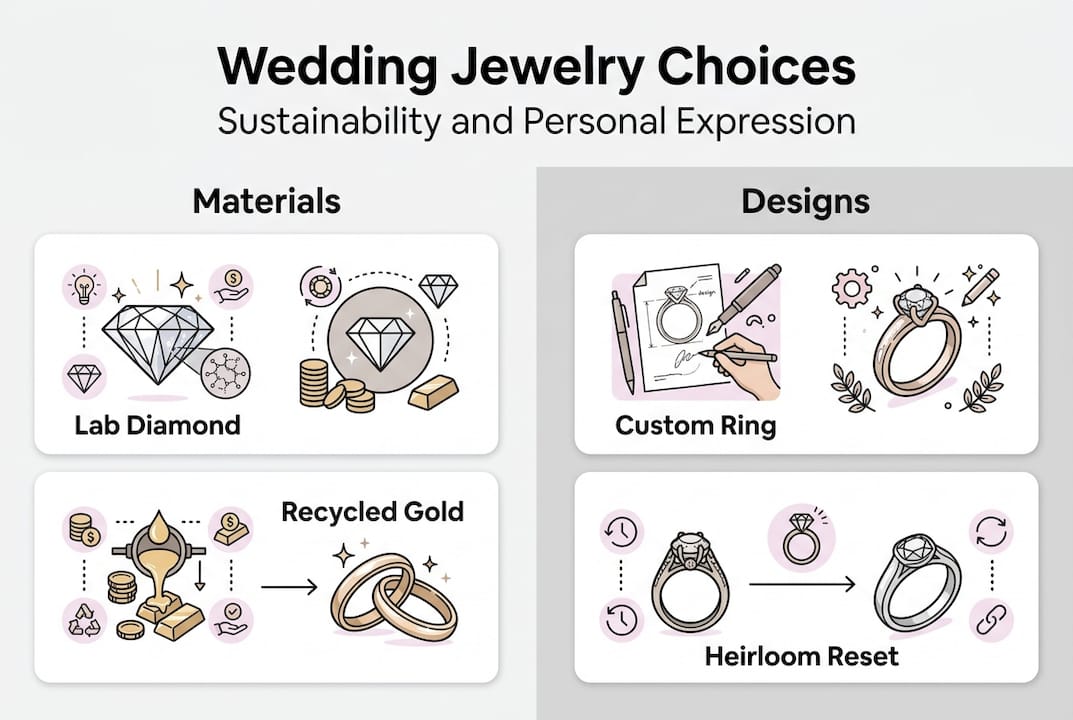
Once you understand certifications, the next step is choosing materials that align with your values. Lab-grown diamonds, recycled metals, and custom design are the three most impactful levers couples have.
Lab-grown diamonds are chemically, physically, and optically identical to mined diamonds. The difference is origin. Lab-grown diamonds carry 7 times less environmental impact and produce 90% lower carbon emissions than mined stones. They’re not simulants or fakes. They’re real diamonds grown in a controlled environment rather than extracted from the earth.

Recycled gold is another strong choice. It carries a 99% lower carbon footprint compared to newly mined gold and currently accounts for about 30% of all gold used in jewelry. Choosing recycled gold doesn’t mean compromising on quality. The metal is refined and processed to the same standards as newly mined gold.
Here’s how the main sustainable material options compare:
| Material | Environmental impact | Traceability | Cost vs. conventional |
|---|---|---|---|
| Lab-grown diamond | 90% lower carbon | High | 50-70% lower |
| Recycled gold | 99% lower carbon | Medium | Similar or slightly lower |
| Fairmined gold | Lower than conventional | High | 10-20% premium |
| Mined diamond (certified) | Higher | Variable | Standard market price |
Custom jewelry brings these choices together in a way that’s deeply personal. Rather than choosing from preset designs, you work with a designer to specify the stone, the metal, the setting style, and the overall aesthetic. This process also gives you direct access to sourcing decisions. You can ask exactly where the stone comes from and request specific certifications before anything is made.
Pro Tip: Before your custom jewelry consultation, write down your three non-negotiables. For most couples, it’s a combination of stone type, metal, and certification standard. Having these clear before you sit down saves time and keeps the conversation focused.
Benefits of going custom for ethical reasons include:
- Full control over material sourcing
- Ability to request specific certifications for each component
- A design that reflects your relationship, not a catalog trend
- Long-term value because a unique piece holds sentimental weight that mass-produced rings rarely do
For inspiration on ethical custom jewelry ideas, there are many creative directions that combine sustainability with striking design.
Consumer trends and challenges: Sustainability meets personal style
The market data confirms what couples are already feeling. Sustainable jewelry grew 20% in 2023, and 65% of millennial buyers now specifically demand certification before purchasing. This isn’t a niche preference anymore. It’s becoming the baseline expectation.
48% of consumers are willing to pay a 10 to 20% premium for verified sustainable jewelry. And the ethical jewelry market is projected to reach $15 billion by 2030. Brands that can’t demonstrate genuine ethical practices are already losing ground with younger buyers.
The trust gap is also shifting. Most buyers now prefer third-party certification over brand self-reporting. A jeweler saying “we source ethically” carries far less weight than showing an active RJC certification with a verifiable audit date. This is a meaningful change because it puts pressure on the industry to back up claims with documentation.
Here’s how couples are currently navigating the main decision points:
| Challenge | Common approach | Better approach |
|---|---|---|
| Budget vs. ethics | Choose lower-cost mined stone | Choose lab-grown for same quality, lower cost and impact |
| Style vs. sustainability | Pick from limited ethical catalogs | Custom design with certified materials |
| Brand trust | Rely on marketing claims | Verify third-party certifications directly |
| Tradition vs. values | Follow family expectations | Blend tradition with modern ethical choices |
The numbered priorities most couples land on after working through these tradeoffs:
- Confirm the jeweler holds active, third-party certification
- Choose lab-grown or recycled materials as the default starting point
- Use custom design to solve the style vs. ethics tension
- Verify lab-grown diamond facts independently before making assumptions about value or quality
- Set a realistic budget that accounts for a modest premium for verified ethical sourcing
The artisanal mining challenge deserves honest acknowledgment. Many beautiful colored gemstones come from regions where certification infrastructure simply doesn’t exist yet. Couples who love sapphires or emeralds may face harder traceability questions than those choosing lab-grown diamonds. Asking your jeweler how they specifically vet colored stone suppliers is a fair and important question.
Our take: Making wedding jewelry meaningful and ethical in 2026
Most guides stop at listing certifications and calling it done. That’s not enough. The uncomfortable truth is that even well-intentioned couples can end up with jewelry that looks ethical on paper but has gaps in the actual supply chain. The difference is in how you ask questions, not just which certifications you check for.
Our practical framework is straightforward: start with an RJC-certified jeweler who uses lab-grown or recycled materials, then use a custom design process to verify each component individually. This combination closes most of the gaps that single-certification approaches leave open.
The pitfall we see most often is couples relying on one certification or one brand claim without cross-checking. A jeweler can hold RJC certification while still sourcing colored stones from unverified artisanal suppliers. Asking for material-specific documentation, not just business-level certification, is what separates a truly ethical purchase from a well-marketed one.
Personal expression and ethical sourcing aren’t in conflict. A custom jewelry consultation is actually the best environment to get both right at the same time. You design exactly what you want while making sourcing decisions with full information.
Explore custom and ethical jewelry options for your wedding
Ready to find jewelry that matches your values and your vision? At Bel Viaggio Designs, every piece starts with a conversation about what matters most to you, whether that’s a specific stone, a certified metal, or a design that no one else has.

Our collections include options for every style and tradition. A black diamond ring makes a bold, modern statement for couples who want something unconventional. An emerald engagement ring brings rich color and vintage elegance to a sustainable choice. And for partners, a men’s wedding band in white and yellow gold offers a timeless, versatile design. Every option is available with ethical sourcing and custom design support built in.
Frequently asked questions
How do I know if a wedding ring is ethically sourced?
Look for active certifications like RJC, Chain of Custody, and the Kimberley Process, and ask your jeweler for material-specific supply chain documentation rather than relying on general brand statements.
Are lab-grown diamonds as valuable as mined diamonds?
Lab-grown diamonds are chemically identical to mined stones and are eco-superior, but some buyers still associate value with rarity. 80% of buyers now prefer lab-grown for sustainability reasons, which is shifting how the market defines value.
Can custom jewelry be sustainable and personal at the same time?
Absolutely. Custom design lets you specify certified ethical materials for every component while creating a piece that’s entirely your own. Custom designs through consultation are one of the most reliable ways to verify the supply chain while expressing your personal style.
What are the risks with recycled or artisanal materials?
Recycled metals vary in their actual sustainability depending on processing methods, and artisanal mining carries significant risks including child labor and lack of certification, particularly for colored gemstones. Always ask for specific sourcing documentation rather than accepting general claims.
Recommended
- Custom jewelry ideas for ethical engagement rings 2026 – Bel Viaggio Designs, LLC
- Custom jewelry ideas for ethical engagement rings 2026 – Bel Viaggio Designs, LLC
- Unique custom jewelry designs for your engagement 2026 – Bel Viaggio Designs, LLC
- Custom ring guide: step-by-step ethical luxury (2026) – Bel Viaggio Designs, LLC
- What is gothic jewelry: meaning and style guide 2026 – GothMarket