

TL;DR:
- Wedding rings evolved from practical and legal symbols in ancient Rome to personal expressions of love and commitment. The tradition of wearing rings on the left fourth finger originated from the mistaken belief in a vein connecting to the heart. Modern choices reflect individual values through materials like diamonds, gemstones, and sustainable metals.
Wedding rings are circular bands used to signify marriage commitment, with origins tracing back thousands of years to ancient Egypt and Rome. The wedding rings origin story is not a single moment but a long evolution shaped by culture, religion, law, and personal expression. What began as a practical marker of legal contract became one of the most emotionally loaded objects in human history. Understanding where this tradition started reveals how deeply rings reflect the values of every society that adopted them.
What is the historical origin of the wedding ring?
The clearest archaeological and textual evidence for wedding rings as formal marriage tokens comes from ancient Rome. Roman historical texts confirm that rings marked marital status and played a role in wedding rituals, making Rome the most documented starting point for the tradition. Roman rings were not purely sentimental. They functioned as legal instruments, marking a binding agreement between families.
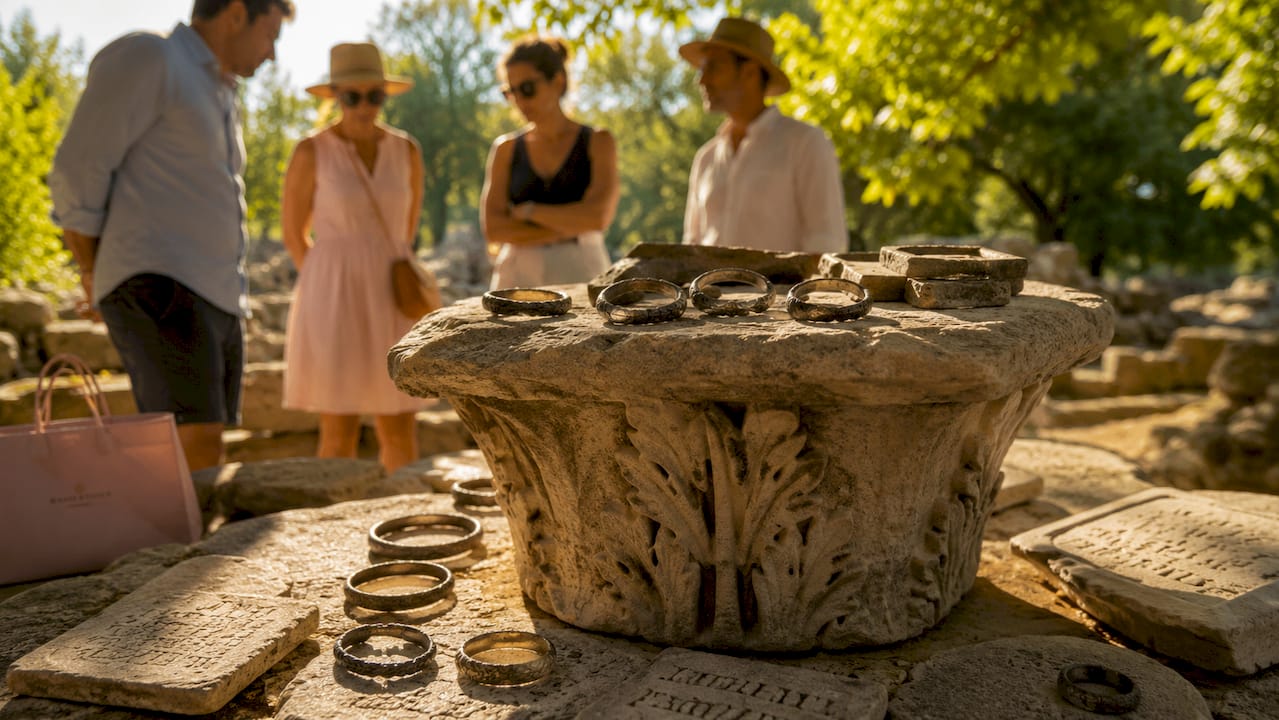
Ancient Egypt is often cited as the earliest source of the wedding ring tradition, but the evidence is more complicated. Direct archaeological proof of Egyptian rings as formal marriage tokens is limited. Many rings found in Egyptian contexts were utilitarian or personal objects, and confirming matrimonial use requires corroborating inscriptions or textual records, not just the ring itself. Popular narratives overstate how uniform Egyptian wedding ring rituals actually were.
What Egypt did contribute was the symbolism. The circular shape of the ring symbolizes eternity and unbroken commitment, a concept ancient Egyptians and Greeks both recognized. A circle has no beginning and no end. That geometric fact made it the perfect physical metaphor for a lifelong bond.
Pro Tip: When reading about ancient wedding ring history, check whether claims about Egypt are backed by inscriptions or texts. Many popular accounts confuse decorative rings with matrimonial ones.
Key facts about the earliest wedding ring traditions:
- Egypt: Rings were worn as personal and symbolic objects, but direct evidence of matrimonial use is limited and often overstated.
- Rome: Rings served as legal and ceremonial marriage tokens, with strong textual and archaeological support.
- Greece: Contributed the symbolic framework of the circle as eternity, which spread through the Mediterranean world.
- Medieval Europe: Adopted Roman customs and layered Christian religious meaning onto the ring exchange ceremony.
Why is the ring worn on the fourth finger of the left hand?
The choice of finger comes from one of history’s most enduring anatomical myths. The ancient Greco-Roman world believed in the vena amoris, a Latin phrase meaning “vein of love.” This vein was thought to connect the ring finger directly to the heart. Placing a ring on that finger was therefore an act of symbolic connection between two hearts.
The belief is anatomically incorrect. Every finger has a similar vascular structure, and no single vein runs from the fourth finger to the heart in any special way. Yet the tradition persisted for centuries across Western Europe and eventually spread globally through colonial and cultural influence. The power of a good story consistently outlasts scientific correction.
“The vena amoris belief shaped Western wedding customs for over two millennia, surviving long after anatomy proved it wrong. That persistence says more about the human need for symbolic meaning than about biology.”
This tradition shaped which hand couples use today. In most Western countries, including the United States and the United Kingdom, the ring goes on the left hand’s fourth finger. In Germany, Norway, Russia, and several other countries, the right hand is traditional, reflecting different cultural and religious histories. The left-hand custom in English-speaking countries traces directly back to the Roman practice built on the vena amoris belief.
How did wedding ring materials and symbolism evolve?
The history of wedding ring materials is a direct record of what each society valued most. Early rings were made from organic materials: reeds, hemp, and leather in ancient contexts. These were not durable, but they were available and carried symbolic weight. The shift to metal changed everything.
Rome introduced iron rings as the standard for betrothal, chosen for strength and permanence rather than beauty. Roman women often wore two rings: an iron band for daily household use and a gold band for public appearances. This two-ring system reflected both class stratification and the dual symbolic roles a ring played, one practical and one social.
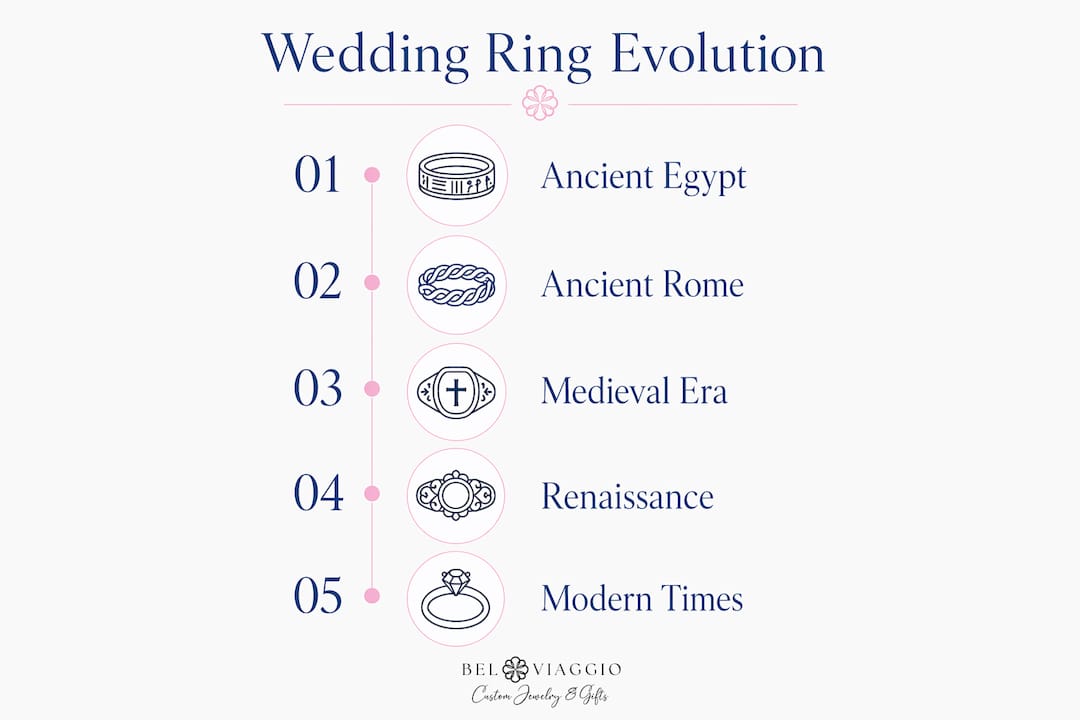
The transition from legal contract to romantic symbol was gradual. Wedding rings historically functioned as legal contracts or dowry markers, representing family agreements and economic transfers. The ring was proof of a deal, not a declaration of love. That meaning shifted slowly through the medieval period as Christian ceremony placed greater emphasis on spiritual and emotional union.
The 1477 turning point for diamond rings
The first recorded diamond engagement ring dates to 1477, when Archduke Maximilian of Austria gave one to Mary of Burgundy. That single gift launched a centuries-long association between diamonds and engagement. Diamonds remained symbols of aristocratic wealth until large-scale mining in South Africa and 20th-century marketing campaigns made them accessible to the middle class.
| Era | Primary material | Symbolic meaning |
|---|---|---|
| Ancient Egypt | Reed, bone, leather | Personal and possibly marital identity |
| Ancient Rome | Iron, then gold | Legal contract, class status |
| Medieval Europe | Gold, precious stones | Spiritual union, family alliance |
| Post-1477 Europe | Gold with diamonds | Aristocratic love and betrothal |
| Modern era | Gold, platinum, lab-grown gems | Personal expression, ethical values |
Modern couples increasingly choose custom ring designs that reflect personal values rather than inherited convention. Lab-grown diamonds, moissanite, colored gemstones, and alternative metals now compete directly with traditional gold and mined diamonds. The material of the ring has always communicated something about the wearer’s world.
How have wedding ring customs varied across cultures?
The history of wedding rings is not a single linear story. Different cultures developed distinct customs around who wears rings, when they are worn, and what they mean.
- Ancient Rome: Both betrothal rings and wedding rings existed, but primarily women received them as markers of a legal agreement.
- Medieval Europe: The fede ring, featuring two clasped hands, was a common betrothal symbol tracing back to antiquity. Gimmel rings, which split into two or three interlocking bands worn separately during engagement and joined at marriage, were popular in 16th and 17th-century Europe.
- Men and wedding rings: For most of Western history, only women wore wedding rings. Men began wearing them in significant numbers during World War II. Soldiers wore wedding bands as emotional reminders of their spouses while deployed. That wartime practice became a permanent cultural shift in the mid-20th century.
- Eastern traditions: Many Asian cultures historically used different objects, such as bangles or ceremonial threads, to mark marriage. Western-style ring exchange spread through colonial contact and global media.
- Modern variations: Same-sex couples, non-binary individuals, and couples from blended cultural backgrounds have created new ring traditions that mix and adapt historical customs.
The evolution of engagement ring trends reflects this ongoing cultural negotiation. What counts as a wedding ring has always been defined by the people wearing it, not by a fixed universal rule.
One consistent thread across cultures is that rings mark transitions. Whether the ring is iron or platinum, plain or set with stones, worn on the left hand or the right, it signals a change in social status and a public commitment. That function has remained constant even as every other detail shifted.
Key Takeaways
Wedding rings originated as legal and symbolic markers in ancient Rome and Egypt, evolving across centuries from contract tokens into deeply personal expressions of commitment and identity.
| Point | Details |
|---|---|
| Roman origins are best documented | Rome provides the clearest textual and archaeological evidence for wedding rings as formal marriage tokens. |
| Egyptian evidence is overstated | Popular claims about Egyptian wedding rings often lack the inscriptions or texts needed to confirm matrimonial use. |
| The vena amoris shaped finger choice | The Greco-Roman belief in a vein connecting the ring finger to the heart drove the left-hand tradition still common today. |
| Materials reflect cultural values | Rings shifted from reed and iron to gold and diamonds as societies changed what they wanted to communicate through marriage. |
| Men’s ring-wearing is recent | Widespread male wedding band use began during World War II, not in antiquity. |
The ring as a mirror of what we value
The thing that strikes me most about the history of wedding rings is how honestly they reflect power. For most of recorded history, a woman receiving a ring was not a romantic gesture. It was a legal transaction. The ring said: this woman is spoken for, this family has made a deal, this property has changed hands. Calling that romantic would be a serious misreading of the historical record.
What changed was not the ring. What changed was the relationship between individuals and institutions. As marriage became less about family alliances and more about personal choice, the ring followed. It absorbed new meaning because people needed it to. The object stayed the same. The story around it transformed completely.
The modern push toward unique and personalized ring designs is the latest chapter in that transformation. Couples choosing lab-grown stones, colored gems, or non-traditional metals are not rejecting tradition. They are doing exactly what every generation before them did: using the ring to say something true about who they are and what they value. That is the real continuity in this story.
— Stacy
Rings with meaning, made for you

Every ring Belviaggiodesigns creates carries that same weight of history, expressed through materials and craftsmanship chosen for the person wearing it. The collection includes ethically sourced options that reflect both the emotional depth of the tradition and the values modern couples prioritize. A black diamond halo ring offers a striking departure from convention while honoring the centuries-old practice of marking commitment with something lasting. For those drawn to color and rarity, the gemstone ring collection spans aquamarine, emerald, morganite, and beyond. Each piece is handcrafted and available for customization, so the ring you choose tells your story, not someone else’s.
FAQ
Where did wedding rings originally come from?
The most documented origin of wedding rings is ancient Rome, where rings served as legal marriage tokens with strong textual and archaeological support. Ancient Egypt contributed the symbolism of the circle as eternity, though direct evidence of Egyptian matrimonial rings is limited.
Why is the wedding ring worn on the left hand?
The left-hand tradition comes from the ancient Greco-Roman belief in the vena amoris, a vein thought to connect the ring finger to the heart. The belief is anatomically incorrect but shaped Western wedding customs for over two thousand years.
When did diamond engagement rings become popular?
Diamond engagement rings trace back to 1477, when Archduke Maximilian of Austria gave a diamond ring to Mary of Burgundy. Diamonds remained an aristocratic symbol until 20th-century mining and marketing made them widely accessible.
Did men always wear wedding rings?
Men did not routinely wear wedding rings for most of Western history. The widespread adoption of male wedding bands began during World War II, when soldiers wore rings as reminders of their spouses, permanently shifting cultural norms.
How have wedding ring materials changed over time?
Wedding ring materials shifted from organic materials like reeds and leather in ancient times, to iron and gold in Rome, to precious stones in medieval Europe, and now to lab-grown diamonds, moissanite, and colored gemstones in the modern era. Each shift reflected changing values around wealth, status, and personal expression.
Recommended
- Ring settings explained: types, styles & custom options – Bel Viaggio Designs, LLC
- The Role of Personalized Design in Meaningful Rings – Bel Viaggio Designs, LLC
- Wedding jewelry guide: Meaning, sustainability, custom design – Bel Viaggio Designs, LLC
- Custom Jewelry Guide: Meaning, Magic & Your Perfect Ring – Bel Viaggio Designs, LLC