

TL;DR:
- Gemstone grading varies widely, with no universal standard, making disclosure and certification crucial for buyers.
- Understanding the Four Cs—color, clarity, cut, and carat—requires specific attention to gemstone types, treatments, and origin details.
- Evaluating reports and lab credibility, along with considering durability and lifestyle, ensures a well-informed, satisfying purchase.
Most people walk into a jewelry purchase assuming gemstone grading works the same way across every stone. It does not. Unlike diamonds, which follow a globally recognized system developed by GIA, colored gemstones operate in a world where grading is not standardized and terms like “AAA quality” can mean something completely different from one seller to the next. Explaining gemstone grading properly means going beyond the Four Cs and covering treatment disclosures, certification differences, durability factors, and how to actually read a report before you spend real money.
Table of Contents
- Key Takeaways
- Explaining Gemstone Grading: the Four Cs in Detail
- Treatments, origin, and certification
- Durability: the grading factor buyers ignore
- How to read a gemstone grading report
- My honest take on gemstone grading
- Shop gemstones graded with transparency
- FAQ
Key Takeaways
| Point | Details |
|---|---|
| No universal grading standard | Colored gemstone grading varies by vendor; terms like AAA are marketing labels, not scientific benchmarks. |
| Four Cs are just the start | Color, clarity, cut, and carat each carry specific nuances that differ between diamonds and colored stones. |
| Treatment disclosure matters | Undisclosed treatments can reduce resale value and durability significantly; always verify what the report covers. |
| Not all lab reports are equal | Reports range from basic identification to full grading and origin analysis; knowing the difference protects your investment. |
| Durability is a buying factor | Hardness and toughness determine how a stone holds up to daily wear, not just how beautiful it looks. |
Explaining Gemstone Grading: the Four Cs in Detail
The Four Cs are the most widely recognized framework in gemstone quality assessment: color, clarity, cut, and carat weight. Understanding how each one applies to colored gemstones specifically, rather than just diamonds, is where buyers gain a real edge.
Color
Color is the single most important value factor in most colored gemstones. But it is not a single measurement. It breaks down into three components:
- Hue: The basic color family, such as blue in a sapphire or red in a ruby.
- Tone: How light or dark the color appears, ranging from very light to very dark.
- Saturation: The intensity or vividness of the hue. A vivid, highly saturated blue sapphire commands dramatically more value than a grayish or washed-out one.
For sapphires, color grading considers hue, tone, and saturation together as a system, and even slight differences in saturation can translate into thousands of dollars per carat. The ideal tone for most colored stones sits in the medium to medium-dark range, because stones that are too dark lose their color in low light, while stones that are too light lack the richness buyers pay premiums for.
Clarity
Clarity in colored gemstones is assessed differently than in diamonds. Most diamonds are expected to be eye-clean. Many colored stones are not. Emeralds, for example, almost always contain inclusions called “jardin” (the French word for garden), and a completely inclusion-free emerald would raise more questions than confidence. What matters is whether the inclusions affect the stone’s beauty or structural integrity.
Inclusions like feathers, silk, and fingerprints each carry different implications for wearability. Clarity notes in grading reports describe not just what is present but where it sits and whether it reaches the surface. A feather near the girdle under a prong is far less concerning than one running through the table of the stone.
Pro Tip: When reviewing clarity on a colored stone, ask whether the inclusion is eye-visible from the face-up position at arm’s length. If it is not, it typically has minimal impact on the stone’s visual appeal or value.
Cut
Cut in gemstones is a balance between maximizing light return and preserving carat weight, since rough material is priced by weight. A well-executed cut optimizes proportion, symmetry, and polish to maximize light return and produce even color distribution across the face of the stone. Brilliants, step cuts like emerald cuts, and mixed cuts all interact with light differently and suit different stone types.
The artistry element is real. Some gems are windowed (appearing transparent and washed out in the center) or extinctioned (showing dark dead zones) because the cutter prioritized weight retention over beauty. Knowing what to look for visually makes a significant difference.
Carat weight
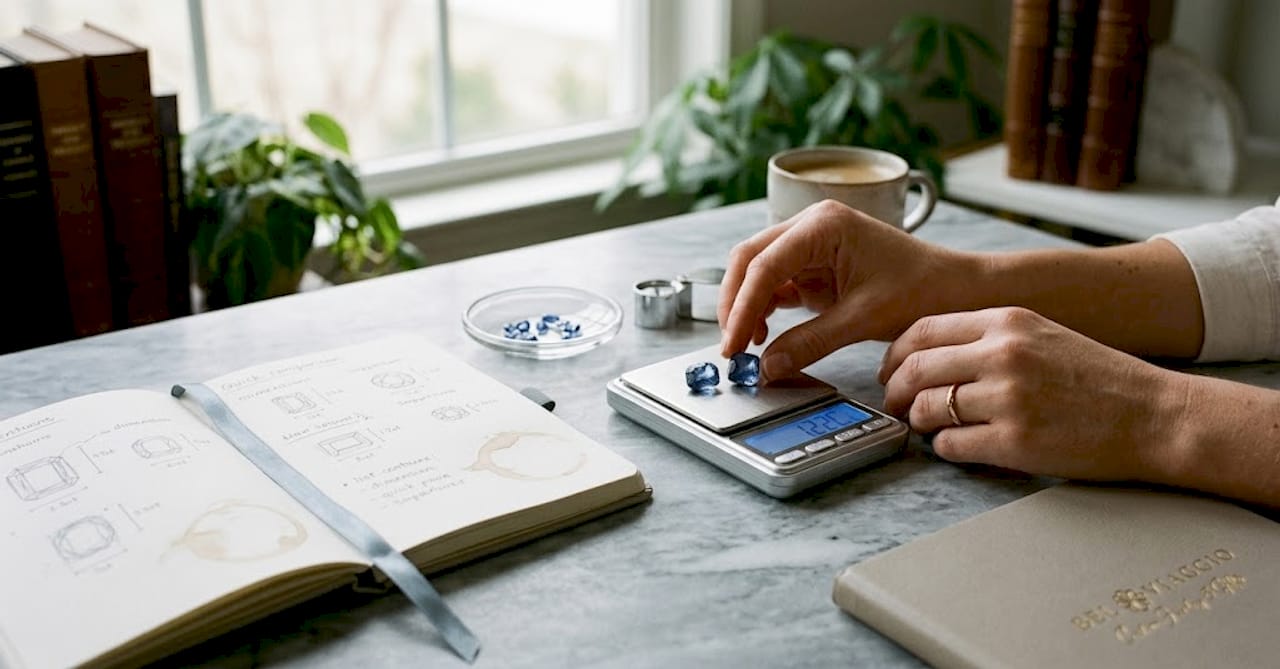
Carat measures weight, not size. Two stones can weigh exactly the same but look dramatically different in face-up dimensions depending on their cut. More carat weight does not automatically mean better quality. A well-cut, deeply saturated 1-carat ruby will almost always outperform a poorly cut, pale 1.5-carat stone in both beauty and value.
Treatments, origin, and certification
Understanding gemstone certification is where many buyers get tripped up. Treatments and origin opinions are two distinct but related elements that can dramatically affect both price and long-term satisfaction with a purchase.
Common treatments and why they matter
Gemstone treatments are used to improve a stone’s appearance and are extremely common in the market. What separates acceptable from problematic is disclosure.
- Heat treatment: The most widely accepted treatment. It permanently enhances color and clarity in sapphires, rubies, and many other stones. Mainstream and generally priced into market rates.
- Fracture filling: Resins or glass fill surface-reaching fractures to improve apparent clarity. Fracture filling reduces value and durability significantly, since the filler can deteriorate or be damaged during jewelry repair.
- Surface coating: A thin layer applied to alter color. It is fragile and considered deceptive if undisclosed.
Treatment disclosure is rapidly becoming a core ethical and financial component in gemstone valuation. A report that does not specify treatment status is not giving you the full picture, regardless of the grade it assigns. Source
When undisclosed treatments reduce resale value, the buyer absorbs that loss entirely. Always verify that a report explicitly states whether treatments are present and what type.
Origin and its role in pricing
Origin opinions are exactly that: opinions based on scientific analysis of trace elements and inclusions. A Burmese ruby, a Kashmir sapphire, or a Colombian emerald can command significant premiums over stones with identical visual grades from other locations. Origin is a scientific opinion, not an absolute fact, but it carries enormous weight in high-value purchases.
Evaluating lab reports
Certification transforms visual appeal into documented records that support resale and insurance. But not every lab operates at the same standard. GIA remains the gold standard for diamonds, while labs like AGL (American Gemological Laboratories) and Gübelin specialize in colored stone origin and treatment analysis. Not all certificates deliver the same rigor, and a certificate from an obscure lab with no reputation deserves as much scrutiny as the stone itself.
Durability: the grading factor buyers ignore
Visual grading tells you how beautiful a stone is. Durability tells you whether it can handle the way you actually live your life.
Hardness, toughness, and stability
These three properties are distinct and all matter for gemstone longevity:
- Hardness (Mohs scale): Resistance to scratching. Stones rated 7 or above on the Mohs scale are generally preferred for everyday rings because quartz dust in the environment rates around 7 and will scratch softer stones over time.
- Toughness: Resistance to chipping and fracturing under impact. A stone can be very hard but still brittle. Diamond is the hardest natural material but can cleave along crystal planes with a sharp blow.
- Stability: Sensitivity to heat, light, and chemicals. Amethyst can fade in prolonged sunlight. Opals crack in extreme temperature swings. Emeralds require extra care around ultrasonic cleaners.
Setting and metal choices
The setting you choose affects how well a stone survives daily wear just as much as the stone’s inherent properties. Bezel settings surround the stone’s girdle with metal, offering the most protection. Prong settings allow maximum light exposure but leave the stone more vulnerable to chips on the edges. For stones below 7 on the Mohs scale, protective settings become less optional and more necessary.
Pro Tip: If you plan to wear your ring every day, prioritize stones rated 8 or above on the Mohs scale, like sapphire, ruby, or spinel. They can handle routine contact without requiring the same level of care softer stones demand.
How to read a gemstone grading report
A grading report is a tool. Using it correctly requires knowing what to look for and what questions it should answer.
What a complete report should include
| Report Element | What to check |
|---|---|
| Gemstone identity | Confirms species, variety, and whether it is natural or synthetic |
| Color grading | Describes hue, tone, and saturation with standardized language |
| Clarity grade | Notes specific inclusions and their positions |
| Treatment disclosure | Explicitly states if treatments are present and what type |
| Origin opinion | Indicates probable geographic origin, noted as an opinion |
| Lab credentials | Names the issuing laboratory and provides a verification number |
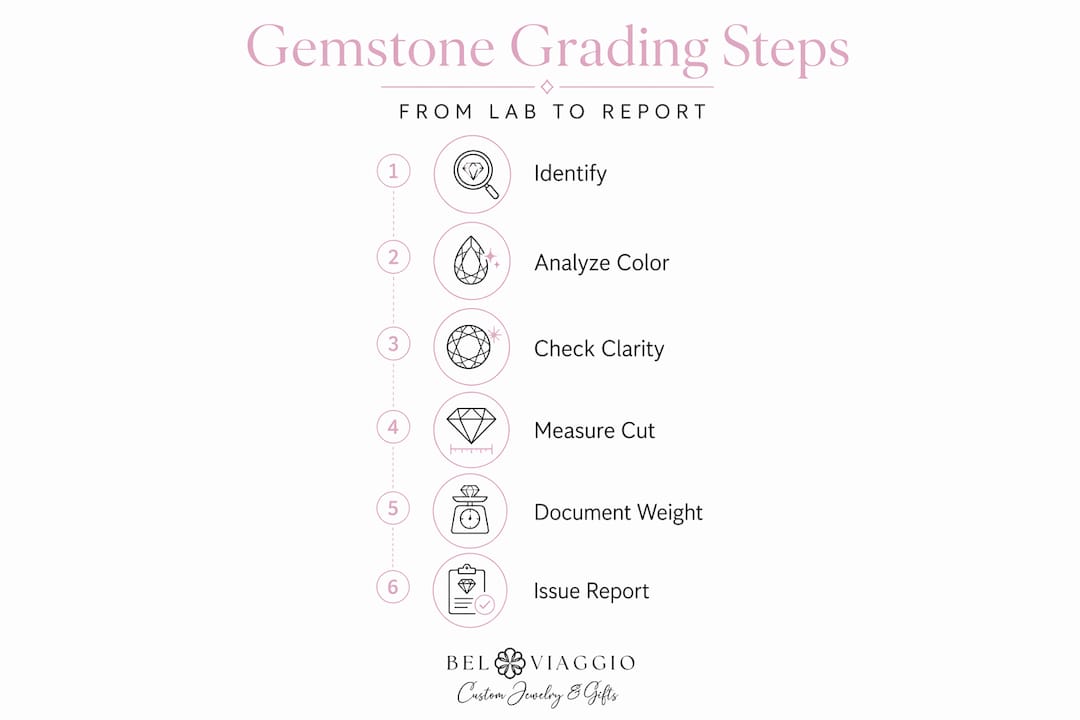
Report content varies significantly between labs. An identification-only report confirms what the stone is but says nothing about quality. A full grading report covers the Four Cs. An origin and treatment report adds provenance analysis, which is what you want for high-value purchases.
Cross-checking and due diligence
- Verify the report number directly on the issuing lab’s website before purchasing.
- Compare the report’s descriptions to photos or in-person viewing. A “slightly included” stone that looks heavily included in photos is a red flag.
- Ask the seller for high-resolution images in natural light and under magnification.
- For significant purchases, get an independent appraisal from a gemologist who has no financial stake in the sale.
Grading reports are one layer in a broader buying process that includes seller reputation, return policies, and independent verification. A beautiful report from a questionable lab means less than a modest report from a trusted one. Learning to understand diamond certification gives you a foundation for evaluating colored stone reports as well, since many of the same principles apply.
My honest take on gemstone grading
I have worked with enough buyers to know that the biggest mistake people make is treating a grade like a guarantee. I have seen stones with outstanding clarity grades that looked lifeless in person, and I have seen modestly graded gems that stopped conversations. The grade captures data. It does not capture character.
What I have found actually matters more than any single grade is the combination of treatment transparency and lab credibility. A buyer who demands to know exactly what treatments were performed and gets a report from a reputable lab is far better protected than someone chasing a perfect clarity score from an unknown certification company. The grade is only as good as the lab and the disclosure behind it.
I also think buyers underestimate durability at their own expense. A stunning, fragile stone in a solitaire prong setting worn daily is a future heartbreak. Pairing stone selection with setting style based on lifestyle is practical advice that most sellers skip over entirely.
My advice: develop a relationship with a jeweler who answers your questions with specifics, not generalities. If they cannot tell you the treatment status of a stone or name the lab that issued the report, that is information worth having.
And if you are just starting to build your knowledge, reading about the 4Cs of diamonds is still one of the best foundational exercises, because it sharpens your instincts for all gemstone evaluation.
— Stacy
Shop gemstones graded with transparency

At Belviaggiodesigns, every gemstone piece in our collection is selected with grading principles in mind. Whether you are drawn to the deep color of a certified emerald ring or the dramatic presence of a black diamond halo setting, you will find detailed product information, ethical sourcing standards, and handcrafted quality in every design. Browse our full gemstone ring collection to find a piece that reflects both your values and your taste, and reach out to our team for personalized guidance on stone selection.
FAQ
What is gemstone grading?
Gemstone grading is the process of evaluating a stone’s quality based on factors like color, clarity, cut, and carat weight, along with treatment status and origin. Unlike diamond grading, colored gemstone grading lacks a single universal standard.
Why does treatment disclosure matter when buying gemstones?
Treatment disclosure matters because some treatments, like fracture filling, reduce a stone’s durability and resale value. Undisclosed treatments shift the financial risk to the buyer, so always verify treatment status in a lab report.
Are all gemstone grading reports equally reliable?
No. Reports range from basic identification to full grading and origin analysis, and labs vary widely in scientific rigor. GIA is the benchmark for diamonds, while AGL and Gübelin are respected authorities for colored stone origin and treatment assessment.
How does the Mohs scale affect which gemstone I should choose?
The Mohs scale measures scratch resistance. Stones rated 7 or higher are better suited for everyday rings because they resist surface abrasion from common environmental contact. Softer stones require more careful wear and protective settings.
What should I check first on a gemstone grading report?
Verify the gemstone’s identity, then check treatment disclosure and the issuing lab’s credentials. Confirm the report number on the lab’s official website before completing any purchase.
Recommended
- How to Choose Gemstone Jewelry: An Ethical, Custom Guide – Bel Viaggio Designs, LLC
- Ethical gemstone selection guide for engagement rings 2026 – Bel Viaggio Designs, LLC
- How education empowers couples in ethical jewelry shopping – Bel Viaggio Designs, LLC
- Why Diamond Certification Matters for Ethical, Custom Jewelry – Bel Viaggio Designs, LLC