

TL;DR:
- Diamond certification provides an independent, unbiased assessment of a stone’s quality and origin.
- Certification protects buyers from overpaying, undisclosed treatments, and ethical concerns.
- GIA, AGS, and IGI are the top labs, with GIA offering the strictest standards and highest resale value.
Two diamonds can sit side by side in a jeweler’s case, look absolutely identical, and carry price tags that differ by thousands of dollars. The difference isn’t always visible to the naked eye. It lives inside a document: the diamond certificate. For couples investing in a custom engagement ring or wedding band, that certificate is the difference between knowing exactly what you’re buying and taking someone’s word for it. Certification shapes value, confirms ethical origin, and protects your investment for decades. This guide breaks down everything you need to know before you say yes to any stone.
Table of Contents
- What is diamond certification and how does it work?
- Why certification is crucial for ethics and true value
- How grading labs compare: GIA, AGS, IGI, and more
- Certification for natural vs lab-grown diamonds
- Why certification is your best defense in diamond buying (and what most people miss)
- Bring ethical confidence to your diamond purchase
- Frequently asked questions
Key Takeaways
| Point | Details |
|---|---|
| Certification determines true value | Diamonds with reputable certification are worth up to 25 percent more and are easier to insure and resell. |
| Lab differences matter | Major grading labs like GIA and AGS offer stricter, more trusted assessments than others like IGI or EGL. |
| Ethics requires more than a certificate | Certification proves origin but should be paired with ethical assurances like KPCS or RJC memberships for full confidence. |
| Lab-grown vs natural | Certification helps distinguish origin and value; lab-grown diamonds often use IGI while naturals excel with GIA or AGS. |
What is diamond certification and how does it work?
Diamond certification is an independent, written assessment of a diamond’s quality produced by a third-party gemological laboratory. The key word here is independent. The lab has no financial stake in selling you the diamond, which means its findings are unbiased. When you receive a certificate, you’re getting an objective snapshot of what that stone actually is.
The three most recognized labs are the Gemological Institute of America (GIA), the American Gem Society (AGS), and the International Gemological Institute (IGI). Each uses its own methodology. Diamond certification involves independent labs grading diamonds on the 4Cs using standardized methodologies: GIA created the 4Cs framework and is known for strict, consistent standards; AGS uses a numerical 0 to 10 scale with a strong emphasis on cut and light performance; IGI is ISO 17025 accredited and uses an anonymous multi-grader process, making it faster and more accessible, especially for lab-grown stones.
The 4Cs are the universal language of diamond grading:
- Carat: The weight of the diamond. One carat equals 0.2 grams.
- Color: Graded on a D-to-Z scale, where D is colorless and Z shows visible yellow or brown tints.
- Clarity: Measures internal and external flaws (called inclusions and blemishes) on a scale from Flawless to Included.
- Cut: Often considered the most important factor, cut determines how well a diamond reflects light and how much it sparkles.
A certificate also lists the diamond’s measurements, fluorescence, polish, symmetry, and any treatments applied to the stone. This is far more than a receipt. It’s a technical profile.
Pro Tip: Always ask to see the actual certificate before purchasing, not just a verbal description. Cross-reference the certificate number with the lab’s online database to confirm authenticity.
Here’s the financial reality: certified diamonds are valued 15-25% higher than uncertified ones. That premium reflects the trust, transparency, and documentation that certification provides. When you’re choosing a stone for a piece as meaningful as an engagement ring, that documentation is part of the value. Learning about ethical gemstone selection before you shop gives you an even stronger foundation for this decision.
For a deeper look at how GIA diamond grading works, the GIA’s own resources are a great place to start.
Why certification is crucial for ethics and true value
Certification does something no salesperson can do on their own: it creates an objective paper trail. For couples who care about where their diamond comes from and what it’s truly worth, that trail matters enormously.
First, certification distinguishes between natural, lab-grown, and treated diamonds. These are three very different products with different price points, environmental footprints, and resale behaviors. A treated diamond, for example, may have been fracture-filled or laser-drilled to improve its appearance artificially. Without a certificate, you may never know.
Here’s what certification protects you from:
- Paying natural diamond prices for a lab-grown stone (or vice versa, depending on your preference)
- Receiving a treated diamond without disclosure
- Overpaying based on a seller’s verbal quality claims
- Losing out on insurance coverage due to lack of documentation
- Getting a lower resale price because buyers can’t verify quality
“A diamond without a certificate is like a house without a title deed. You might love it, but you can’t fully own the story.”
On the resale side, GIA-certified diamonds command a 15-25% premium over uncertified stones, with GIA outperforming IGI by up to 18.77% in resale scenarios. That’s a meaningful difference if you ever plan to upgrade, sell, or pass the piece down.
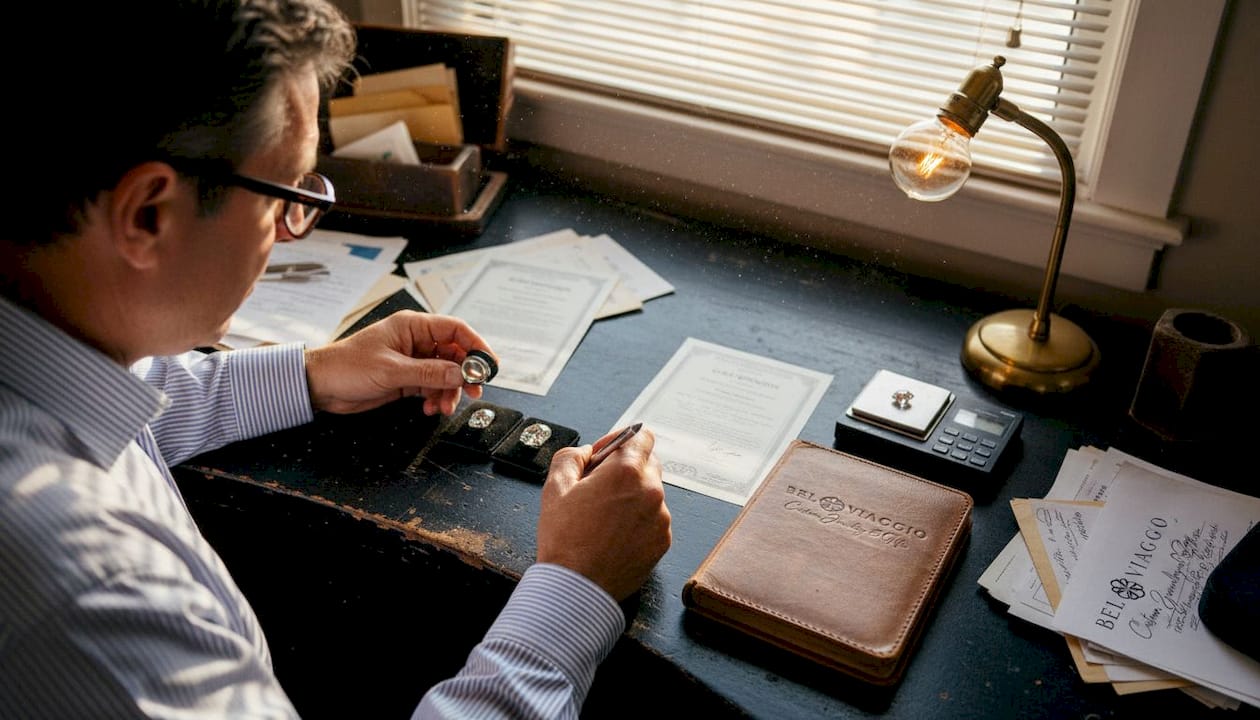
For insurance purposes, most appraisers and insurers require a certificate to establish replacement value. A bespoke ring with a certified center stone is far easier to insure accurately than one with an undocumented stone.
Pro Tip: After purchasing, use the GIA Report Check or IGI’s online verification tool to confirm your certificate is real and hasn’t been altered or reused on a different stone.
It’s also worth understanding that certification alone doesn’t guarantee a diamond is conflict-free. Schemes like the Kimberley Process Certification Scheme (KPCS) and the Responsible Jewellery Council (RJC) add another layer of ethical assurance. Our responsible jewelry guide and how to ethically source jewelry walk you through what to look for beyond the certificate itself.
How grading labs compare: GIA, AGS, IGI, and more
Not all certificates carry the same weight. Understanding the differences between labs helps you make a smarter purchase, especially when comparing prices across retailers.
| Lab | Strengths | Weaknesses | Best for |
|---|---|---|---|
| GIA | Strictest standards, gold standard for resale | Slower, more expensive | Natural diamonds, heirloom pieces |
| AGS | Best cut grading, 0-10 numerical scale | Fewer labs, less common | Buyers prioritizing brilliance |
| IGI | Fast, affordable, ISO 17025 accredited | Less stringent, grades can run high | Lab-grown diamonds |
| EGL | Widely available, lower cost | Least consistent, often overstates quality | Generally not recommended |
Grading labs differ significantly: GIA is the strictest and most consistent, AGS excels in cut and light performance grading, and IGI is faster and more affordable but sometimes grades diamonds slightly higher than GIA would for the same stone.
The real-world impact of this is significant. An IGI-certified stone graded as VS1/G may actually be closer to VS2/H under GIA’s stricter eye. That one-grade difference can translate to hundreds or even thousands of dollars in price. EGL certifications are even more inconsistent and are generally not accepted by major auction houses or insurers.
Here’s a quick guide to choosing the right lab based on your priorities:
- Resale value and investment: Choose GIA
- Cut quality and light performance: Choose AGS
- Lab-grown diamonds at a fair price: IGI is widely accepted and reliable
- Speed and budget: IGI offers faster turnaround at lower cost
- Avoid: EGL for any high-value purchase
For couples exploring lab grown diamonds, IGI certification is the industry standard and offers solid documentation. If you want the full picture on why lab-grown stones are a compelling ethical choice, the truth about lab grown diamonds is worth reading. For natural stone purchases where resale matters, GIA’s reputation is unmatched.
Certification for natural vs lab-grown diamonds
Certification doesn’t work the same way for every diamond. The type of stone you choose changes what you should look for on the certificate and which lab’s documentation carries the most weight.
| Factor | Natural diamond | Lab-grown diamond |
|---|---|---|
| Resale value | Retains 25-50% of retail | Retains 20-40% of retail |
| Insurance eligibility | Widely accepted | Accepted with valid cert |
| Preferred lab | GIA | IGI |
| Grading stringency | High (GIA) | Moderate (IGI) |
| Treatment disclosures | Critical to check | Less common |
Certified diamonds outperform uncertified by 15-25%, and natural diamonds retain 25-50% of retail value on resale compared to lab-grown stones at 20-40%. However, because lab-grown diamonds cost significantly less upfront, the absolute dollar loss on resale is often lower.
When reading a certificate for a natural diamond, pay close attention to the origin notation, any treatment disclosures, and the clarity plot (a diagram showing inclusion locations). For lab-grown stones, confirm the certificate clearly states “laboratory grown” and check whether any post-growth treatments like High Pressure High Temperature (HPHT) processing have been applied.
Here’s what couples should prioritize based on their goals:
- Ethical priority: Lab-grown diamonds have a lower environmental impact and no conflict risk. Look for IGI certification and confirm “laboratory grown” is stated clearly.
- Investment priority: Natural diamonds with GIA certification hold value better over time.
- Budget priority: Lab-grown with IGI certification offers the best value per carat without sacrificing documentation quality.
Browsing loose lab grown diamonds with verified IGI certification is a great starting point. For a broader view of sustainable stone choices, our guide to ethical gemstone choices covers everything from origin to long-term impact.
Why certification is your best defense in diamond buying (and what most people miss)
Here’s something most buyers don’t realize until it’s too late: having a certificate isn’t the same as understanding it. We’ve seen couples walk away with certified diamonds that were technically documented but practically misrepresented, because they didn’t know what to look for inside the document itself.
The most common mistake is assuming all certificates are equal. They’re not. A certificate from a less stringent lab on an overgraded stone is still a certificate. It just doesn’t tell the whole truth. The second mistake is failing to verify the certificate’s authenticity. Certificates can be copied, altered, or swapped onto different stones.
Think of your diamond certificate as a birth certificate for your stone. It records origin, characteristics, and identity. You wouldn’t accept a forged birth certificate for a person. Don’t accept an unverified one for a diamond worth thousands of dollars.
The deeper issue is that certification protects you from misrepresentation at every stage: at purchase, during insurance appraisal, and at resale. Couples who skip this step often discover the gap when it matters most. Our ethical ring buying tips go further into how to ask the right questions before you commit.
Bring ethical confidence to your diamond purchase
Understanding certification transforms how you shop. You stop taking anyone’s word for it and start making decisions grounded in verified facts.

At Bel Viaggio Designs, every stone we work with comes with traceable, ethical sourcing documentation and proper certification from recognized labs. Whether you’re drawn to a brilliant natural diamond or a stunning lab-grown alternative, our custom ring designs are built around stones you can trust completely. If you’re open to exploring beyond diamonds, our gemstone ring alternatives offer equally certified, ethically sourced options with incredible character. Your ring should tell a story you’re proud of, and we’re here to help you tell it right.
Frequently asked questions
How can I verify if a diamond certificate is genuine?
You can verify certificates directly through grading lab websites or apps, like GIA’s report check or IGI’s online verification feature. Always match the certificate number to the stone’s laser inscription when possible.
Does certification guarantee my diamond is conflict-free?
Certification labels natural vs lab-grown and clarifies treatments, but additional schemes like KPCS and RJC are needed for full ethical assurance. Certification is one layer of protection, not the complete picture.
Are all diamond certificates equally valuable for resale?
No. GIA-certified diamonds yield 15-25% higher resale values compared to those certified by other labs like IGI, making lab choice a meaningful financial decision.
Why do lab-grown diamonds often have IGI certification instead of GIA?
IGI is faster and more affordable and widely accepted for lab-grown stones, while GIA holds stricter grading standards applied primarily to natural diamonds.
What impact does not having a certificate have on diamond value?
Uncertified diamonds sell for 15-25% less than certified equivalents and often face challenges with insurance appraisals and resale verification.
Recommended
- What is ring certification? Guide to ethical rings 2026 – Bel Viaggio Designs, LLC
- How thoughtful design shapes ethical, unique fine jewelry – Bel Viaggio Designs, LLC
- How to ethically source jewelry for your wedding – Bel Viaggio Designs, LLC
- Ethical gemstone selection guide for engagement rings 2026 – Bel Viaggio Designs, LLC