

TL;DR:
- The custom jewelry process is a collaborative, staged journey that transforms your ideas into a personalized, ethically crafted piece built specifically for you. It involves multiple stages, including consultation, design, CAD rendering, wax modeling, production, and final delivery, each with checkpoints for approval and adjustments. Prior planning, clear communication, and understanding ethical sourcing practices ensure a satisfying experience resulting in a meaningful keepsake that tells your unique story.
Custom jewelry feels like it belongs to another world. Celebrity proposals, velvet boxes in Parisian ateliers, price tags that require a financial advisor. But that image is largely fiction. Today, the custom jewelry design process is structured, accessible, and often more affordable than couples expect. When you understand each stage clearly, from that first conversation to the moment you hold the finished ring in your hands, personalizing your engagement ring or wedding band becomes one of the most rewarding parts of planning your future together.
Table of Contents
- What is the custom design process for jewelry?
- Key stages of custom jewelry creation
- Ethical sourcing and design values in custom jewelry
- True bespoke: Human artistry vs. technology in jewelry design
- How to prepare for your custom design journey
- A jeweler’s take: Clarity, commitment, and joy in custom design
- Start your custom jewelry journey with Bel Viaggio Designs
- Frequently asked questions
Key Takeaways
| Point | Details |
|---|---|
| Collaborative process | Custom jewelry follows a clear, stepwise journey with opportunities for personal input at every stage. |
| True bespoke artistry | Expert guidance and craftsmanship, not just technology, define genuinely personalized jewelry. |
| Ethical considerations | Ethical choices require verifying claims about sourcing, materials, and certifications—never only a label. |
| Preparation is key | Defining your budget, timeline, and values ensures a smoother, more rewarding design experience. |
| Memorable milestones | Actively engaging in the custom process creates unique, meaningful memories for important life events. |
What is the custom design process for jewelry?
The custom design process is a staged, collaborative sequence that transforms your ideas into a wearable piece of jewelry built specifically for you. It is not a single appointment or a click-and-ship transaction. It is a conversation that evolves over several weeks, involving your input, a skilled designer’s expertise, and a series of approvals before anything is ever cast in metal.
According to current best practices in the industry, a custom engagement ring design process is structured into clear stages: consultation and vision capture, design concepts, CAD (computer-aided design) digital renderings, customer approvals, production including a wax model and casting, stone setting and finishing, and then final delivery and inspection. Each stage has a purpose, and each one gives you a checkpoint to confirm the piece is heading in the right direction.
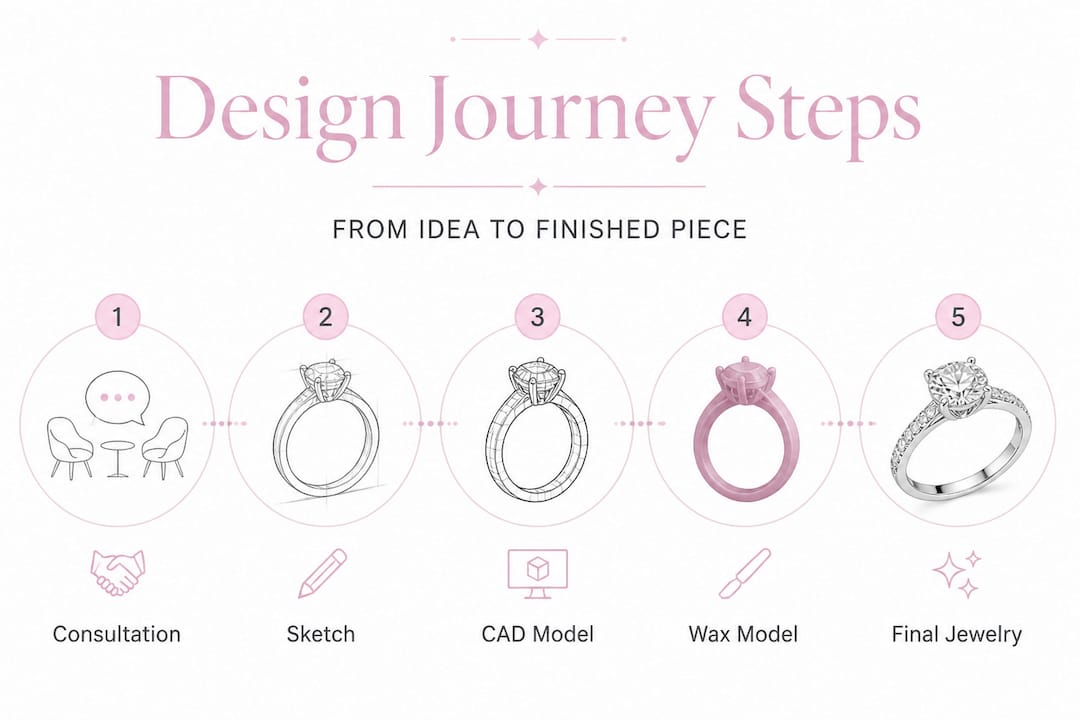
Think of it like a workflow for made-to-order fashion. Nothing moves forward without sign-off at every milestone. That structure protects you and the jeweler alike.
Here is a practical overview of each stage:
| Stage | Approximate time | What to expect |
|---|---|---|
| Consultation | 1 to 2 hours | Share your vision, lifestyle, budget, and inspiration |
| Design concept | 3 to 7 days | Sketches or mood board presented for your feedback |
| CAD rendering | 5 to 10 days | 3D digital model reviewed and approved by you |
| Wax model | 3 to 5 days | Physical prototype for size and proportion check |
| Production and casting | 1 to 2 weeks | Metal is cast, refined, and prepared for stone setting |
| Setting and finishing | 3 to 7 days | Stones are set, polished, and detailed |
| Inspection and delivery | 1 to 3 days | Final quality check and shipment or pickup |
Walk through the process step by step:
- Book a consultation and come prepared with photos, sketches, or a rough idea of the style you want.
- Share your lifestyle details so the jeweler understands how the ring will be worn daily.
- Review design concepts and give honest feedback on what feels right and what needs adjustment.
- Approve the CAD rendering, confirming proportions, stone placement, and overall silhouette.
- Examine the wax model to get a tangible sense of size and weight before the metal is cast.
- Confirm production materials including your chosen metal, stone type, and any ethical sourcing requirements.
- Review the finished piece at delivery or via detailed photographs before final acceptance.
Before your first meeting, it helps to review questions to ask your jeweler so you arrive with confidence and clarity.
Key stages of custom jewelry creation
With a sense of the overall process, let’s look closely at each key stage and what your participation looks like from start to finish.
The consultation is where everything begins. This is not a sales pitch. It is a discovery session. A skilled jeweler will ask about your partner’s aesthetic, their daily activities, any metal sensitivities, and the stones that excite them most. Your answers shape every decision that follows.
The design and CAD phase is where your words become visuals. Designers create digital renderings that you can rotate and examine from every angle. This is the stage where most meaningful changes happen, so do not hold back feedback. The goal of a CAD rendering is not to overwhelm you with technical data but to show you exactly how the ring will look before a single gram of metal is committed.
“Modern custom jewelry benefits from sophisticated digital tools, but the most important driver of the outcome is still the expert reading your brief and translating it into something wearable, meaningful, and built to last. Technology assists; craftsmanship leads.” Custom Engagement Ring Tips
The wax model stage catches surprises early. A ring that looks elegant in a CAD file may feel heavy or wide in a physical prototype. Handling the wax model in person, or requesting detailed photos and measurements if you are working remotely, is time well spent. Once you approve the wax model, casting begins and significant changes become costly.
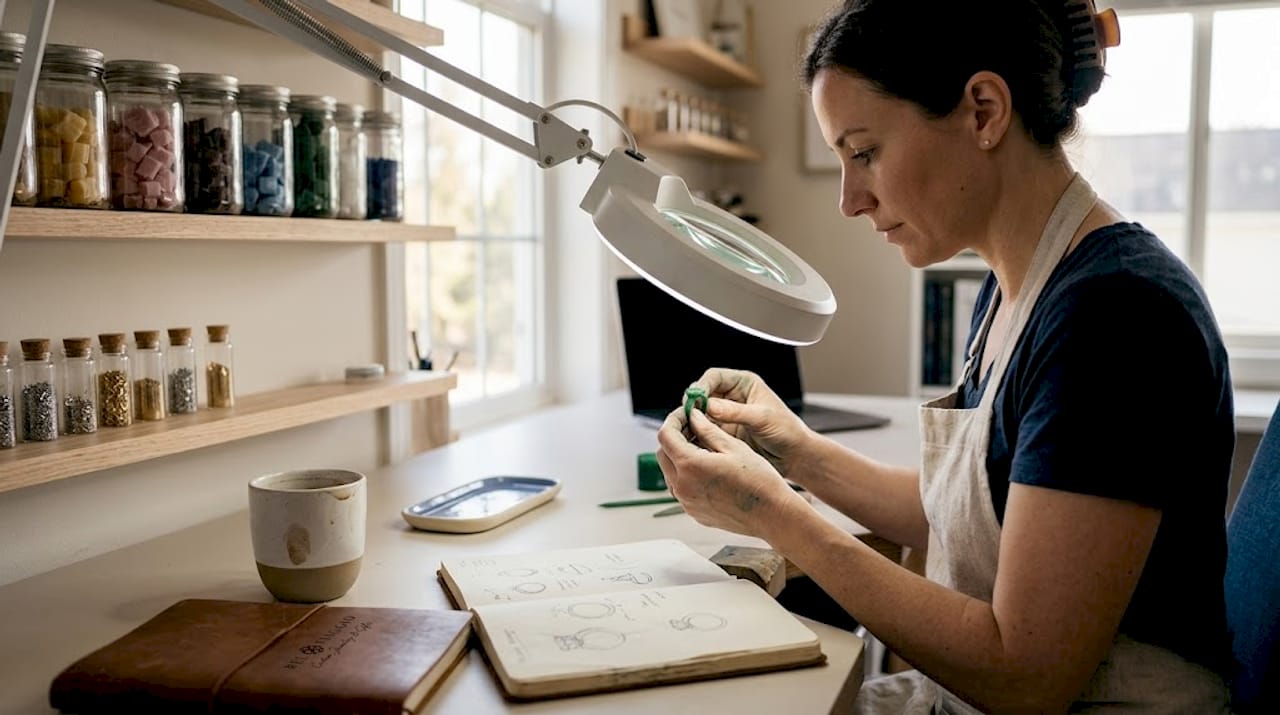
Production and finishing are largely in the jeweler’s hands, but that does not mean you go silent. Good communication during this phase avoids misunderstandings and keeps the timeline predictable. A transparent jeweler will proactively share progress updates.
Here is a quick breakdown of who does what at each stage:
- Consultation: You share vision; jeweler listens, asks questions, and documents requirements.
- Design: Jeweler drafts concepts; you provide directional feedback.
- CAD: Jeweler builds a 3D model; you review and approve every detail.
- Wax model: Jeweler creates prototype; you confirm proportions and comfort.
- Production: Jeweler casts and refines; you remain available for questions.
- Finishing: Jeweler sets stones and polishes; you prepare for delivery review.
- Delivery: You inspect the final piece and confirm it matches the approved design.
Understanding the custom ring deposit process before you commit ensures there are no financial surprises along the way. A reputable jeweler will be completely transparent about what the deposit covers and at which stage remaining payments are due. For a thorough look at personalizing each element, a step-by-step personalization guide can reinforce the decisions you make at every checkpoint.
Pro Tip: Request written or visual updates at each stage milestone. A short photo or screen share from your jeweler is not too much to ask, and it prevents the uncomfortable experience of a finished ring that does not match your expectations.
Ethical sourcing and design values in custom jewelry
As important as the jewelry’s appearance is, many couples are passionate about the values behind their ring or band. Let’s focus on how to align your custom piece with true ethical standards, not just feel-good marketing language.
Ethical jewelry is not a single certification or a buzzword. It is a set of verifiable practices across the entire supply chain. As research on the subject makes clear, sustainability claims depend on verifiable factors including energy source, labor standards, and third-party auditing rather than any single label alone.
What does “ethical” actually look like in practice? Here is what to check:
- Fair labor: Are workers at every stage of production paid fairly and protected by safe working conditions?
- Transparent sourcing: Can the jeweler trace where the metal and stones originated?
- Environmental impact: Does production minimize water use, carbon output, and toxic waste?
- Third-party certification: Are claims backed by recognized organizations like the Responsible Jewellery Council?
- Conflict-free stones: For natural diamonds, is there documentation supporting Kimberley Process compliance?
- Lab-grown options: Are lab-grown diamonds or moissanite produced using renewable energy sources?
The contrast between custom ethical pieces and mass-produced alternatives is significant:
| Feature | Mass-produced jewelry | Custom ethical jewelry |
|---|---|---|
| Sourcing transparency | Rarely documented | Fully traceable by request |
| Labor standards | Opaque, varies widely | Disclosed and verified |
| Environmental footprint | High due to scale | Reduced with intentional sourcing |
| Customization | Limited or template-based | Fully tailored to your values |
| Certifications | Rare or marketing-driven | Third-party audited |
| Stone options | Stock inventory | Lab-grown, recycled, or curated |
For couples who want to go deeper, the ethical gemstone guide breaks down responsible sourcing by stone type. You can also explore the broader topic of sourcing jewelry ethically before your first consultation so you arrive with informed questions. A practical resource for spotting sustainable materials across industries can also help you separate genuine transparency from greenwashing.
Do not accept vague phrases like “responsibly sourced” or “eco-friendly” without documentation. Ask for it in writing. A jeweler who values ethics will welcome the question.
True bespoke: Human artistry vs. technology in jewelry design
Choosing custom design also means evaluating what level of handcraft, interpretation, and human touch you want. It is crucial to understand the difference between truly bespoke and mass-customized.
Mass-customized jewelry lets you select from preset options: this font for an engraving, that metal for the band, a stone from a dropdown menu. It feels personal but follows a template. True bespoke is something different. It starts with your story and builds backward from there.
As one important industry perspective notes, true bespoke remains a human-led discipline. Even as digital and AI imaging tools become more sophisticated, the core value of bespoke work is the expert who listens deeply, interprets your brief with craft knowledge, and makes judgment calls that no algorithm can replicate. Technology assists; it does not replace artistry.
Statistic to consider: Industry surveys consistently show that couples who engage in fully collaborative bespoke processes report higher satisfaction with the finished piece than those who choose from pre-made collections, largely because the back-and-forth creates emotional investment in the outcome.
How do you spot genuine bespoke work? Look for these signals:
- The designer asks about your relationship story, not just your preferred style.
- The first design presented reflects something unique to you, not a recognizable catalog style.
- The jeweler pushes back thoughtfully when a choice may not serve you well.
- You receive handcrafted sketches or design notes alongside digital files.
- There is no rush to reach the approval stage; questions are encouraged.
For more guidance on what to look for, understanding true custom work across creative disciplines provides a useful framework that applies directly to jewelry design. And if you want to see how craft and ethical values combine in practice, exploring custom ethical engagement rings gives you a concrete reference point.
Pro Tip: Ask your designer directly: “Will you interpret our story in this design, or are you working from a template?” The answer tells you everything.
How to prepare for your custom design journey
Once you have decided that true custom is right for you, a few essential preparations will ensure your experience is satisfying and surprise-free.
Custom work involves back and forth and deliberate expectations-setting from the very start. Couples who align on key decisions before meeting a jeweler consistently have smoother, more enjoyable experiences.
Here is a practical numbered preparation checklist:
- Set a realistic budget together. Include not just the ring price but potential revision costs, stone upgrades, and shipping. Build in a 10 to 15 percent buffer for unexpected choices.
- Define your values early. Decide whether ethical sourcing, lab-grown stones, or recycled metals are non-negotiable. This narrows your designer search significantly.
- Research designers thoroughly. Review portfolios, read client testimonials, and confirm that the designer’s aesthetic aligns with your vision before making contact.
- Gather visual inspiration. Collect images from social media, magazines, or real-life jewelry you admire. Visual references speed up the consultation and reduce miscommunication.
- Choose a timeline that is honest. Most custom projects take 4 to 8 weeks minimum. If you have a proposal date or wedding date, work backward and build in buffer time.
- Designate a decision-maker. As a couple, agree on how you will handle disagreements during the design process so the jeweler is not caught between conflicting feedback.
- Monitor progress actively. Schedule regular check-ins or request updates at each stage rather than waiting passively for the final result.
For couples who are deciding between different stone types and cuts, choosing ethical gemstone jewelry provides a thorough breakdown that simplifies one of the most complex decisions in the entire process.
Pro Tip: Build at least two weeks of buffer into your project timeline for sourcing delays, especially if you are requesting a specific lab-grown diamond grade or a rare colored stone. Supply chains are not always predictable, and a rush fee never feels good.
A jeweler’s take: Clarity, commitment, and joy in custom design
Here is the part most guides skip over. The iterations are not a problem. They are the point.
Couples often approach the custom process hoping their first design will be perfect. When it is not, some feel disappointed, as if something has gone wrong. Nothing has gone wrong. The back-and-forth is where meaning is made. Every revision is a conversation. Every change brings you closer not just to a ring you love but to a shared understanding of what this milestone means to you both.
Asking hard questions about ethics and sourcing does not create friction with your jeweler. It deepens the relationship. A designer who is genuinely committed to sustainable work will light up when you ask for documentation. Those questions signal that you care about the craft, not just the outcome, and that tends to bring out the best work from everyone involved.
There is also something worth naming directly: the ring you hold at the end carries the memory of every decision you made together. The hours spent choosing a stone. The conversation where you realized a different band width felt more “you.” The moment the wax model confirmed the proportions were exactly right. You do not just wear the ring. You carry the story of how it came to be.
That is a dimension of custom design that no ready-made piece can offer. If you want to see how other couples have brought their unique design stories to life through this process, the examples are both grounding and genuinely inspiring.
Start your custom jewelry journey with Bel Viaggio Designs
Inspired to create something personal and ethical? Here is how to take the next step with expert guidance.
At Bel Viaggio Designs, every custom piece starts with a real conversation. We guide couples through each stage of the process described above, from vision capture to final delivery, with full transparency on ethical sourcing and pricing. You are never left guessing about what comes next.
Whether you are drawn to a striking black diamond engagement ring or want to explore our full range of gemstone ring options, our collections serve as starting inspiration for your completely custom creation. Every piece we make is handcrafted with ethically sourced materials, built to reflect your story, and designed to last a lifetime. Reach out to start a consultation and discover what becomes possible when craft meets intention.
Frequently asked questions
How long does the custom jewelry design process usually take?
Most custom jewelry projects take 4 to 8 weeks from consultation to delivery, though complexity, design revisions, and material sourcing can extend that timeline.
What makes a piece of jewelry “ethical”?
Ethical jewelry is produced with transparent labor practices, environmentally responsible sourcing, and verifiable third-party certifications. As guidance on lab-grown diamond buying confirms, no single label guarantees ethical production without documentation.
How do I know if a designer truly offers bespoke jewelry?
A genuine bespoke designer leads with direct collaboration and interprets your personal story, rather than generating designs from stock templates. True bespoke work is always driven by human expertise, even when digital tools support the process.
What are the first steps I should take before starting a custom jewelry project?
Align on budget, timeline, and sourcing values with your partner first, then research designers and schedule a consultation. As expert guidance confirms, the most successful projects begin with clear expectations on both sides.
Can I use recycled or lab-grown stones in my custom piece?
Yes, and many designers actively encourage these options. Always request written documentation confirming the stone’s origin, because sustainability claims are only meaningful when backed by verifiable evidence.
Recommended
- Custom Jewelry Guide: Meaning, Magic & Your Perfect Ring – Bel Viaggio Designs, LLC
- How thoughtful design shapes ethical, unique fine jewelry – Bel Viaggio Designs, LLC
- 8 key benefits of custom jewelry for unique engagements – Bel Viaggio Designs, LLC
- Unique custom jewelry designs for your engagement 2026 – Bel Viaggio Designs, LLC
- How to identify and buy premium gold jewelry – Baker Gold Chains