

TL;DR:
- Couples should define their ethical, style, and durability priorities before selecting jewelry.
- Lab-grown gemstones offer ethical, cost-effective, and customizable options with equal quality to mined stones.
- Verifying sourcing and certification is essential to ensure the jewelry aligns with personal values.
Choosing gemstone jewelry for your engagement or wedding should feel exciting, not overwhelming. Yet most couples find themselves caught between wanting something beautiful, something ethical, and something built to last, all while navigating a market full of conflicting claims and confusing certifications. Lab-grown or mined? Sapphire or moissanite? Fairtrade or Kimberley Process? The options multiply fast. This guide walks you through every decision in a clear, logical order, from clarifying your personal values to verifying authenticity, so you can choose a piece that truly reflects who you are and what you stand for.
Table of Contents
- Clarify your values and requirements
- Understand gemstone options: mined vs. lab-grown
- Choose gems for durability and daily wear
- Verify ethical sourcing and authenticity
- The real secret: style and ethics don’t have to compete
- Explore custom, ethically sourced gemstone jewelry
- Frequently asked questions
Key Takeaways
| Point | Details |
|---|---|
| Define your values | Clarify ethical standards, style, and practicality before shopping for gemstone jewelry. |
| Compare mined and lab-grown | Lab-grown stones offer ethics, customization, and significant savings compared to mined gems. |
| Durability matters most | Choose gemstones with a Mohs hardness of 8 or higher for daily wear and longevity. |
| Verify authenticity | Demand documentation and certifications to confirm ethical sourcing and quality. |
Clarify your values and requirements
Before you browse a single ring, get honest about what matters most to you as a couple. This sounds simple, but skipping this step is why so many people end up with a beautiful piece they feel quietly conflicted about. Your priorities will shape every choice that follows.
Start with ethics and sourcing. Do you want a gemstone that is certified conflict-free? Are you concerned about mining labor conditions, environmental damage, or community impact? These are not fringe concerns. The ethical gemstone guide from Bel Viaggio Designs outlines how key certifications like the Responsible Jewellery Council (RJC), Fairmined, and the Kimberley Process each cover different aspects of ethical sourcing. RJC sets comprehensive ethical, labor, and environmental standards. Fairmined and Fairtrade Gold focus on fair wages and sustainable mining practices. The Kimberley Process addresses conflict-free diamonds but has a narrower scope that does not cover broader human rights or environmental protections. Knowing which standard aligns with your values helps you ask the right questions when you shop.
Next, think about style preferences. Some couples want a classic solitaire diamond. Others are drawn to vivid color: deep blue sapphires, rich green emeralds, or the rainbow flash of moissanite. Consider whether you want a one-of-a-kind custom design or a ready-made piece. Customization lets you choose the exact stone shape, color, metal type, and setting style, which means the ring tells your specific story rather than someone else’s.
Finally, consider practical concerns. An engagement ring is worn every single day, often for decades. Durability, maintenance requirements, and how the stone holds up to daily activity all matter. Some gemstones scratch easily, lose their polish, or require regular professional cleaning. Understanding these realities before you fall in love with a stone saves you frustration later.
Here is a quick checklist to guide your values conversation:
- Ethical sourcing priority: conflict-free, fair labor, environmental impact
- Style: color preference, stone shape, setting type, metal color
- Customization: fully bespoke, semi-custom, or ready-made
- Budget: total spend and openness to lab-grown options
- Durability: daily wear tolerance and maintenance comfort
For couples who care about ethical sourcing for weddings, aligning on these points early makes the rest of the process much smoother.
Pro Tip: Write down your top three non-negotiables before you start browsing. When you are standing in front of a stunning display case, it is easy to forget what you actually care about most.
Understand gemstone options: mined vs. lab-grown
Now that you know your values, it is time to choose between mined and lab-grown gemstones. This is one of the most consequential decisions you will make, and it affects ethics, budget, and aesthetics all at once.
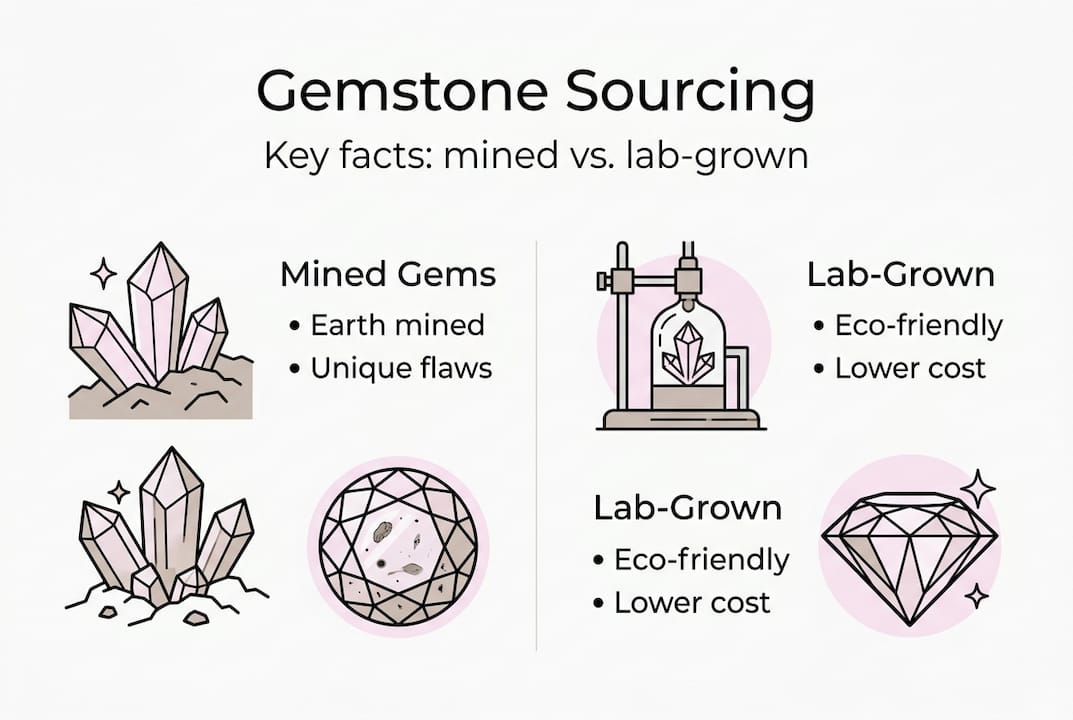
Mined gemstones are extracted from the earth through a process that, depending on the source, can involve significant environmental disruption and complex labor conditions. They carry a traditional appeal and, for some, a sense of natural rarity. However, verifying their ethical origins is genuinely difficult.
Lab-grown gemstones are created in controlled environments using the same chemical and physical processes that occur underground. They are chemically identical to mined stones and carry 7x less environmental impact, making them a strong choice for ethically minded couples. They are also conflict-free by nature, with a significantly lower carbon footprint.
The financial difference is real and significant. Lab-grown options deliver 30 to 90% savings compared to mined equivalents, which means you can often get a larger, higher-quality stone for the same budget. That is not a small advantage.
| Attribute | Mined gemstone | Lab-grown gemstone |
|---|---|---|
| Chemical composition | Natural | Identical to mined |
| Environmental impact | High | ~7x lower |
| Conflict-free | Varies | Always |
| Price | Full market rate | 30 to 90% less |
| Customization flexibility | Limited by nature | High |
| Traceability | Often unclear | Fully documented |
Pro Tip: If you want a specific color or size that is rare in nature, lab-grown gemstones give you far more options at a fraction of the cost. You are not settling. You are choosing smarter.
For couples exploring lab-grown diamonds, the quality difference compared to mined is essentially zero to the naked eye, and often superior in terms of clarity. Browse top gemstone choices to see how lab-grown options compare across different stone types.
Choose gems for durability and daily wear
With ethics and style addressed, couples must evaluate gemstone durability, especially for everyday wear. An engagement ring is not a piece you store in a box. It goes with you to the gym, the kitchen, and everywhere in between.
The standard measure of hardness is the Mohs scale, which runs from 1 (softest) to 10 (hardest). For rings worn daily, prioritize Mohs hardness 8 or above. Sapphire and ruby both score 9. Moissanite scores approximately 9.25. Emerald scores 7.5 and opal scores even lower, making them risky choices for a ring you wear every day.
| Gemstone | Mohs hardness | Daily wear suitability |
|---|---|---|
| Diamond | 10 | Excellent |
| Moissanite | ~9.25 | Excellent |
| Sapphire | 9 | Excellent |
| Ruby | 9 | Excellent |
| Emerald | 7.5 | Moderate (with care) |
| Opal | 5.5 to 6.5 | Not recommended |
A stone’s hardness tells you how well it resists scratching, but toughness, or resistance to chipping, matters too. Sapphires are both hard and tough. Emeralds, despite a decent hardness score, are brittle and prone to chipping under impact.
Here is how to evaluate durability before you buy:
- Check the Mohs hardness rating for your chosen stone.
- Ask about the stone’s toughness and brittleness, not just hardness.
- Consider your daily lifestyle: active, hands-on work demands a harder stone.
- Ask the jeweler about setting style: protective settings like bezel or halo reduce chip risk.
- Confirm the maintenance schedule: some stones need more frequent professional care.
For durable gemstone picks that balance beauty and longevity, sapphires and moissanite consistently top the list. You can also explore real ethical jewelry examples to see how other couples have made durability work for their lifestyle.
Verify ethical sourcing and authenticity
Once you have selected the right stone, verifying that your choice truly matches your values is the next crucial step. This is where many couples stop short, and it is a mistake that can undermine everything else you have done.
Here is a sobering fact: only 11% of diamonds are fully traceable from mine to market. That means the vast majority of mined diamonds come with supply chain gaps that make ethical verification nearly impossible. Lab-grown stones sidestep this problem entirely.
For any gemstone, follow these verification steps:
- Request written documentation of the gemstone’s country of origin.
- Ask for third-party audit reports or certification from RJC, Fairmined, or equivalent bodies.
- Confirm labor and environmental practices at the source mine.
- Request a grading report from a recognized lab like GIA.
- Ask your jeweler directly: “Can you trace this stone from source to setting?”
When it comes to quality assessment, the 4Cs framework is the standard: cut, color, clarity, and carat. Cut matters most for brilliance and light performance. Color and clarity affect visual appeal and value. GIA grading is the gold standard for authenticity and should be requested for any significant purchase.
Key documents to request from your jeweler:
- GIA or equivalent grading certificate
- Country of origin documentation
- Certification under RJC ethical standards or Fairmined
- Third-party audit confirmation
- Conflict-free declaration
For more detail on what to look for, review diamond certification details and conflict-free ring tips to avoid common pitfalls couples miss.
The real secret: style and ethics don’t have to compete
There is an outdated idea floating around that choosing ethical jewelry means accepting compromises on beauty or uniqueness. That you pick the responsible option and quietly mourn the ring you actually wanted. We have seen this play out with real couples, and it is simply not true anymore.
The rise of lab-grown gemstones and custom design has changed everything. Today, you can get a vivid, perfectly cut, ethically verified stone in a setting designed specifically for you, often for less than a compromise mined stone would have cost. The “sacrifice” narrative is a holdover from a time when options were genuinely limited.
What we have learned from working with couples is that the most meaningful pieces are the ones built with intention. When a ring reflects both your values and your taste, it carries more weight. It is not just beautiful. It tells a story you are proud of. Explore custom ethical ring tips to see how personalization and ethics reinforce each other rather than compete.
Explore custom, ethically sourced gemstone jewelry
If you are ready to start shopping for a piece that fits your ethics and your style, here is your next step.

At Bel Viaggio Designs, every ring is handcrafted with verified ethical sourcing and built around your specific vision. Whether you want a bold sapphire solitaire, a moissanite halo, or a fully custom design with a lab-grown center stone, we make it possible without compromise. Our pieces come with a lifetime warranty and personalized service from start to finish. Browse lab-grown diamonds to find your ideal center stone, or shop gemstone rings to explore our curated collection of ethically sourced, custom-ready styles.
Frequently asked questions
What makes a gemstone ethically sourced?
A gemstone is ethically sourced when its origins and mining practices are certified by standards like RJC or Fairmined, ensuring fair labor and environmental protections are in place throughout the supply chain.
Are lab-grown gemstones real and durable?
Yes. Lab-grown gemstones are chemically identical to mined stones and, when they score Mohs hardness 8 or above, they are fully suitable for daily wear in engagement rings.
How can couples check gemstone traceability?
Request supply chain documentation and third-party verification from your jeweler. Keep in mind that only 11% of diamonds are fully traceable, which is one reason lab-grown options offer a significant transparency advantage.
Why does gemstone certification matter?
Certification from bodies like GIA or RJC protects against fraud and confirms both ethical sourcing and stone quality. The 4Cs grading system gives you an objective, standardized way to evaluate what you are actually buying.
Recommended
- Stunning gemstone jewelry examples for ethical couples – Bel Viaggio Designs, LLC
- Ethical gemstone selection guide for engagement rings 2026 – Bel Viaggio Designs, LLC
- Ethical gemstone selection guide for engagement rings 2026 – Bel Viaggio Designs, LLC
- Custom jewelry ideas for ethical engagement rings 2026 – Bel Viaggio Designs, LLC