

TL;DR:
- Bespoke and ethically sourced jewelry allows individuals to create unique pieces that reflect their values and personal stories. Understanding the importance of clear communication, transparent sourcing, and active involvement ensures a meaningful and satisfying jewelry experience. Prioritizing collaboration over trends results in timeless pieces that grow more meaningful over time.
Finding jewelry that truly captures the weight of your engagement or wedding can feel surprisingly hard. Every showcase case is full of rings that look almost right but never quite like you. Bespoke and ethically sourced jewelry solves that problem by putting your story, values, and aesthetic at the center of every design decision. This guide walks you through exactly what bespoke means, how to prepare for the process, the step-by-step commissioning journey, and how to protect yourself from common mistakes so you end up with a piece that matters for generations.
Table of Contents
- Understanding bespoke and ethical jewelry
- What to prepare before starting your bespoke jewelry journey
- Step-by-step guide to commissioning your bespoke jewelry
- Common mistakes and how to ensure your jewelry meets your values
- Why personal involvement matters more than price or trends
- Bring your vision to life with Bel Viaggio Designs
- Frequently asked questions
Key Takeaways
| Point | Details |
|---|---|
| Personalization drives meaning | Custom jewelry allows you to tell your unique story through every detail. |
| Plan before consulting | Gather your inspiration, set your priorities, and clarify your ethical standards early. |
| Involvement ensures satisfaction | Stay engaged during the design and production phases to achieve the perfect piece. |
| Verify ethical claims | Ask for certifications and transparency to guarantee your jewelry matches your values. |
| Expert guidance is key | Work with professionals for a smooth, satisfying bespoke jewelry experience. |
Understanding bespoke and ethical jewelry
The word “bespoke” gets used loosely, so let’s be precise. In fine jewelry, bespoke means that you, the customer, are the co-author of the piece. You influence the metal, the stone, the setting, the finish, and any symbolic details woven into the structure. As stated in one guide to custom jewelry designs, “bespoke jewelry allows customers to influence every aspect of a piece, creating a one-of-a-kind result.” That is fundamentally different from selecting a ring off a rack, even a high-quality one.
Ethical jewelry is a separate but deeply related idea. It refers to how materials are sourced, who crafts them, and what environmental impact the production leaves behind. Ethical sourcing covers:
- Conflict-free stones, including lab-grown diamonds and moissanite that have zero mining footprint
- Recycled or reclaimed metals, which reduce demand for new extraction
- Fair-trade and artisan-certified production, ensuring the makers are paid fairly
- Full supply chain transparency, meaning a jeweler can trace every component back to its origin
Understanding both concepts matters because today’s couples are not just buying a beautiful object. They are making a values statement. Surveys consistently show that younger buyers weigh a brand’s ethical practices nearly as heavily as product quality. Knowing how to read a bespoke and ethical guide before you begin saves you from choosing a stunning ring that later feels complicated.
“The most meaningful jewelry isn’t just beautiful. It reflects the values and story of the people who wear it.”
It is also worth noting that the fashion world is catching up. More editorial voices are discussing how wearing statement jewelry intentionally, with pieces that carry personal meaning, has become a defining style choice rather than an afterthought. For weddings and engagements, that shift is especially powerful.
What to prepare before starting your bespoke jewelry journey
With the groundwork set, let’s get organized and prepared for your consultation. Most couples underestimate how much smoother the entire process goes when they show up with a clear sense of what they want, even if that vision is still rough around the edges.
Build your inspiration board first. Gather images of jewelry styles you love, colors you’re drawn to, architectural shapes, even fabrics or artworks that feel connected to your relationship. This gives your jeweler raw material to work from rather than a blank slate. The benefits of custom jewelry go far beyond aesthetics. They include wearing something that reflects your actual story rather than a marketing team’s idea of what a ring should look like.
Before your first consultation, clarify the following priorities. As noted in a guide to ethical engagement ring ideas, “Couples should clarify their style preferences, required materials, and ethical must-haves before consulting a jeweler.” Being vague at the start costs time and money later.
| Preparation area | Questions to answer |
|---|---|
| Style direction | Vintage, modern, minimalist, or bold? |
| Stone preferences | Diamond, moissanite, sapphire, aquamarine? |
| Ethical priorities | Lab-grown, recycled metal, artisan-made? |
| Budget range | Firm maximum or flexible by material? |
| Timeline | Event date and any hard deadlines? |
| Symbolism | Birthstones, heirloom elements, engravings? |
Understanding your budget is critical and often where people feel uncomfortable being honest. Bespoke jewelry does not have to be prohibitively expensive, but it does require realistic expectations. Lab-grown diamonds, for example, deliver the same optical and chemical properties as mined diamonds at a significantly lower price point, which can free budget for more elaborate metalwork or a larger stone.

Pro Tip: Set a firm budget ceiling before your consultation and share it openly with your jeweler. A skilled artisan will design toward your budget rather than over it, and transparency from both sides produces better outcomes.
Think about timelines carefully too. Custom pieces typically need 4 to 8 weeks from approved design to final delivery. If your proposal or wedding date has a hard deadline, add at least two weeks of buffer for any revision rounds or sourcing delays for unusual stones.
Step-by-step guide to commissioning your bespoke jewelry
With ideas and information in hand, here’s exactly how the bespoke ordering process works.
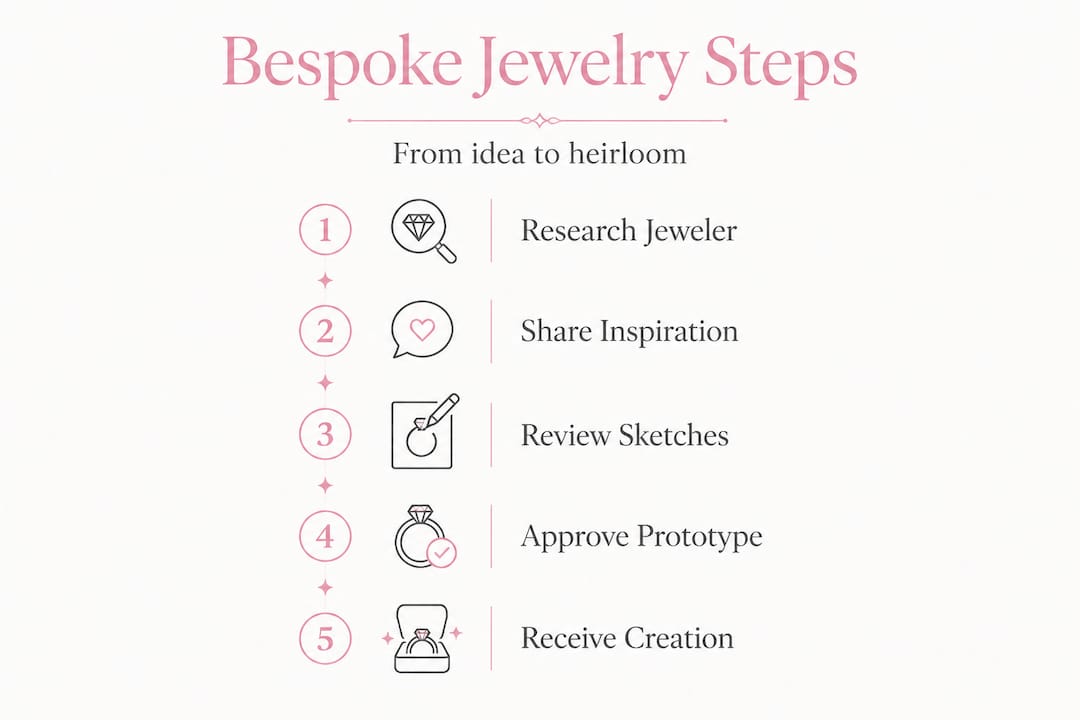
1. Choose your jeweler intentionally. Research several options before committing. Look for clear portfolios, verifiable certifications for ethical sourcing, and genuine reviews that speak to communication quality. A jeweler with stunning pieces but poor responsiveness will frustrate you during the revision stage.
2. Share your vision in detail. Bring your inspiration board, your notes on symbolism, and your ethical priorities. The more context you give, the more accurately a designer can translate your ideas into a sketch. Many jewelers offer digital mood board tools or collaborative design portals now.
3. Review initial sketches and give honest feedback. This is not the time to be polite at the expense of accuracy. If the proportions feel off or a design element does not resonate, say so clearly. The step-by-step custom ring guide confirms that “a transparent bespoke process includes idea sketching, material sourcing verification, prototype approval, and clear communication of timelines.”
4. Confirm material sourcing. Before any physical work begins, ask your jeweler to verify the origin and certifications of every material. Request documentation for lab-grown stones, recycled metal certificates, or artisan sourcing papers. This is your ethical checkpoint.
5. Approve the prototype or CAD model. Many modern jewelers use computer-aided design software to produce a photorealistic render or a wax prototype before cutting metal. This stage is your last easy opportunity to catch anything that does not feel right.
6. Final creation and delivery. Once you approve the prototype, production begins. A good jeweler will give you progress updates at key milestones and confirm a delivery window before shipping or arranging in-person pickup.
| Stage | What you should do | What to ask |
|---|---|---|
| Consultation | Share full vision and budget | What is your ethical sourcing process? |
| Sketching | Give detailed, honest feedback | Can I see alternate proportion options? |
| Material confirmation | Request written documentation | Are these certifications current? |
| Prototype review | Evaluate in real lighting if possible | What changes are still possible here? |
| Final delivery | Inspect in person before accepting | What does the warranty or remake policy cover? |
Knowing the questions to ask your jeweler matters because “asking the right questions and staying involved at every stage is vital to getting a satisfying result.” Passive customers rarely get the best outcomes.
Pro Tip: Take notes or short videos during prototype reviews. When you are emotionally invested in a piece, it is easy to notice something feels slightly off but not remember exactly what it was by the time you follow up.
Common mistakes and how to ensure your jewelry meets your values
Even with care, missteps can happen. Here’s how to avoid or remedy them.
The most common mistake is failing to document everything. Verbal agreements about stone size, metal weight, or engraving text leave too much room for misinterpretation. Every detail should be confirmed in writing, whether through email, a signed design brief, or a formal commission contract.
A second major pitfall is accepting vague ethical claims at face value. Phrases like “responsibly sourced” or “conflict-free” mean nothing without documentation to back them up. As the guide to tips for ethical ring buying notes, “not checking a jeweler’s certifications or asking about sourcing can undermine the ethical integrity of bespoke pieces.” Ask for the actual certificates, not just assurances.
Watch out for these common errors:
- Rushing the timeline. Feeling pressure to finalize a design quickly leads to skipping revision rounds, which leads to regret.
- Conflating price with quality. An expensive piece from an unresponsive jeweler is worse than a moderately priced piece from a transparent, communicative artisan.
- Ignoring the metal. Couples often focus entirely on the stone and let the jeweler choose the metal by default. The metal choice affects durability, weight, skin tone compatibility, and total cost significantly.
- Not asking about sizing and adjustments. Make sure your commission contract specifies how many complimentary resizes are included post-delivery.
“Protecting your investment means staying curious, asking detailed questions, and never assuming your jeweler knows what you have not told them.”
If the finished piece does not meet your expectations, address it immediately and in writing. Reputable jewelers build revision or remake clauses into their process. A guide to the ethical bespoke gift guide reinforces that transparency goes both ways. You have to be as clear about your expectations as your jeweler needs to be about their process.
Why personal involvement matters more than price or trends
Here is something the broader jewelry industry rarely says plainly: the couples who end up most satisfied with their bespoke pieces are not the ones who spent the most money. They are the ones who stayed most involved.
We see this consistently. A couple who brought a worn-down family brooch as inspiration and asked for its scrollwork echoed in their band ended up with a piece no budget could have predicted. Another couple who handed over a Pinterest board and said “something like this” received a technically beautiful ring they felt strangely detached from. The difference was not craftsmanship. It was co-authorship.
Trends in jewelry move quickly. Oval stones dominated one year, emerald cuts the next. Mixed metals went from unconventional to ubiquitous in a short period. If you design around a trend, you risk feeling dated in five years. If you design around your actual relationship, its history, its humor, its values, the piece only grows more meaningful with time.
Personalized jewelry ideas always perform best when they come from a genuine place rather than a search for what looks current. Birthstones, coordinates of where you met, motifs from a shared trip, the silhouette of a meaningful object. These are the details that make someone gasp when they hear the story behind a ring.
Working closely with your jeweler also builds accountability. When your artisan understands why a piece matters, they take the work more personally. That relationship produces better quality control, more thoughtful material choices, and a finished piece that feels as deliberate as it looks.
Bring your vision to life with Bel Viaggio Designs
You have done the research, built the inspiration board, and know exactly what ethical questions to ask. Now it is time to start the real conversation.

At Bel Viaggio Designs, every piece is handcrafted with full ethical sourcing transparency and a collaborative design process built around your story. Browse standout options like the striking black diamond engagement ring for a bold, modern statement, or explore the timeless craftsmanship of the white and yellow gold men’s band. For couples drawn to color and character, the aquamarine engagement ring offers an emerald-cut stone with diamond accents that feels genuinely one-of-a-kind. Payment plans are available so your values and your vision never have to compete with your budget.
Frequently asked questions
How long does it take to create bespoke jewelry?
On average, bespoke jewelry takes 4 to 8 weeks from consultation to delivery, depending on design complexity and how long stone sourcing requires. Build in extra buffer time if your piece involves unusual gemstones or intricate metalwork.
How can I be sure my jewelry is truly ethical?
Ask your jeweler for material certifications and full sourcing transparency before starting any custom work. As noted in a guide to ethical ring buying, skipping this step can compromise the integrity of even a beautifully made piece.
Is bespoke jewelry always more expensive than ready-made?
Not necessarily. Choosing lab-grown stones, recycled metals, or simpler settings can bring bespoke pricing in line with luxury retail. The real cost driver is design complexity, not customization itself.
What if I change my mind after seeing the prototype?
Communicate concerns immediately in writing, because most reputable jewelers build revision rounds into the process. A transparent bespoke process specifically includes prototype approval as a formal stage before final production begins.
What details should I always document in writing before production starts?
Confirm stone specifications, metal type and weight, engraving text, sizing, delivery date, and any ethical sourcing certifications in a signed design brief or email chain before your jeweler starts any physical work.
Recommended
- Unique custom jewelry designs for your engagement 2026 – Bel Viaggio Designs, LLC
- 8 key benefits of custom jewelry for unique engagements – Bel Viaggio Designs, LLC
- How to create bespoke luxury jewelry gifts ethically – Bel Viaggio Designs, LLC
- Custom jewelry ideas for ethical engagement rings 2026 – Bel Viaggio Designs, LLC
- How to Wear Statement Jewelry for Special Events - DressMeUpNY
- How to identify and buy premium gold jewelry – Baker Gold Chains