

A Toi et Moi ring pairs two gemstones side-by-side in one setting, and the name says the rest: French for “you and me.” Couples choose it over a solitaire because it tells a specific story instead of a generic one, and it comes at nearly every budget, from lab-grown pairings under $2,000 to museum-grade estate pieces. Customization is the whole point.
TL;DR:
- The overall cost depends heavily on the choice of metals and gemstones, with lab-grown diamonds offering a budget-friendly option that still provides excellent quality.
- Matching stones typically symbolize harmony, while contrasting stones emphasize individuality, allowing couples to select a design that reflects their relationship.
- The design’s structure, especially the use of bypass or straight gallery settings, influences the visual balance and durability, making consultation with a jeweler crucial for proper proportioning.
- Prices range from a few thousand dollars for lab-grown options to six-figure pieces with rare gemstones or provenance, with certification being essential at higher tiers.
- The style’s enduring appeal lies in its personalization, enabling couples to tell a unique story through custom choices of stones, symbolism, and setting details.
Table of Contents
- What Does “Toi et Moi” Mean, and Why Two Stones?
- Where the Toi et Moi Style Actually Comes From
- How the Design Actually Works: Settings and Stone Pairing
- What a Toi et Moi Actually Costs, Stone by Stone
- Building Your Toi et Moi: A Buyer’s Checklist
- Keeping a Two-Stone Ring in Good Shape
- Bel Viaggio’s Approach to Custom Two-Stone Rings
- Giving a Toi et Moi: Occasions and What It Signals
- An Editorial Take on the Toi et Moi Revival
- Ready to Design Your Own Toi et Moi Ring?
- Sources
- FAQ
What Does “Toi et Moi” Mean, and Why Two Stones?
Say it “twa ay mwah.” Literally, it translates to “you and me,” and jewelers have used that phrase for over two centuries to describe a ring built around exactly two stones set close together, usually angled toward each other on a shared band.
The symbolism is the reason people search for this style instead of just asking for “a two-stone ring.” Two separate gems sitting side-by-side, rather than one dominant center stone, reads as a partnership of equals rather than one big statement piece with supporting cast. That’s a deliberate shift from the solitaire tradition, where a single diamond carries all the visual and emotional weight.
Couples typically land on one of two symbolic approaches:
- Matching stones (two diamonds, or two sapphires of similar tone) suggest harmony, unity, and a relationship built on shared values.
- Contrasting stones (a diamond next to a sapphire, or a round paired with a pear shape) suggest two distinct individuals choosing to stand together, each keeping their own identity.
Neither reading is more “correct.” Which one resonates usually comes down to how a couple describes their own relationship. Some want a ring that mirrors them; others want a ring that captures the fact that they’re different people who happen to fit.
Where the Toi et Moi Style Actually Comes From
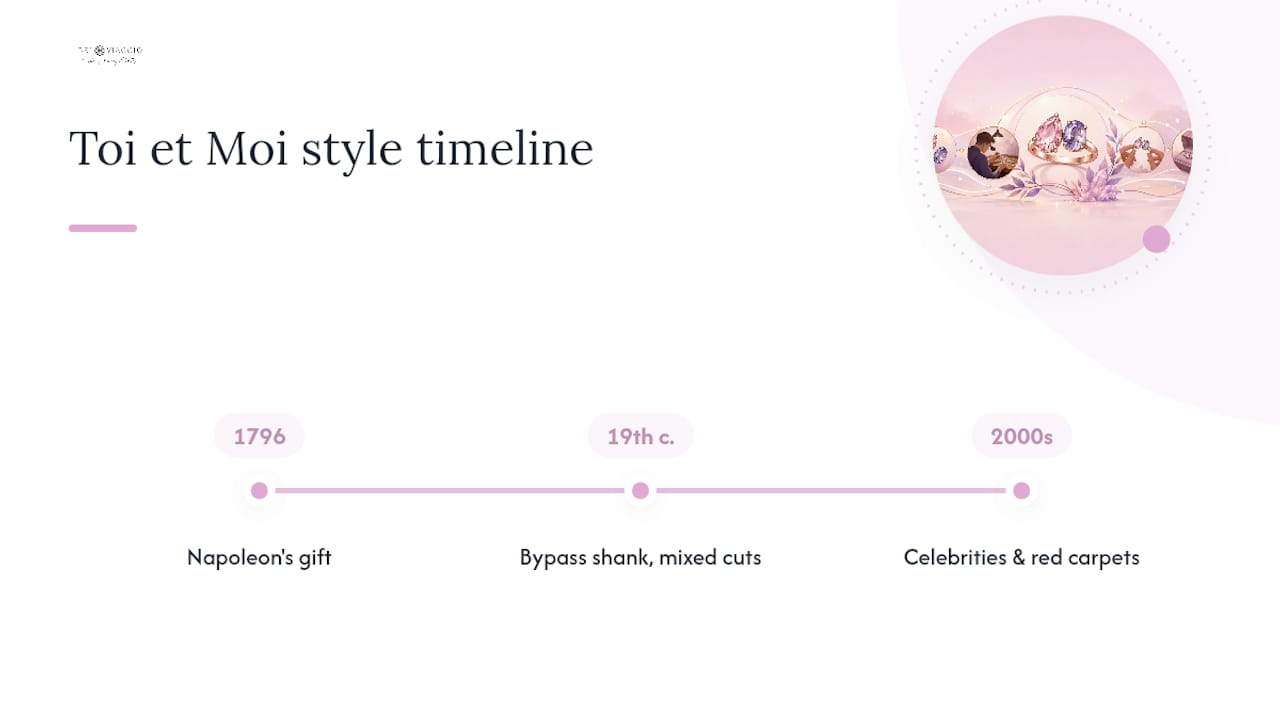
Napoleon Bonaparte started this. In 1796, he gave Joséphine de Beauharnais a ring pairing a pear-shaped sapphire with a pear-shaped diamond, set side-by-side, a design so specific it’s still referenced as the canonical Toi et Moi by auction houses more than two centuries later. That single gift essentially invented a category.
The style traveled through European aristocratic circles for generations, and its construction evolved along the way. Victorian and Edwardian jewelers developed the bypass and crossover shank, a band that curves the two stones toward each other rather than lining them up flat, along with mixed-cut pairings that are still the template today. Collectors hunting antique pieces look for hallmark stamps and period-correct settings to tell an authentic 19th-century ring from a modern reproduction built in an old style.
The modern revival has a different engine: red carpets and engagement announcements. Two-stone rings tied to public figures, including coverage tracing the trend through celebrity engagements, pushed the silhouette back into mainstream demand after decades as a niche antique category.
Napoleon’s ring, gifted in 1796, remains the reference point jewelers cite when explaining the style’s origin. That’s a 230-year-old proposal still shaping engagement ring design today.
How the Design Actually Works: Settings and Stone Pairing
The engineering matters as much as the symbolism. A Toi et Moi ring lives or dies on how the two stones sit relative to each other, and a few structural decisions determine whether it looks intentional or lopsided.
Most Toi et Moi rings use a bypass shank, where the band splits and curves around, letting each stone sit in its own head while the metal visually “wraps” the pair together. Some use a straight shared gallery instead, mounting both stones on one continuous band without the crossover curve. Bypass settings tend to look more dynamic; straight-gallery settings look more classic and streamlined.
Pairing strategy comes down to three common approaches:
- Diamond plus colored gem. A round diamond next to an oval sapphire or emerald is the most requested combination, largely because it lets one stone anchor value and the other carry color and personality.
- Two diamonds, different shapes. A pear beside a round, or a cushion beside an oval, keeps the palette monochrome while still avoiding the “matched pair” look that can feel less bespoke.
- Two colored gems. Rarer, but striking, a sapphire next to a morganite or an emerald next to a ruby reads as the most personalized option, since colored-gem combinations are almost never mass-produced.
Mixed shapes tend to look more custom than two identical cuts, mostly because identical pairs are what factory-made rings default to.
Balance is the technical challenge. A 1.20-carat round diamond and a 1.20-carat pear diamond will not look equal in size on the hand, because carat weight measures mass, not visual spread. Jewelers instead match approximate face-up area, meaning a smaller pear can visually balance a larger round depending on how each stone is cut. Ask your jeweler to show you both stones side-by-side, loose, before they’re set.
Pro Tip: Ask to see the two stones on a flat white surface under the same light before setting. If one visually pulls your eye more than the other, that imbalance only gets more obvious once the ring is mounted and worn daily.
One practical note on durability: prongs on a bypass setting see more stress at the point where the band curves, since that’s where daily knocks concentrate. If you’re active with your hands, ask specifically about prong gauge and whether the setting has been reinforced at the crossover point.
What a Toi et Moi Actually Costs, Stone by Stone
Budget conversations for a two-stone ring differ from solitaire shopping because you’re making two sets of decisions instead of one, and every choice compounds.
Metal is the simpler decision. Platinum costs more upfront and resists tarnish, making it the safer long-term pick for daily wear. Eighteen-karat gold costs less, comes in yellow, white, and rose, and needs occasional rhodium replating if you choose white gold. Mixed-metal bands, where each stone’s prong matches its own metal tone, are a growing custom request specifically because they let each gem’s setting complement its color rather than fighting it.
Gemstone choice is where the real budget swings happen:
- Natural diamonds carry the highest cost per carat and the most established resale market.
- Lab-grown diamonds offer the same optical and chemical properties at a meaningfully lower price point, which is why lab-grown pairings have become the default entry point for two-stone designs.
- Sapphires and emeralds add color without diamond pricing, though emeralds need more careful daily-wear handling due to natural inclusions.
- Moissanite delivers diamond-like brilliance at a fraction of the cost, ideal for buyers who want a bigger visual impact per dollar.
Realistic price tiers: an entry-level Toi et Moi using lab-grown diamonds or moissanite, totaling around 1.5 carats combined, typically lands in the low thousands. Mid-tier natural diamond and sapphire combinations run into the five figures depending on clarity and origin. High-jewelry examples with rare colored diamonds or significant provenance, the kind Sotheby’s has auctioned, can reach into six figures or beyond, driven as much by rarity and history as by carat weight.
Certification is non-negotiable at any tier above entry-level. A GIA or equivalent independent lab report on each stone confirms carat, cut, clarity, and color grade, and it protects resale value if you ever need to insure, upgrade, or sell. At higher budgets, buyers increasingly prioritize cut quality and paperwork over raw carat size, since a well-cut, well-documented stone performs better visually and holds value better than a larger, poorly cut one.
Building Your Toi et Moi: A Buyer’s Checklist
Move through these steps in order, and you’ll avoid the most common regret buyers report: falling in love with a design before locking in a realistic budget.
- Define your symbolism first. Decide if you want matching stones (unity) or contrasting ones (individuality). This decision shapes every choice after it.
- Set a total budget before shopping stones. Split it roughly by priority, deciding upfront whether the “hero” stone or the setting complexity matters more to you.
- Choose your stone types and confirm sourcing. Ask directly whether stones are natural or lab-grown, and request documentation either way.
- Request grading reports. Get GIA or equivalent certification on each stone individually, not just a combined appraisal.
- Check proportion, not just carat weight. Ask to see both stones together before final setting to confirm visual balance.
- Ask about resizing, warranty, and lead time. Custom two-stone settings often take longer to build than standard solitaires, so confirm turnaround before you commit to a date.
If you already own a stone, a family diamond or an heirloom sapphire, resetting it into a Toi et Moi design paired with a new stone is one of the most requested custom projects in this category. It lets you keep the sentimental piece while building something new around it.
Keeping a Two-Stone Ring in Good Shape
Two stones means two sets of care requirements, sometimes with different rules for each side.
- Diamonds and moissanite tolerate daily wear well; clean them every two to three weeks with warm water, mild dish soap, and a soft brush.
- Sapphires are nearly as hard as diamond and handle daily wear fine, but avoid ultrasonic cleaners if the stone has visible inclusions or has been treated.
- Emeralds are softer and more brittle; skip ultrasonic cleaners entirely and avoid wearing them during heavy manual work.
- Get a professional inspection annually, especially on bypass settings, where prongs at the crossover point see the most stress.
- Insure both stones individually on your policy, and get the appraisal updated any time you have work done, since resetting or resizing can affect valuation.
Bel Viaggio’s Approach to Custom Two-Stone Rings
Belviaggiodesigns builds Toi et Moi designs through direct custom consultation rather than a fixed catalog, pairing lab-grown diamonds, moissanite, and colored gems like sapphire and emerald to fit a couple’s budget and symbolism. Pieces like the oval sapphire and diamond design show how a colored center pairs against a diamond accent. Every custom order includes sourcing transparency and a free ring sizer to get proportions right before production starts.
Giving a Toi et Moi: Occasions and What It Signals
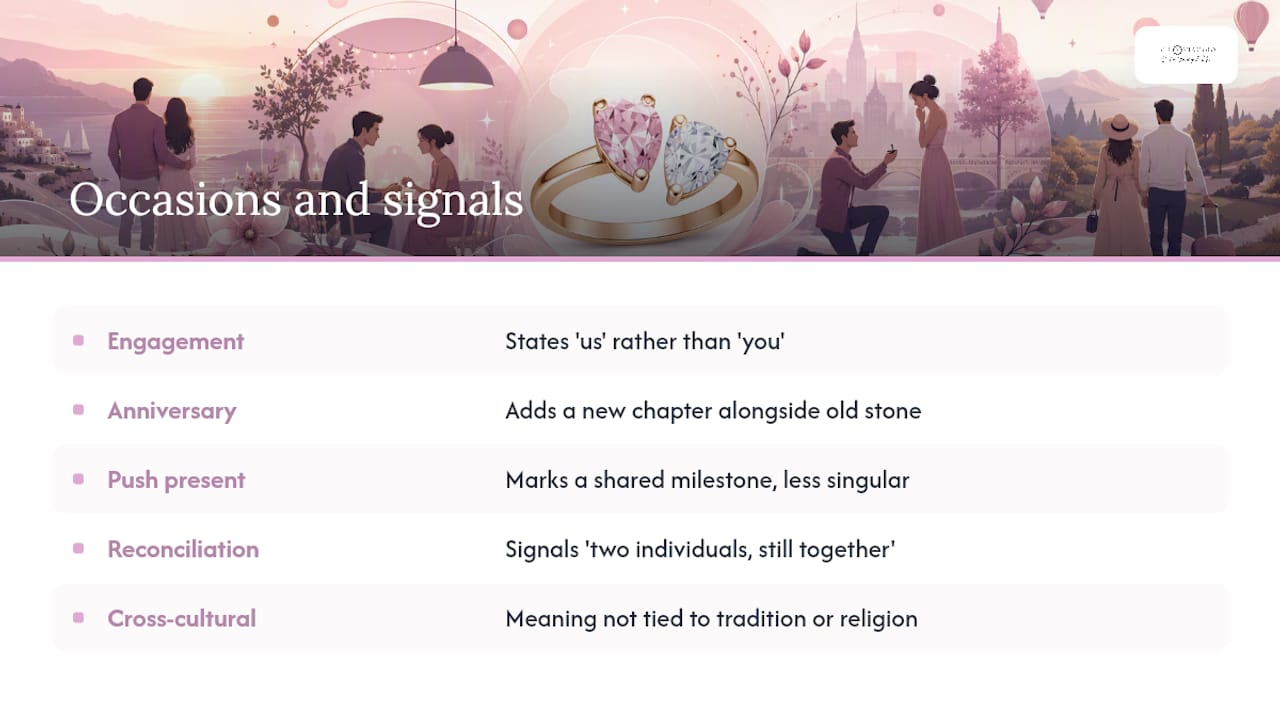
Engagement is the most common occasion, and for good reason: a ring built around two stones instead of one visually states “us” rather than “you,” which is exactly the message most proposals are trying to send. But the format isn’t locked to engagements.
Anniversary gifts, particularly milestone years, are a growing use case. A couple who married with a traditional solitaire sometimes commissions a Toi et Moi for a tenth or twenty-fifth anniversary specifically because it can incorporate a new stone alongside a stone with history, symbolically adding a new chapter rather than replacing the old one.
Push presents and “we survived a hard year together” gifts have also adopted the two-stone format, since the contrasting-stone version reads less romantically singular than a diamond solitaire and more like a shared milestone marker. Some buyers give Toi et Moi pieces to mark reconciliation after a difficult period, leaning into the “two individuals, still together” symbolism rather than the unity reading.
Cross-culturally, the format travels well because its meaning isn’t tied to one specific tradition or religious symbolism the way some ring styles are. It’s built on a phrase, not a custom, which is part of why it has moved so easily from 18th-century French aristocracy to modern engagement culture without needing translation or adaptation.
An Editorial Take on the Toi et Moi Revival
The conventional advice on Toi et Moi rings treats it like a trend piece, something couples chase because a celebrity wore one. That undersells what’s actually happening. The real shift is that couples have gotten more comfortable rejecting a one-size-fits-all engagement ring, and the two-stone format is simply the most flexible vehicle for that instinct.
Where most guides fall short is treating “customization” as a luxury add-on rather than the actual point. A Toi et Moi isn’t a fancier solitaire. It’s a different premise entirely, built stone by stone around what a specific couple wants to say. That’s why lab-grown and moissanite options matter here more than in almost any other ring category: they let a buyer prioritize meaning and proportion over raw carat spend.
If you’re shopping this style, prioritize the story first, then the stones, then the setting. Buyers who reverse that order usually end up with a ring that looks bespoke but doesn’t feel personal.
— Stacy
Ready to Design Your Own Toi et Moi Ring?
Belviaggiodesigns builds two-stone rings through direct custom consultation instead of a fixed inventory, which means you’re not choosing from a limited set of preset pairings. You pick the stones, the shapes, and the metal, and lab-grown diamonds or moissanite keep that bespoke look accessible even on a modest budget.
Explore pairings like the emerald and diamond design or the aquamarine and pear diamond combination for a sense of what’s possible before your consultation. Every custom piece is handcrafted with transparent sourcing on both natural and lab-grown stones, and you can confirm your size ahead of time with the free ring sizer. Ready to start? Browse the black diamond halo setting or reach out to schedule a custom design consultation and get your proportions and stone pairing mapped out before you order.
Sources
- Two Stones Symbolizing Love since 1796, The Toi et Moi Ring | Jewelry | Sotheby’s
- What engagement rings look like at different price points | The Knot
- Engagement ring trends including toi et moi revival — SCMP
FAQ
What Does “Toi et Moi” Mean for Rings?
It’s French for “you and me,” describing a ring set with two stones side-by-side rather than one center stone, symbolizing partnership or individuality depending on whether the stones match or contrast.
What Celebrity Has a Toi et Moi Engagement Ring?
Several public engagements have featured two-stone designs, and coverage of modern engagement ring trends credits celebrity engagements with reviving the style’s popularity in recent years.
What Is Meghan Markle’s Ring?
Meghan Markle’s engagement ring includes a center diamond sourced from Botswana flanked by two diamonds that belonged to Princess Diana, a design built around personal provenance rather than a traditional Toi et Moi pairing.
What Does a $100,000 Engagement Ring Look Like?
At that tier, expect exceptional cut quality, larger or rarer carat weights, and often significant provenance; Sotheby’s auction examples show that rarity and history drive value as much as size does at high-jewelry levels.
Is a Toi et Moi Ring More Expensive Than a Solitaire?
Not necessarily. Using lab-grown diamonds, moissanite, or smaller paired stones keeps a two-stone design affordable, while natural diamonds or rare colored gems can push the price well above a comparable solitaire.