

TL;DR:
- Gemstone provenance records a stone’s origin and supply chain journey, ensuring ethical sourcing and transparency.
- Verifiable provenance helps prevent funding conflict, human rights abuses, and environmental harm in gemstone acquisition.
- Always request both grading certificates and detailed provenance documentation linked to the exact stone when buying jewelry.
When you choose an engagement ring, a certificate from a gemologist feels like proof enough that you’ve done your homework. But why gemstone provenance matters goes far deeper than any single document. Provenance is the full, documented story of where your stone came from and every hand it passed through before reaching you. Many couples don’t realize that a grading certificate tells you how beautiful a stone is, not how ethically it was sourced. This guide breaks down what provenance really means, where the system can fail, and how to ask the right questions before you buy.
Table of Contents
- What is gemstone provenance and why does it matter?
- Provenance and conflict prevention: The Kimberley Process and beyond
- Why origin alone isn’t enough: Traceability challenges in the gemstone journey
- Certificates vs. provenance systems: What ethical couples need to know
- How to apply provenance knowledge when choosing ethically sourced engagement jewelry
- Why provenance verification is more than a trend — it’s your best safeguard
- Find your ethically sourced engagement and wedding rings at Bel Viaggio Designs
- Frequently asked questions
Key Takeaways
| Point | Details |
|---|---|
| Provenance is more than paperwork | It tracks a gemstone’s origin and journey to ensure ethical sourcing beyond just certificates. |
| Conflict prevention matters | Provenance helps avoid gems linked to conflict and human rights abuses like those from Myanmar. |
| Traceability is complex | Stones often travel globally, so physical and digital provenance verification is essential. |
| Certificates differ from provenance | Quality grading differs from ethical origin verification; layered documentation is key. |
| Ask detailed provenance questions | Couples should verify their stone’s exact chain of custody for assurance and personal values. |
What is gemstone provenance and why does it matter?
Gemstone provenance is the verified record of a stone’s origin and its journey through the entire supply chain, from the mine where it was extracted, through cutting and polishing facilities, to the retailer who sells it. Think of it like a passport with every border crossing stamped. The importance of gemstone origin isn’t just philosophical. It determines whether your stone financed conflict, involved unsafe labor conditions, or caused environmental damage somewhere far from the jewelry counter.
The challenge is that provenance is not a single document. It’s a chain of evidence. OECD Due Diligence Guidance expects traceability and risk-based due diligence across the supply chain, not just paperwork. That’s a meaningful distinction. A document that says “mined in Zambia” means very little if no one has verified that the stone sitting in your ring is actually the same stone the document describes.
Here’s what genuine provenance covers:
- Origin documentation: The specific country, region, and mine where the stone was extracted
- Chain-of-custody records: Every verified transfer of ownership from extraction to retail
- Conflict risk assessment: Whether the origin carries known risks of financing war or human rights violations
- Environmental and labor factors: How the mine operates and whether it meets responsible sourcing standards
- Physical stone verification: Confirmation that the documentation matches the exact stone, not just a batch description
Understanding this helps you use our ethical gemstone selection guide more effectively, and our choosing ethical gemstone jewelry guide walks through how to apply these criteria when browsing collections.
Now that you understand what provenance means, let’s explore how it helps prevent conflict and harm.
Provenance and conflict prevention: The Kimberley Process and beyond
When most people hear “conflict diamond,” they think of a problem largely solved by the early 2000s. The reality is more complicated. The Kimberley Process stops conflict diamonds from entering legitimate trade by protecting rough diamond supply chain integrity. It’s a government-backed international certification scheme that requires participating countries to certify that rough diamond exports are conflict-free before they can cross borders.
But the Kimberley Process has real limits. It covers only diamonds, and only those financing rebel movements against recognized governments. It doesn’t address broader human rights abuses, environmental destruction, or military-linked mining. For other gemstones, there’s no equivalent global framework. Rubies, sapphires, emeralds, and aquamarines each carry their own sourcing complexities.
Myanmar produces a significant share of the world’s rubies, but Myanmar rubies carry serious risks due to direct links between gem revenue and military or armed groups involved in human rights abuses. Purchasing an unverified Myanmar ruby without due diligence may inadvertently fund harm, regardless of how beautiful the stone is.
Key conflict-related provenance considerations:
- Diamond sourcing: Look for Kimberley Process certification and, ideally, additional chain-of-custody verification
- Ruby and colored stone sourcing: Myanmar is not the only high-risk origin. Research the political and labor situation for any country of origin
- Artisanal mining: Many small-scale mines operate outside formal certification systems, creating traceability gaps
- Blending and mixing: Stones from different origins are sometimes combined in lots, which dilutes traceable provenance
Our guide on conflict-free engagement rings covers specific steps for verifying these factors before you commit to a stone.
Understanding these conflict risks highlights why provenance extends beyond origin claims to real-world impact.
Why origin alone isn’t enough: Traceability challenges in the gemstone journey
Knowing a stone came from, say, Colombia is a starting point, not a finish line. After extraction, gemstones travel far globally via many hands, separating origin information from the finished piece. A Colombian emerald might be sent to India for cutting, then to Belgium for wholesale trading, then to a retailer in the United States. At each transfer, the link between the stone and its documentation can weaken.
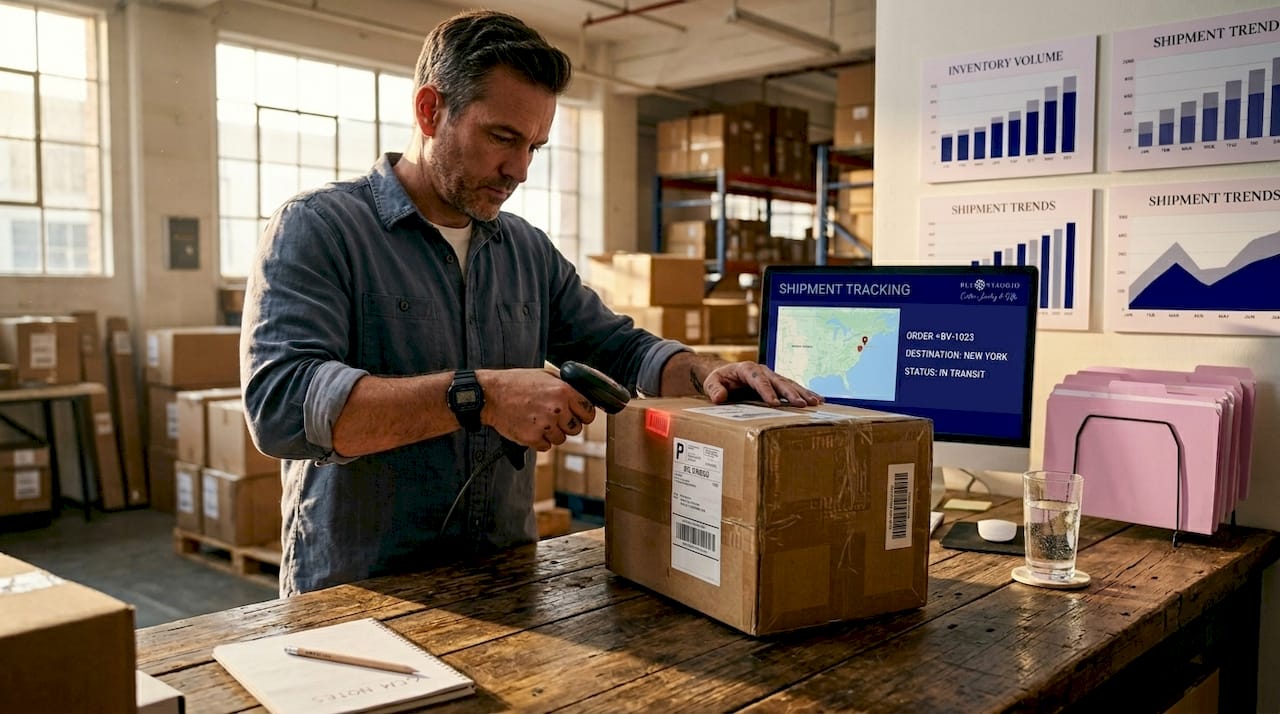
This is where “identity drift” becomes a real problem. If a stone is removed from its labeled parcel, mixed with others, or repackaged at any point, the origin document no longer reliably describes the specific stone you’re buying. Documentation can fail if not robustly connected to the physical stone, risking this kind of identity drift.
Here’s how a traceable supply chain should work:
- Extraction and registration: The stone is documented at the mine with origin details and assigned an identifier
- Physical marking: A laser inscription, micro-tracer, or spectral fingerprint is applied to the stone before it leaves the mine
- Digital record creation: A blockchain or secure database entry links the physical marker to provenance data
- Transfer verification: Every new owner in the chain verifies and updates the record, maintaining continuity
- Retail confirmation: The jeweler can demonstrate that the stone in your ring matches the origin record, not just the paperwork category
Pro Tip: When speaking with a jeweler, ask specifically: “How is the provenance documentation linked to the exact stone I’m purchasing?” If the answer is vague or relies entirely on paper certificates, that’s a sign to dig deeper. Our ethical gemstone provenance guide outlines the specific questions worth asking.
With these challenges in mind, let’s compare how provenance systems and certificates differ and complement each other.
Certificates vs. provenance systems: What ethical couples need to know
A GIA or AGS certificate is a grading report. It tells you a stone’s cut grade, color grade, clarity grade, and carat weight. What it does not tell you is where the stone came from, who mined it, or whether its extraction caused harm. That’s not a flaw in grading labs. It’s simply not what those reports are designed to do.
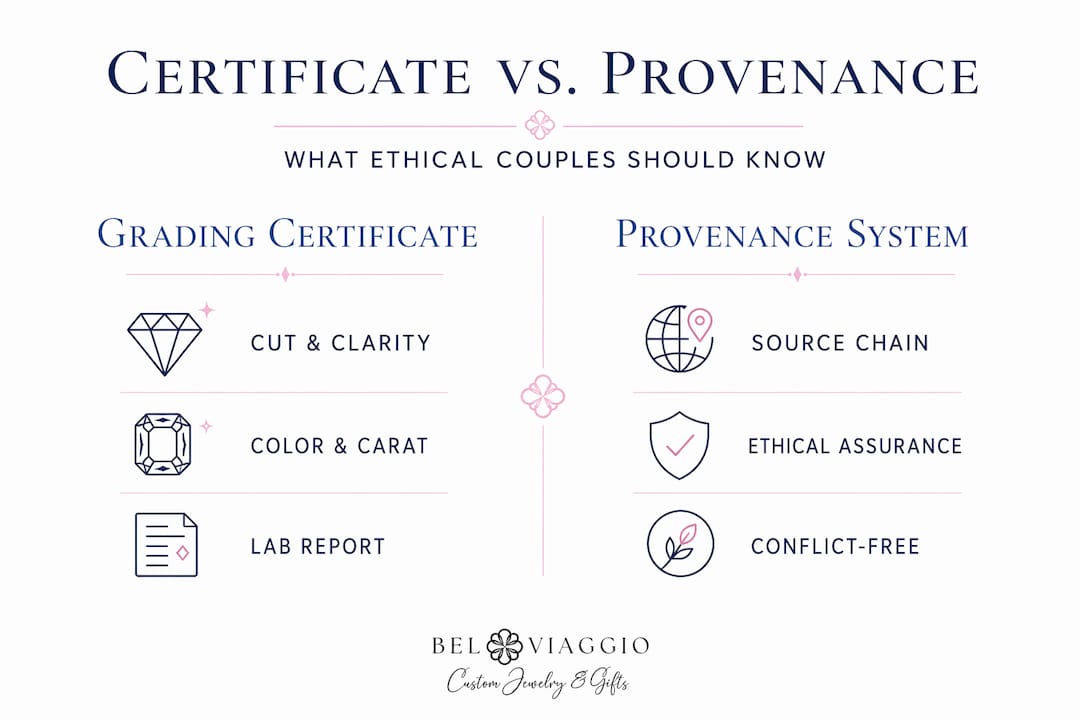
Provenance systems serve a completely different purpose. And as layered provenance becomes essential for ethical sourcing, conflict-risk assurance and gem-quality grading must work together rather than being treated as interchangeable.
| Feature | Grading certificate | Provenance system |
|---|---|---|
| Assesses quality (cut, color, clarity) | Yes | No |
| Confirms geographic origin | No | Yes |
| Verifies chain of custody | No | Yes |
| Flags conflict risk | No | Yes |
| Ties documentation to physical stone | Rarely | Yes (when done well) |
| Considers labor and environmental factors | No | Partially, varies by system |
The benefits of traceable gemstones go beyond ethics. A stone with verified provenance carries a story you can share. It holds a kind of authenticity that a generic certificate cannot provide. For couples designing personalized engagement rings, that story becomes part of what the ring means.
Key takeaways for ethical buyers:
- Always request both a grading certificate and provenance documentation
- Treat them as complementary, not substitutes for each other
- Ask which provenance system or standard your jeweler uses
- Understand that provenance verification varies widely in rigor
Our guide to ethical engagement rings explores how these factors play out when selecting specific stones and settings.
Now that you see the differences, we’ll cover practical steps to apply provenance knowledge when buying your engagement ring.
How to apply provenance knowledge when choosing ethically sourced engagement jewelry
Gemstone sourcing ethics can feel abstract until you’re sitting across from a jeweler and need to ask concrete questions. Here’s how to turn everything you’ve learned into a confident buying process.
-
Research your jeweler’s sourcing practices first. Before visiting or contacting a jeweler, look for clear published policies on ethical gemstone sourcing. Vague language like “we care about ethics” is not a sourcing policy. Look for named suppliers, certification systems, or specific country-of-origin disclosures.
-
Request stone-specific provenance documentation. Ask for records tied to the exact stone, not just a batch or parcel. The difference matters enormously. Technologies like blockchain registration and physical micro-tracers, referenced in systems like Provenance Proof, link your exact stone to chain-of-custody records.
-
Ask about due diligence procedures. A responsible jeweler should be able to explain how they vet their suppliers, what standards they require, and how they respond when a supplier can’t demonstrate compliance.
-
Consider origin risk in context. Not every high-risk country produces only unethical stones, but the burden of proof is higher. If a stone originates in a region with known conflict or labor concerns, ask what additional verification was done.
-
Prioritize transparency over polish. A jeweler who gives you a clear, honest answer about what they can and cannot verify is more trustworthy than one with a perfectly rehearsed story that falls apart under questions.
Pro Tip: Avoid vendors who respond to provenance questions by only offering standard grading certificates. That’s a signal they either don’t have the information or don’t understand the difference. Our ethical jewelry sourcing tips walk through what responsible retailers should be able to tell you.
With these practical tips, you’re equipped to choose ethically sourced jewelry confidently.
Why provenance verification is more than a trend — it’s your best safeguard
Here’s what doesn’t get said enough: provenance verification isn’t just about feeling good at the point of purchase. It’s about the long-term integrity of what you’re buying. A stone without verifiable provenance is, in a meaningful sense, anonymous. And anonymous objects don’t become heirlooms. They become just things.
The provenance verification process enhances the trustworthiness and future value of personalized engagement rings far beyond what marketing claims can offer. When a stone has a verified identity, a documented origin, and a clear history, it carries that forward. Generations from now, that ring tells a story that can actually be confirmed, not just assumed.
We’ve also seen something shift in how couples approach jewelry. Provenance used to be a concern for a small segment of buyers. It’s becoming a baseline expectation. Jewelers who can’t answer basic origin questions are increasingly being passed over, not because buyers are being difficult, but because transparency is now a reasonable standard.
The uncomfortable truth is that much of what passes as “ethical sourcing” in the jewelry industry still relies heavily on self-reporting and paper documentation without physical verification. That gap between claim and proof is where your due diligence matters most. You have real leverage here. When enough buyers demand verifiable, stone-specific provenance, the industry responds.
Browse ethical gemstone jewelry examples to see what verified provenance looks like in practice before you shop.
Find your ethically sourced engagement and wedding rings at Bel Viaggio Designs
You now understand why gemstone provenance matters and what to look for in an ethical jeweler. The next step is finding a ring that reflects both your values and your story.
At Bel Viaggio Designs, every piece is handcrafted with ethical sourcing at the center of the process. Whether you’re drawn to the striking depth of a black diamond engagement ring, the vivid color of a green emerald diamond ring, or the cool elegance of an aquamarine diamond engagement ring, each stone comes with transparent sourcing you can stand behind. Custom design options mean your ring can be as personal as the commitment it represents. Explore the collection and find the piece that’s worth keeping forever.
Frequently asked questions
What exactly does gemstone provenance mean?
Gemstone provenance is the documented history of a stone’s origin and every step of its supply chain journey, confirming ethical and sustainable sourcing. Traceability is becoming a structural requirement to verify gemstone origin and chain of custody at each stage.
Why is provenance important beyond getting a gemstone certificate?
Certificates grade quality but don’t verify ethical origin. Conflict-risk assurance and gem grading serve different purposes, so layered provenance is essential to confirm a stone’s actual sourcing story.
How can couples confirm their gemstone’s provenance?
Ask your jeweler for chain-of-custody records tied directly to the physical stone and look for sellers using verified traceability systems. Provenance-proof systems combine physical tracers and blockchain tracking to verify gemstone identity through the full supply chain.
Are all gemstones from Myanmar unethical?
Not automatically, but Myanmar rubies carry serious risks due to military involvement in mining and documented human rights violations, making heightened due diligence essential for any stone sourced from that region.
What should I ask my jeweler about provenance when buying an engagement ring?
Request origin details, ask how your exact stone is linked to its chain-of-custody records, and confirm whether traceability technology is used. Evidence linking the physical stone to provenance documentation is what separates a verified claim from a paper promise.
Recommended
- Ethical gemstone selection guide for engagement rings 2026 – Bel Viaggio Designs, LLC
- Ethical gemstone selection guide for engagement rings 2026 – Bel Viaggio Designs, LLC
- Top gemstone choices for ethical engagement rings 2026 – Bel Viaggio Designs, LLC
- Top gemstone choices for ethical engagement rings 2026 – Bel Viaggio Designs, LLC