

TL;DR:
- A 2 carat engagement ring ranges from $1,000 to over $45,000 depending on the diamond’s quality and the setting. Natural diamonds are significantly more expensive than lab-grown stones, with price differences driven by rarity and resale value, while both types are visually identical. Prioritizing cut quality, buying just below whole-carat increments, and comparing prices across retailers help maximize value in ring purchasing decisions.
A 2 carat engagement ring costs between $1,000 and over $45,000, depending on whether the center stone is natural or lab-grown and the quality of the diamond and setting. Natural 2 carat diamonds average around $17,673, while lab-grown equivalents typically run $1,000–$12,000. The setting adds another $1,000–$7,500 to the final price. Retailers like Tiffany & Co. charge a steep premium for brand prestige, while online retailers like Blue Nile offer certified stones at significantly lower markups. Understanding what drives the 2 carat engagement ring price puts you in control of every dollar you spend.
What factors determine the price of a 2 carat engagement ring?
The 4Cs — cut, color, clarity, and carat weight — are the industry standard framework for diamond pricing. Every certified diamond receives grades in all four categories, and each grade directly shifts the price up or down.
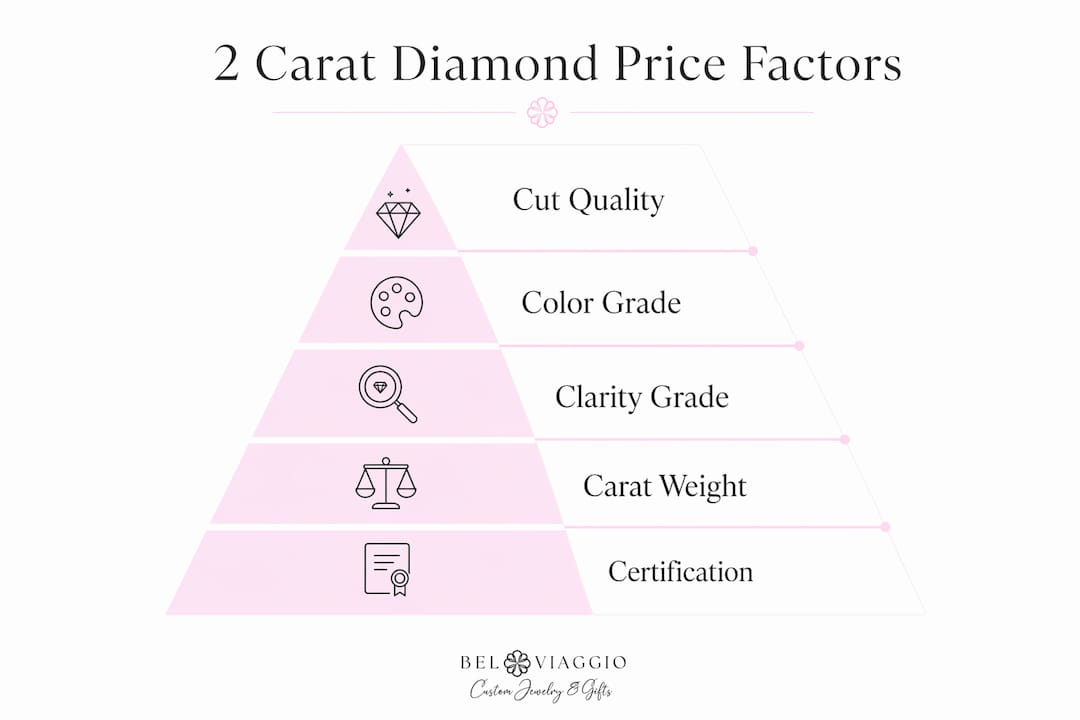
Cut is the most important factor for visual impact. A well-cut stone reflects light brilliantly, making it appear larger and more alive. Color grades run from D (colorless) to Z (visible yellow tint), with D–F stones commanding the highest prices. Clarity measures internal flaws called inclusions, graded from Flawless down to Included. Carat weight is the measure of the diamond’s mass, not its physical size, though heavier stones are generally larger.
How diamond shape affects the 2 carat ring cost range
Shape has a bigger impact on price than most buyers expect. Fancy shapes like oval, cushion, and emerald cut cost 15–30% less per carat than round brilliant stones. Round brilliants dominate demand and require more rough diamond material to cut, which drives their premium. Choosing an oval or cushion cut at 2 carats can save you thousands while delivering a stone that looks equally impressive on the hand.
How the setting adds to the total cost
Setting costs add $1,000–$7,500+ depending on metal type and design complexity. A simple 14K white gold solitaire starts around $2,300 total. A halo or pavé setting in platinum can push the final price past $7,500 for the setting alone. Metal choice matters too: platinum costs more than gold, and 18K gold costs more than 14K. Accent stones, engraving, and custom design work all add to the final bill.
Pro Tip: If you love the look of a halo setting but want to control costs, choose 14K gold over platinum. The visual difference is minimal, but the price difference can be $1,500 or more.
How do natural and lab-grown diamonds compare in cost?
The cost difference between natural and lab-grown 2 carat diamonds is substantial. Natural 2 carat diamonds range from $5,000 to $45,000, with a median around $16,370. Lab-grown stones of equivalent quality typically sell for $1,000–$5,000, with a popular sweet spot at $2,500–$5,500.
| Feature | Natural Diamond | Lab-Grown Diamond |
|---|---|---|
| Average 2 carat price | $16,370–$17,673 | $1,000–$5,500 |
| Chemical composition | Carbon crystal | Identical carbon crystal |
| Visual appearance | Identical to lab-grown | Identical to natural |
| Resale value | Moderate to strong | Significantly lower |
| Environmental impact | Mining required | Lower footprint |
| Certification | GIA, AGS | IGI, GCAL |
Lab-grown diamonds are chemically and physically identical to natural diamonds. The only meaningful differences are rarity and resale value. A gemologist cannot tell them apart without specialized equipment. This reality is reshaping the market in 2026, with more couples choosing lab-grown stones to allocate budget toward the setting, the wedding, or other life priorities.
Resale value is the one area where natural diamonds hold an edge. Lab-grown stones depreciate faster because supply is essentially unlimited. If you plan to hold the ring as a long-term asset, a natural diamond makes more financial sense. If the ring is purely a symbol of commitment with no investment intent, lab-grown delivers the same beauty at a fraction of the cost.
You can explore lab-grown diamond options at Belviaggiodesigns to see how quality and pricing compare across different carat weights and cuts.
Pro Tip: Ask your jeweler for an IGI or GCAL certificate when buying lab-grown. These labs specialize in grading lab-grown stones and provide the most accurate quality assessments.
What are the typical price tiers for a 2 carat diamond ring?
Pricing for 2 carat diamonds breaks into three clear quality tiers. Each tier reflects a different combination of cut, color, and clarity grades.
| Quality Tier | Natural Diamond Price | Lab-Grown Diamond Price | Typical Grades |
|---|---|---|---|
| Entry level | $5,000–$10,000 | $1,000–$2,500 | I–J color, SI2–I1 clarity |
| Mid-range | $12,000–$22,000 | $2,500–$5,000 | G–H color, VS2–SI1 clarity |
| Premium | $25,000–$45,000+ | $5,000–$12,000 | D–F color, VVS2–FL clarity |
Typical price brackets by quality tier show that entry-level natural stones start at $5,000 and premium stones exceed $45,000. This range reflects how dramatically grading affects value. An I-color, SI2-clarity stone and a D-color, Flawless stone are both “2 carat diamonds,” but they are priced worlds apart.
Retail markups also vary widely. Pricing for identical certified diamonds can vary by over $50,000 between retailers due to overhead and markup differences. Independent online retailers consistently offer better prices than high-street stores for the same GIA-certified stone. Comparing prices across at least three retailers before buying is not optional. It is the single most effective way to avoid overpaying.
Certification matters at every tier. A GIA or AGS certificate for natural diamonds, or an IGI certificate for lab-grown, guarantees the grades are independently verified. Uncertified stones are priced lower for a reason, and that reason is usually that the grades would not hold up to scrutiny.
What practical tips help you get the best value?
Getting the best value on a 2 carat ring requires a few specific strategies, not just general advice about “doing your research.”
-
Buy just under the carat threshold. A 1.95 carat stone is visually indistinguishable from a 2.00 carat stone but priced 10–15% lower. Diamond pricing jumps at whole-number carat weights because of psychological demand. Buying at 1.90 or 1.95 carats captures the look without paying the threshold premium.
-
Prioritize cut above all other grades. Excellent cut delivers more visual sparkle than moving from VS1 to VVS2 clarity. Clarity differences above SI1 are invisible to the naked eye on a 2 carat stone. Spending more on cut and less on clarity is the highest-return trade-off available.
-
Compare prices across multiple retailers. Online retailers typically carry lower overhead than brick-and-mortar stores. For the same GIA-certified round brilliant, you will often find a $2,000–$5,000 price gap between an independent online retailer and a mall jeweler.
-
Choose a fancy shape for size and savings. An oval or cushion cut at 2 carats looks larger than a round brilliant of the same weight because of how the shape distributes mass. You get a bigger-looking stone at a lower price per carat.
-
Factor in the full ring cost from the start. Many buyers budget for the diamond and forget the setting. A $10,000 diamond budget plus a $3,500 halo setting in 18K gold is a $13,500 ring. Build the setting cost into your total from day one.
Pro Tip: For natural diamonds, stick to GIA-certified stones. For lab-grown, IGI is the most widely trusted lab. Avoid stones with in-house or unrecognized certifications, regardless of how good the price looks.
Key takeaways
A 2 carat engagement ring costs $1,000–$45,000+, and the single biggest lever on that price is whether you choose a natural or lab-grown diamond.
| Point | Details |
|---|---|
| Price range is wide | Natural 2 carat rings run $5,000–$45,000+; lab-grown equivalents cost $1,000–$12,000. |
| Cut drives sparkle most | Prioritize excellent cut over high clarity grades, which are invisible to the naked eye. |
| Shape saves money | Oval, cushion, and emerald cuts cost 15–30% less than round brilliants at the same carat weight. |
| Buy below the threshold | A 1.95 carat stone looks identical to 2.00 carats but costs 10–15% less. |
| Compare retailers carefully | Identical certified diamonds can vary by over $50,000 between retailers due to markup differences. |
The honest truth about 2 carat ring pricing in 2026
I have spent years watching couples walk into this decision with a number in their head and walk out either overpaying or second-guessing themselves. The 2 carat engagement ring market is genuinely confusing, and that confusion is not accidental. Retailers benefit when buyers do not know the difference between a $12,000 mid-range stone and a $22,000 premium stone that looks nearly identical in a display case.
Here is what I have found actually matters: cut quality and certification. Every other variable is negotiable. A G-color, VS2-clarity, excellent-cut stone in a well-made 14K solitaire will outshine a D-color, VVS1 stone with a mediocre cut every single time. The sparkle comes from the cut. The prestige comes from the color and clarity grades. Most people in the room will only ever see the sparkle.
On the lab-grown question: I think the stigma is almost entirely gone in 2026. The couples I talk to are not choosing lab-grown because they cannot afford natural. They are choosing it because they want a bigger, better-cut stone for the same budget, or they care about where their diamond comes from. Both are completely valid reasons. The stone is real. The love is real. The only thing that is not real is the rarity premium, and that is a financial construct, not a measure of quality.
My honest advice: set a total ring budget, not just a diamond budget. Decide on natural versus lab-grown based on your values and your long-term plans for the ring. Then spend the majority of your diamond budget on cut quality and certification, and let everything else fall into place.
— Stacy
Find your perfect ring at Belviaggiodesigns
If you are ready to move from research to reality, Belviaggiodesigns offers handcrafted engagement rings built around your priorities, whether that means a bold center stone, an intricate setting, or an ethically sourced design that reflects your values.
The collection includes rings close to and above the 2 carat range, like the striking black diamond halo ring and the 2.95 ctw black diamond engagement ring, which shows exactly how setting design transforms a stone at this size. Every piece is made to order, with custom design options and payment plans available. Browse the full collection at Belviaggiodesigns to find the ring that fits both your vision and your budget.
FAQ
How much does a 2 carat diamond engagement ring cost on average?
A 2 carat natural diamond engagement ring averages around $17,673, though prices range from $5,000 to over $45,000 depending on cut, color, and clarity grades. Lab-grown 2 carat rings typically cost $1,000–$12,000 for the same visual quality.
Is a lab-grown 2 carat diamond as good as a natural one?
Yes. Lab-grown diamonds are chemically and physically identical to natural diamonds. The primary differences are resale value and the rarity premium, not quality or appearance.
What is the best way to save money on a 2 carat ring?
Buy at 1.90–1.95 carats instead of exactly 2.00 carats to save 10–15%, and prioritize an excellent cut grade over high clarity grades that are invisible to the naked eye.
Does the setting significantly affect the total ring price?
Setting costs add $1,000–$7,500+ to the total price. A simple solitaire in 14K gold starts around $2,300 total, while a platinum halo or pavé setting can exceed $7,500 for the setting alone.
Should i buy a 2 carat ring online or in a store?
Online retailers consistently offer lower prices for identical certified diamonds because of lower overhead. Pricing for the same stone can vary by over $50,000 between retailers, making price comparison across multiple sellers a critical step before purchasing.
Recommended
- Oval Blue Sapphire Engagement Ring Diamond Halo 2.9 CT – Bel Viaggio Designs, LLC
- Black Diamond Engagement Ring 2.95 ctw – Bel Viaggio Designs, LLC
- Black Diamond Engagement Ring Unique Engagement Ring 2.40 CT – Bel Viaggio Designs, LLC
- Black Diamond Engagement Ring 2.04 CTW – Bel Viaggio Designs, LLC