

Most people assume moissanite is just a cheap diamond knockoff. It isn’t. Discovered in 1893 by Nobel Prize-winning chemist Henri Moissan inside a meteorite crater in Arizona, moissanite is a genuine mineral with its own remarkable properties. Today, nearly all moissanite sold in jewelry is lab-created, making it one of the most ethical and accessible gemstones available. If you’re searching for an engagement or wedding ring that combines beauty, durability, and a clear conscience, this guide will walk you through everything you need to know about moissanite before you buy.
Table of Contents
- What is moissanite? Origins and properties
- Moissanite vs diamond: How do they compare?
- Why couples choose moissanite: Ethics, customization, and affordability
- What to know before buying moissanite jewelry
- Discover your perfect ethical engagement ring
- Frequently asked questions
Key Takeaways
| Point | Details |
|---|---|
| Meteorite origins | Moissanite was first discovered in a meteorite, making it a truly cosmic gemstone. |
| Diamond-like beauty | Moissanite closely resembles diamonds but offers more fire and a unique look. |
| Ethical and affordable | Moissanite is an ethical, budget-friendly alternative, perfect for couples seeking personalized rings. |
| Smart buying tips | Verify certification, compare designs, and prioritize reputable jewelers when choosing moissanite. |
What is moissanite? Origins and properties
Moissanite is not a diamond simulant in the traditional sense. It’s a distinct mineral with its own identity. Chemically, it is silicon carbide (SiC), a compound so rare in nature that virtually every moissanite gemstone you’ll find in a jewelry store was grown in a laboratory. That lab origin is actually a feature, not a flaw. It means consistent quality, zero mining impact, and a traceable supply chain.
What makes moissanite visually stunning is its optical performance. It has a refractive index between 2.65 and 2.69, which is higher than a diamond’s 2.42. In plain terms, moissanite bends light more aggressively, producing intense flashes of color known as “fire.” You can learn more about moissanite basics to understand how these properties translate into real-world sparkle.
Did you know? Moissanite’s thermal conductivity is so close to a diamond’s that it can actually fool standard diamond testers. Only specialized moissanite detectors or trained gemologists can reliably tell them apart.
Here’s a quick look at how moissanite’s core properties stack up:
| Property | Moissanite | Diamond |
|---|---|---|
| Hardness (Mohs scale) | 9.25 | 10 |
| Refractive index | 2.65 to 2.69 | 2.42 |
| Fire (dispersion) | 0.104 | 0.044 |
| Origin | Lab-created | Mined or lab-grown |
| Price per carat | Much lower | Much higher |
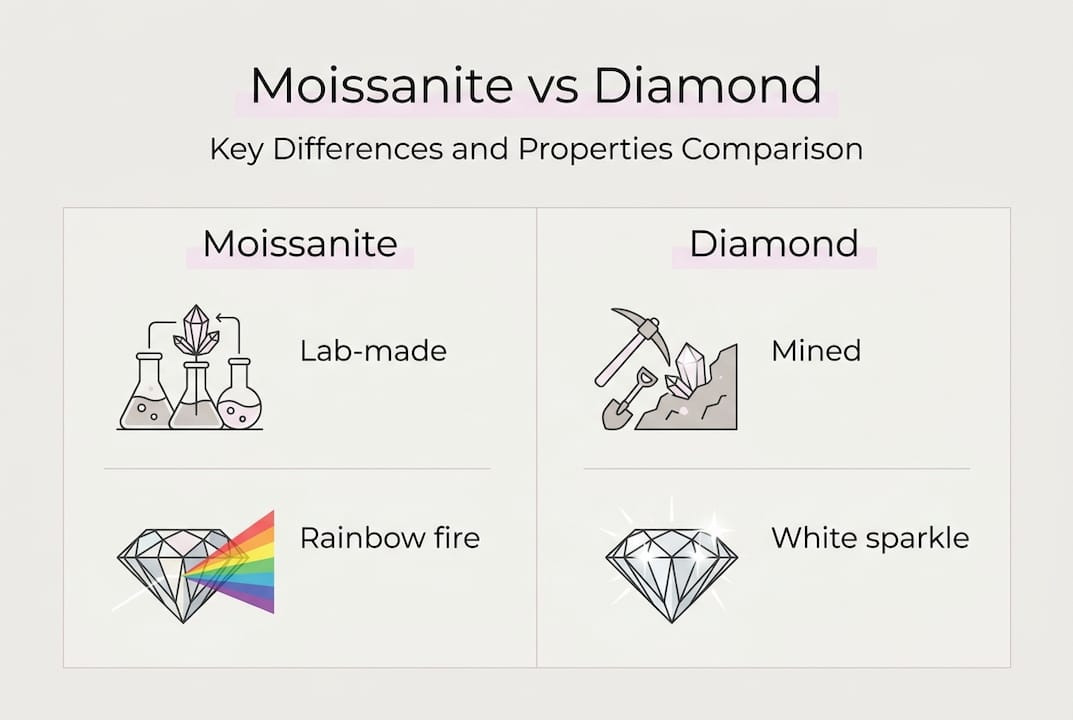
That fire rating of 0.104 is more than double a diamond’s. That’s the science behind the rainbow flashes moissanite is famous for.
Moissanite vs diamond: How do they compare?
With a science-backed understanding of moissanite, it’s time to see how it holds up against diamonds, the classic standard for engagement rings.
The most obvious difference is price. A one-carat diamond can cost anywhere from $4,000 to $10,000 or more depending on cut and clarity. A comparable moissanite stone typically runs $300 to $600. That’s a significant gap, and it opens up a lot of creative possibilities for your ring design.
Visually, the two stones are close but not identical. Moissanite shows more rainbow fire than a diamond, which produces a brighter, more colorful sparkle. Diamonds tend toward a whiter, icier brilliance. Neither is objectively better. It comes down to personal taste.
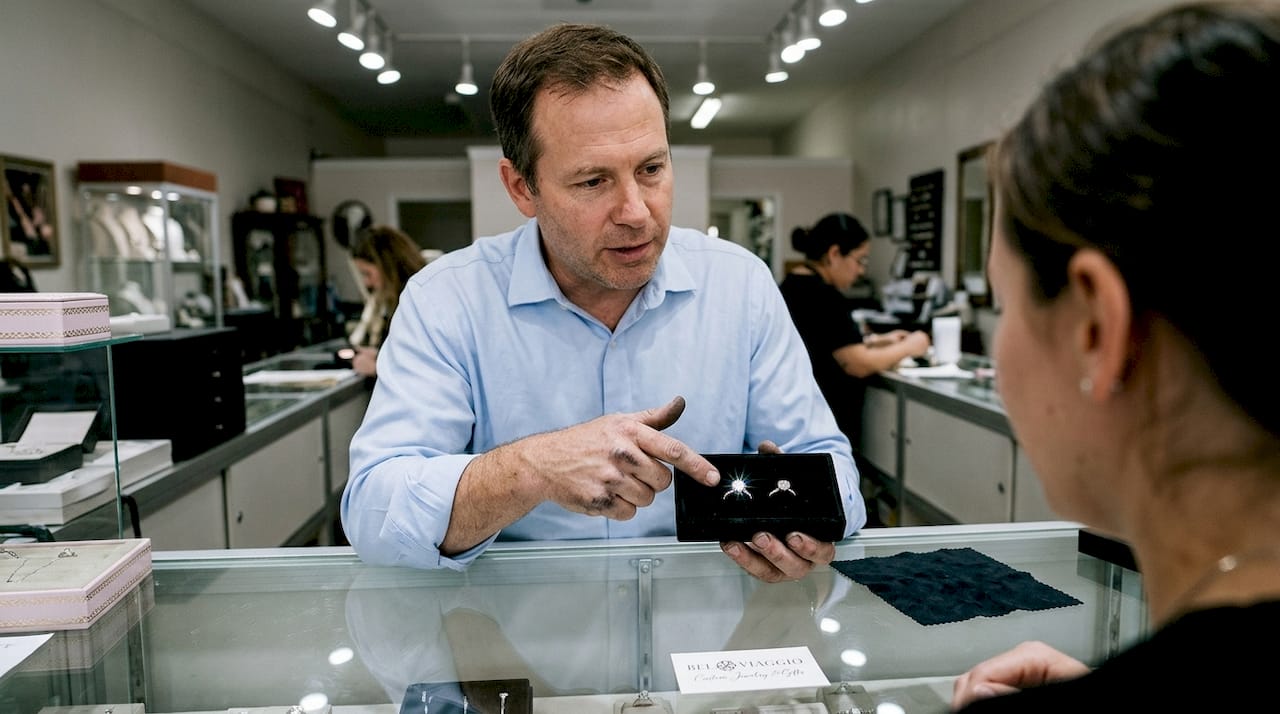
According to expert moissanite vs diamond analysis, some people find that in larger stones, moissanite’s fire can read as too colorful compared to a diamond’s classic white sparkle. If you prefer a more traditional look, consider a smaller center stone or a near-colorless moissanite grade.
Moissanite pros:
- Significantly lower cost
- Higher fire and brilliance
- Ethically sourced and lab-created
- Nearly as hard as diamond (9.25 on the Mohs scale)
- Eco-friendly production
Diamond pros:
- Classic, widely recognized sparkle
- Higher resale value
- Slightly harder (10 on the Mohs scale)
- Traditional cultural significance
For a deeper look at how these two stones appear side by side, explore moissanite vs diamond appearance to see real comparisons. And if budget is a priority, affordable moissanite rings can show you just how far your dollar goes.
Pro Tip: If you’re drawn to moissanite but worried about the colorful fire, choose a round brilliant cut in a smaller size. That cut maximizes white light return and minimizes the rainbow effect.
Why couples choose moissanite: Ethics, customization, and affordability
Having seen what makes moissanite both similar to and different from diamonds, let’s look at why this gem is so appealing for modern engagement and wedding jewelry.
The reasons couples are choosing moissanite go well beyond price. Here’s what drives the decision for most:
- Ethical sourcing: Lab-created moissanite has no connection to conflict mining or environmental destruction
- Eco-friendly production: Growing a gemstone in a lab uses a fraction of the resources required for mining
- Affordability: You can get a larger, more intricate ring for the same budget
- Personalization: Moissanite is available in virtually every shape and can be set in any style
- Durability: At 9.25 on the Mohs scale, it handles daily wear beautifully
One thing to be clear about upfront: moissanite does not hold resale value the way diamonds do. As noted in moissanite buying research, you should buy moissanite for personal enjoyment and meaning, not as a financial investment.
The right mindset: A moissanite ring is a symbol of your relationship, not a commodity. Its value lives in what it means to you, not what it fetches on the secondary market.
Customization is where moissanite really shines. Because the stones are lab-created and widely available in different shapes, including round, oval, cushion, pear, and emerald cuts, you have enormous freedom to design something truly personal. Explore ethical reasons for moissanite to understand why so many couples are making this choice, or read through custom moissanite ring tips to start planning your design.
If you’re still weighing your options, should you choose moissanite breaks down the decision in a straightforward way.
Pro Tip: Ask your jeweler about moissanite color grades. Near-colorless (G to I range equivalent) stones look stunning in white gold or platinum settings, while warmer grades pair beautifully with yellow or rose gold.
What to know before buying moissanite jewelry
If you’re considering making a moissanite ring part of your love story, here’s how to shop wisely and get lasting beauty.
Not all moissanite is created equal, and not all jewelers are equally transparent. Follow these five steps before you commit to a purchase:
- Confirm lab origin. Ask for documentation that confirms the stone is lab-created moissanite, not a different simulant like cubic zirconia. They are not the same stone.
- Request a grading report. For higher-priced pieces, ask for a third-party grading report that details color, clarity, and cut quality.
- Compare warranties. Quality moissanite should come with a manufacturer’s warranty covering the stone’s brilliance and structural integrity over time.
- Check setting durability. The metal setting matters as much as the stone. Prong settings should be sturdy enough to protect the stone during daily wear.
- Understand sizing and proportions. Moissanite is measured in millimeters, not carats. A 6.5mm moissanite is equivalent in size to a one-carat diamond but weighs slightly less.
Because moissanite’s thermal conductivity is so similar to a diamond’s, some unscrupulous sellers have been known to misrepresent moissanite as diamond or pass it off as a “diamond simulant” without full disclosure. Always buy from a jeweler who is upfront about what you’re purchasing.
Caring for your moissanite ring is simple. Warm water, a drop of dish soap, and a soft brush will restore its sparkle. Avoid ultrasonic cleaners if your ring has delicate side stones or intricate metalwork. For a full breakdown of what to look for before you buy, the moissanite ring buying guide covers every detail.
Pro Tip: Insist on third-party certification for any moissanite stone priced above $500. It protects your investment and gives you peace of mind about what you’re wearing.
Discover your perfect ethical engagement ring
Ready to find a ring that reflects your values and style? At Bel Viaggio Designs, every piece is handcrafted with ethical sourcing and personalized design at the core. Whether you’re drawn to moissanite’s brilliant fire or want to explore other stunning options, the collections are built for couples who want something meaningful.
Browse the gemstone ring collection to discover rings that go beyond the ordinary, from vibrant colored stones to classic designs with a modern twist. If you love the idea of a unique center stone, the aquamarine engagement rings are a breathtaking example of what’s possible when craftsmanship meets ethical design. You can also request a custom design consultation to create a ring that tells your specific story, your way.
Frequently asked questions
Is moissanite a real gemstone?
Yes, moissanite is a genuine mineral, silicon carbide, though nearly all gemstones sold today are lab-created because natural moissanite is extremely rare.
Will moissanite pass a diamond tester?
Moissanite can sometimes fool standard diamond testers because of its thermal conductivity, though specialized testers or trained gemologists can reliably distinguish the two.
Does moissanite lose its sparkle over time?
No, moissanite retains its brilliance with regular daily wear. A gentle cleaning with warm soapy water and a soft brush is all it takes to restore its original shine.
Is moissanite considered ethical?
Yes, because moissanite is lab-created, it carries no connection to conflict mining or environmental damage, making it a genuinely ethical and eco-friendly choice for couples.
Can moissanite be customized in jewelry designs?
Absolutely. Moissanite is available in a wide range of shapes, sizes, and cuts, and it can be set in virtually any custom design to match your personal style and vision.
Recommended
- Blog: “Will it Look Like a Diamond?" – Bel Viaggio Designs, LLC
- Affordable Moissanite Engagement Rings: Look Stunning for Less – Bel Viaggio Designs, LLC
- Affordable Moissanite Engagement Rings: Look Stunning for Less – Bel Viaggio Designs, LLC
- Why moissanite rings are a popular choice for ethical couples – Bel Viaggio Designs, LLC
- Lab-Created Diamonds: 85% Less Carbon & Ethical Luxury – Eternal Carat