

TL;DR:
- Fairtrade Gold is certified to originate from small-scale artisanal mines that meet strict social, environmental, and traceability standards, ensuring fair pay and safe working conditions. It includes a community premium and requires rigorous, audited proof of physical segregation from mine to jewelry, supporting community development and reducing environmental harm. Although more expensive, Fairtrade Gold offers verified ethical sourcing that benefits miners and their communities, unlike vague labels or recycled gold.
Fairtrade Gold is gold certified to come exclusively from artisanal and small-scale mining operations that meet strict social, environmental, and traceability standards, guaranteeing miners fair pay and safer working conditions. The formal industry term is Fairtrade Gold, governed by Fairtrade International, though you will also see it called ethical gold or responsibly sourced gold in retail settings. If you are shopping for an engagement ring or wedding band and want your purchase to reflect your values, understanding what separates certified Fairtrade Gold from a generic “responsibly sourced” label is the single most important thing you can do before buying.
What is fair trade gold and how does certification work?
Fairtrade Gold certification is a structured, audited system that tracks gold from a specific mine to the finished piece of jewelry. The certification is managed by Fairtrade International and applies only to artisanal and small-scale mining (ASM) operations, not large industrial mines. This distinction matters because ASM miners represent some of the most economically vulnerable workers in the global supply chain.
The certification process covers four interconnected pillars:
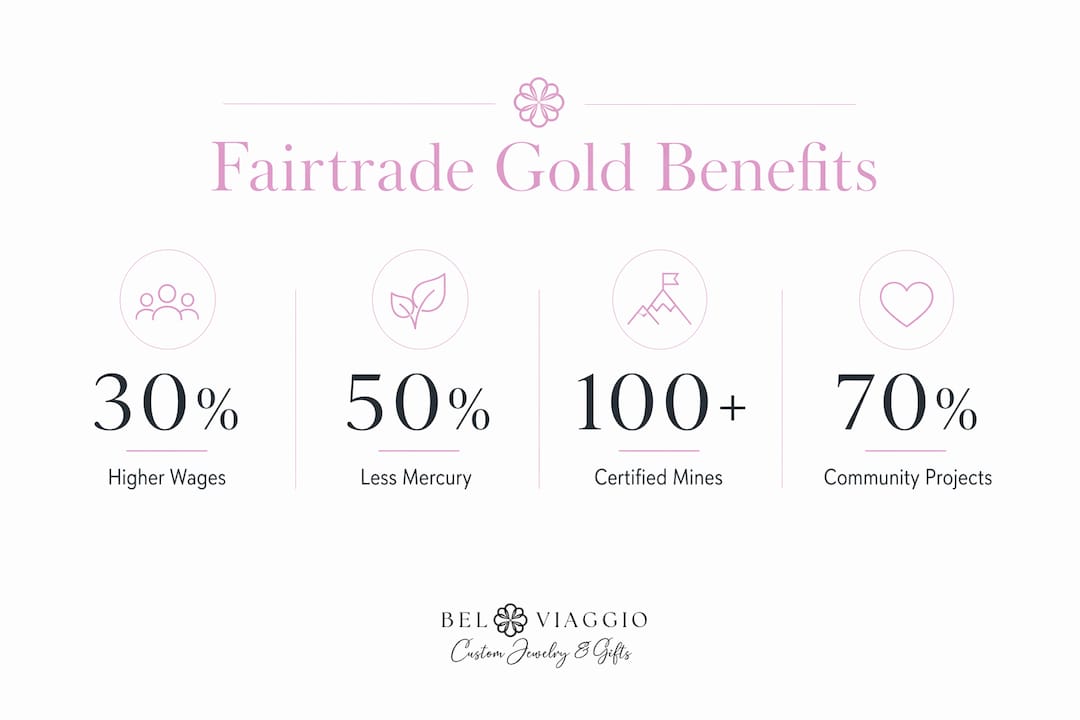
- Social standards. Certified mines must prohibit child labor and forced labor, pay fair wages, and provide safe working conditions. Workers have the right to organize, and no mine can receive certification while violating these baseline protections.
- Environmental standards. Mines must comply with environmental laws, reduce the use of toxic chemicals like mercury, and commit to land restoration after extraction. This directly addresses one of the most damaging aspects of unregulated small-scale mining.
- Fairtrade Minimum Price. Miners receive a guaranteed minimum price set at 95% of the London Bullion Market Association (LBMA) gold price. This protects miners from market volatility that would otherwise wipe out their income during price dips.
- Fairtrade Premium. On top of the minimum price, buyers pay an additional $2,000 per kilogram into a community fund. This premium is not a wage supplement. It is a separate, collectively managed fund directed toward community projects.
The chain of custody requirement is equally rigorous. Certified gold must be physically segregated at every stage, from the mine through the refinery to the jewelry workshop, so it never mixes with non-certified gold. Independent auditors verify compliance at each link in that chain. This is what separates Fairtrade Gold from vague marketing language like “ethically considered” or “responsibly sourced.”
Pro Tip: When shopping for fair trade jewelry, ask the jeweler for their Fairtrade International registration number. Registered partners can provide documented provenance, not just a label on a display case.

What are the social and environmental benefits of Fairtrade Gold?
The benefits of Fairtrade Gold extend well beyond the individual miner’s paycheck. The certification creates structural change at the community level, which is where its real power lies.
On the social side, the improvements are measurable and direct:
- Safer workplaces. Certified mines must meet occupational health standards, reducing injuries from unventilated tunnels, unstable shafts, and unprotected chemical exposure.
- Labor rights enforcement. The prohibition on child and forced labor is audited, not self-reported. This matters in a sector where about 20 million people work directly in artisanal mining globally, and oversight is historically weak.
- Community investment. Each certified mine elects a committee that democratically manages the Fairtrade Premium funds. Communities have directed these funds toward building schools, installing clean water systems, and funding health clinics. The decision stays with the miners, not with an outside NGO or corporation.
- Economic stability. The minimum price guarantee means mining families can plan ahead. That kind of income predictability is rare in the ASM sector, where spot price swings can cut earnings by a third overnight.
“The democratic management of Fairtrade Premium funds allows miners a strong voice in community investment priorities, enhancing sustainable development impact beyond just fair wages.” — Fairtrade International
On the environmental side, certified mines reduce mercury use, a chemical that contaminates rivers and causes neurological damage in communities downstream. Land restoration requirements mean that once a site is exhausted, it cannot simply be abandoned. The fair trade gold impact on ecosystems is not zero, but it is substantially lower than unregulated alternatives. With 100 million people globally depending on artisanal mining for their livelihoods, the scale of potential positive impact from widespread certification adoption is significant.
How does Fairtrade Gold compare to other ethical gold options?
Three labels dominate the ethical gold conversation: Fairtrade Gold, Fairmined, and recycled gold. Each has genuine merit, and each has real trade-offs.
| Feature | Fairtrade Gold | Fairmined | Recycled Gold |
|---|---|---|---|
| Certification body | Fairtrade International | Alliance for Responsible Mining (ARM) | No universal standard |
| Mining type | Artisanal and small-scale only | Artisanal and small-scale only | No new mining |
| Community premium | Yes, $2,000/kg fund | Yes, community development focus | No direct community support |
| Environmental focus | Mercury reduction, land restoration | Strict hazard elimination, mine practices | Avoids new extraction entirely |
| Traceability | Audited chain of custody | Audited chain of custody | Variable, often limited |
| Price premium | Yes | Yes | Lower, but no social benefit |
Fairtrade and Fairmined both target ASM operations, but their governance differs. Fairtrade emphasizes price stability and community-managed development funds. Fairmined places heavier emphasis on eliminating hazardous mining practices at the technical level. Neither is objectively superior. They address different weaknesses in the same broken system.
Recycled gold is the most common “ethical” option sold in mainstream jewelry retail. It avoids new extraction, which reduces environmental pressure from mining. However, recycled gold provides no direct financial or social support to mining communities. Choosing recycled gold does not help a miner in Colombia or Peru earn a living wage or send their child to school. It simply avoids adding to the problem.
The critical issue with all ethical gold labeling is verification. Genuine Fairtrade Gold requires physical separation and audited traceability throughout the supply chain. A jeweler who says their gold is “ethically sourced” without naming a specific certification framework is making a claim that cannot be independently verified.
Pro Tip: Ask specifically whether a piece carries Fairtrade International or Alliance for Responsible Mining certification. Generic terms like “conflict-free” or “responsibly mined” have no standardized definition and no third-party audit requirement.
Why is Fairtrade Gold more expensive, and what does that mean for buyers?
The price premium on Fairtrade Gold is real, and it is structural. The mandatory $2,000 per kilogram premium above market price is built into every certified transaction. That cost travels up the supply chain and lands, in part, on the consumer. For a wedding band or engagement ring, the difference in material cost is typically modest relative to the total piece price, but it exists.
Several factors drive the higher cost beyond the premium itself:
- Certification and audit fees. Mines, refineries, and jewelers all pay for independent audits to maintain certification. Those costs are passed along.
- Limited supply. Fairtrade Gold represents a small fraction of global gold production. Scarcity keeps prices elevated and limits how much inventory certified jewelers can stock.
- Logistical complexity. Maintaining a segregated chain of custody from mine to finished ring requires more documentation, more handling care, and more administrative overhead than conventional gold sourcing.
- Jeweler registration. Not every jeweler is a registered Fairtrade partner. Many jewelers stock limited amounts due to these complexities, which means consumers often need to seek out specific retailers rather than finding certified pieces at any store.
What does this mean for you as a buyer? The premium you pay is not profit padding. It funds clean water access, school construction, and health care in mining communities. For couples who want their rings to carry genuine meaning, that context transforms the price difference from a cost into a contribution. You can learn more about ethical gold mining practices to understand how certification translates into real-world sourcing decisions at the retail level.
When verifying a purchase, request explicit documentation rather than relying on in-store signage. Ask the jeweler whether they are registered with Fairtrade International and whether they can provide a certificate of provenance for the specific piece. A legitimate certified jeweler will have this paperwork ready.
Key takeaways
Fairtrade Gold is the only gold certification that combines audited traceability, a guaranteed minimum price, and a mandatory community development premium paid directly to mining communities.
| Point | Details |
|---|---|
| Certification scope | Fairtrade Gold applies only to artisanal and small-scale mines with audited social and environmental standards. |
| Community premium | A mandatory $2,000/kg premium funds democratically managed community projects like schools and clean water. |
| Traceability requirement | Certified gold is physically segregated from mine to finished jewelry, verified by independent auditors. |
| Comparison to recycled gold | Recycled gold avoids new extraction but provides no direct financial support to mining communities. |
| Buyer verification | Request Fairtrade International registration and provenance documentation, not just generic ethical claims. |
Why I think the “ethical gold” conversation is still missing the point
The jewelry industry has made real progress on ethical sourcing language. Nearly every major retailer now uses phrases like “responsibly sourced” or “conflict-free.” But after years of watching how these claims are made and verified, I think most of that language is doing more to reassure buyers than to protect miners.
Here is what I have found to be true: the difference between a certified Fairtrade piece and a piece marketed with vague ethical language is not a matter of degree. It is a matter of whether any independent verification happened at all. Certification frameworks like Fairtrade International and the Alliance for Responsible Mining require audits, documentation, and physical chain-of-custody controls. A store display that says “ethically considered” requires nothing.
The consumer’s role in this is more powerful than most people realize. When buyers start asking specific questions, specifically which certification, which mine, which auditor, jewelers respond. I have seen retailers shift their sourcing practices not because of regulation but because enough customers asked the right questions. That is not idealism. That is how retail supply chains actually change.
The future of ethical gold sourcing depends on whether consumers treat certification as a minimum standard rather than a premium feature. Fairtrade Gold is not perfect. The supply is limited, the logistics are complex, and not every miner in every country has access to certification programs yet. But it is the most documented, most independently verified option available to jewelry buyers today. Choosing it, and asking for proof of it, is the most direct way to connect your purchase to a real outcome for a real person.
— Stacy
Ethical gold jewelry crafted with purpose at Belviaggiodesigns

Belviaggiodesigns builds every piece around the belief that a ring should be as meaningful in its making as it is in the moment you give it. The team sources gold with documented provenance and works with customers who want to know exactly where their metal comes from. Whether you are looking for a 7mm comfort fit wedding band or an 8mm gold band with a clean, classic profile, each piece is handcrafted to order with ethical sourcing at the center of the process. Browse the collection and ask about certification details directly. The team is ready to walk you through provenance documentation so your purchase reflects exactly what you stand for. For couples planning their wedding jewelry, the guide on ethically sourcing wedding jewelry is a strong starting point.
FAQ
What is fair trade gold in simple terms?
Fairtrade Gold is gold mined by certified artisanal and small-scale operations that meet strict standards for fair pay, safe working conditions, and environmental responsibility. Buyers pay a premium that funds community development projects managed by the miners themselves.
How is Fairtrade Gold different from recycled gold?
Recycled gold avoids new mining but provides no direct financial support to mining communities, while Fairtrade Gold delivers a mandatory $2,000 per kilogram community premium and enforces labor and environmental standards at the source.
How can I verify that gold is genuinely Fairtrade certified?
Ask the jeweler for their Fairtrade International registration number and a certificate of provenance for the specific piece. Certified jewelers maintain audited documentation rather than relying on generic sustainability signage.
Is Fairtrade Gold the same as Fairmined gold?
No. Both certifications cover artisanal and small-scale mining, but Fairtrade International emphasizes price stability and community-managed development funds, while the Alliance for Responsible Mining’s Fairmined standard focuses more heavily on eliminating hazardous mining practices at the technical level.
Why does fair trade gold cost more?
The price reflects a mandatory community premium, certification and audit fees, limited supply, and the logistical complexity of maintaining a segregated chain of custody from mine to finished jewelry. That cost funds real community outcomes, not margin.
Recommended
- Ethical Gold Mining Explained for Responsible Jewelry Choices – Bel Viaggio Designs, LLC
- How to ethically source jewelry for your wedding – Bel Viaggio Designs, LLC
- Ethical gemstone selection guide for engagement rings 2026 – Bel Viaggio Designs, LLC
- What Is Fair Trade Jewelry? A Guide for Ethical Couples – Bel Viaggio Designs, LLC