

TL;DR:
- The 4Cs—Cut, Color, Clarity, and Carat—are essential for evaluating diamond quality and value.
- Prioritizing cut quality significantly enhances a diamond’s sparkle, often more than size or color.
- Certified stones from reputable labs ensure ethical sourcing and accurate quality assessments.
Most couples shopping for engagement rings walk in believing the biggest diamond wins. It’s an understandable assumption, but it’s also one of the most expensive misconceptions in fine jewelry. The real story is more nuanced and, honestly, more exciting. A diamond’s beauty, value, and ethical standing depend on four measurable qualities: Cut, Color, Clarity, and Carat. Master these four factors and you’ll make a smarter purchase, avoid common pitfalls, and find a stone that genuinely dazzles, whether it’s a natural diamond or a lab-grown alternative. Let’s break it all down.
Table of Contents
- What are the 4Cs of diamonds?
- Cut: The brilliance factor
- Color: Understanding diamond shades
- Clarity and carat: Balancing visibility and size
- Our perspective: Buying diamonds with real-world wisdom
- Find your ideal diamond or gemstone ring
- Frequently asked questions
Key Takeaways
| Point | Details |
|---|---|
| 4Cs framework essentials | Understanding Cut, Color, Clarity, and Carat helps buyers maximize beauty and value. |
| Cut is paramount | Prioritizing cut delivers the most sparkle—it’s the key to diamond brilliance. |
| Balance for best value | Mix near-colorless and mid-clarity grades to find affordable, gorgeous diamonds. |
| Ethical buying matters | Seek GIA certification and consider lab-grown diamonds for responsible, ethical purchases. |
| Certification is non-negotiable | Trust only diamonds graded by reputable labs like GIA or AGS to ensure authenticity and quality. |
What are the 4Cs of diamonds?
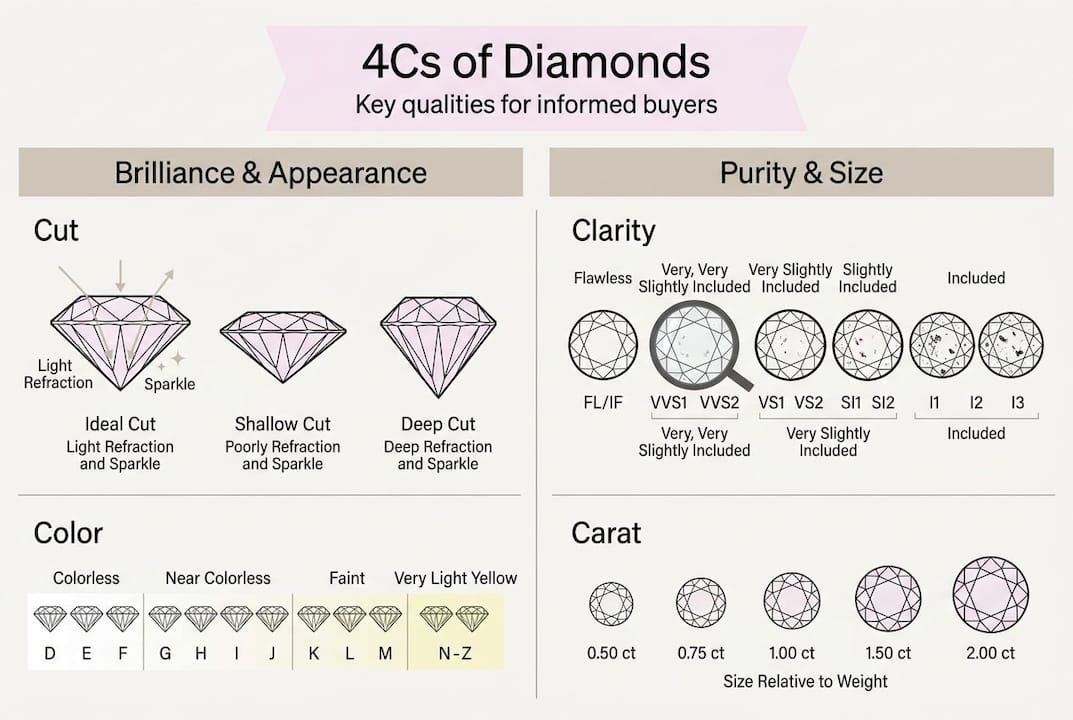
The 4Cs give buyers a shared language for evaluating diamonds, no matter where they shop. The 4Cs standardized system was created by the Gemological Institute of America (GIA) in the 1940s to evaluate diamond quality objectively, covering Cut, Color, Clarity, and Carat weight. Before this system existed, comparing diamonds was largely subjective and ripe for manipulation. Today, any reputable jeweler, lab, or retailer uses this same framework.
Here’s a quick overview of what each C covers:
- Cut: How well a diamond’s facets interact with light. Determines sparkle.
- Color: The presence or absence of yellow or brown tones. Graded D through Z.
- Clarity: The number and visibility of internal flaws (inclusions) and surface blemishes.
- Carat: The weight of the diamond. One carat equals 0.2 grams.
Each C affects the diamond’s appearance and price in a different way, and they interact with each other. A high-carat stone with poor cut and low clarity can look duller than a smaller, well-cut stone. That’s the core insight most buyers miss.
Why certification matters
Not all diamonds are graded equally. GIA and the American Gem Society (AGS) are the two most trusted grading labs. GIA uses at least two independent graders per diamond and evaluates all 4Cs plus fluorescence and any treatments. AGS uses a 0 to 10 scale, with 0 being the top grade. A certified diamond gives you an objective, third-party evaluation, which protects you from overpaying and ensures ethical accountability.
| Grading lab | Scale used | Known for |
|---|---|---|
| GIA | Descriptive (Excellent to Poor) | Industry gold standard |
| AGS | Numeric (0 to 10) | Precise light performance data |
| IGI | Descriptive | Popular for lab-grown diamonds |
Certification also connects to ethical sourcing. When you buy a certified stone, you have documented proof of its origin and quality. For couples who care about where their diamond comes from, pairing certification with an ethical gemstone guide can make the process feel much more aligned with your values.
Cut: The brilliance factor
If you could only focus on one C, make it cut. This is the single factor most responsible for how much a diamond sparkles, and it’s the one buyers most often sacrifice to get a bigger stone.
GIA cut grading evaluates round brilliant diamonds on proportions, symmetry, polish, and light performance, including brightness, fire, and scintillation. The grades run from Excellent to Very Good, Good, Fair, and Poor. An Excellent cut diamond reflects almost all light back through the top of the stone. A Poor cut lets light leak out the sides and bottom, leaving the diamond looking flat and lifeless.
Here’s how cut grades translate in real life:
| Cut grade | Light performance | Visual impact |
|---|---|---|
| Excellent | Maximum brilliance | Stunning sparkle |
| Very Good | Near-maximum | Slightly less fire |
| Good | Moderate | Noticeably dimmer |
| Fair/Poor | Significant light loss | Dull, lifeless appearance |
Three elements work together to produce a great cut:
- Proportions: The angles and ratios of each facet relative to the others.
- Symmetry: How precisely the facets align and mirror each other.
- Polish: The smoothness of each facet surface, which affects how cleanly light enters and exits.
A common mistake couples make is choosing a larger carat weight and dropping from Excellent to Good cut to stay on budget. The result is a bigger stone that looks smaller because it doesn’t reflect light well. A well-cut stone always looks more impressive face-up than its measurements suggest.
“Even a high-color, high-clarity diamond will be dull if the cut is poor.” This is the most important thing to understand before you start shopping.
Pro Tip: If you’re considering a fancy shape like an oval or cushion, ask for light performance data since GIA only assigns cut grades to round brilliants. For a striking example of how cut affects a finished ring, look at how the black diamond cut grade shapes the overall visual drama of the stone.
Color: Understanding diamond shades
Diamond color is one of the most misunderstood factors in buying. Most people assume colorless is always best. In practice, the difference between a D and a G is nearly invisible to the naked eye, but the price gap is significant.
IGI color grading runs from D (colorless) to Z (light yellow or brown). D through F are the rarest and most valuable. G through J are near-colorless and offer excellent value. The grading happens face-down under controlled lighting conditions, which means the subtle tint that separates a D from an F is essentially undetectable once the diamond is set in a ring and worn in everyday light.
Here’s how to think about color practically:
- D to F: True colorless. Worth it if you’re setting in platinum or white gold and want the purest look.
- G to J: Near-colorless. Virtually indistinguishable from D-F in most settings. Best value tier.
- K to M: Faint yellow. Can be beautiful in yellow or rose gold settings where the warmth complements the metal.
- N to Z: Noticeable color. Rarely used in engagement rings unless the buyer specifically wants a warm tone.
Pro Tip: If you’re choosing a yellow gold setting, you can comfortably go as low as J or even K in color. The gold itself adds warmth, so the slight tint in the diamond becomes invisible and you save significantly on price.
Color also connects to ethical considerations. Some diamond color treatments, like irradiation or high-pressure high-temperature (HPHT) processing, can artificially alter a stone’s grade. Always ask for a certificate that discloses any treatments. For more on how sourcing intersects with color grading, our diamond color ethics resource covers the key questions to ask your jeweler. You can also explore our clarity guide to understand how color and clarity interact when building your ideal stone.
Clarity and carat: Balancing visibility and size
Clarity and carat are often the two factors buyers fixate on, and they’re also the two most likely to be misunderstood when it comes to real-world impact.

Clarity explained
Clarity measures the presence of inclusions (internal flaws) and blemishes (surface imperfections). The GIA clarity scale runs from Flawless (FL) at the top down through VVS1, VVS2, VS1, VS2, SI1, SI2, and finally Included (I1, I2, I3). For most buyers, the sweet spot is VS2 to SI1. These grades are considered “eye-clean,” meaning you won’t see inclusions without magnification, but you pay far less than for VVS or Flawless stones. Explore more in our diamond clarity explained resource.
Key clarity considerations:
- Always ask to see the diamond in person or request a high-resolution image before buying online.
- Check where inclusions are located. A small inclusion near the edge is much less visible than one under the table (the flat top facet).
- Avoid I1 and below for engagement rings since inclusions at this level can affect durability.
Carat and what it actually means
Carat measures weight, with one carat equal to 0.2 grams. Price jumps sharply at “magic sizes” like 0.50 ct and 1.00 ct because demand spikes at these round numbers. A 0.95 ct diamond can look identical to a 1.00 ct stone but cost noticeably less. The same carat weight can also look very different depending on cut. A well-cut 0.90 ct diamond often appears larger face-up than a poorly cut 1.10 ct stone.
Additional carat considerations:
- Lab-grown diamonds offer the same carat weight and clarity grades as natural stones but at a lower price point, making it easier to prioritize cut and color without stretching your budget. See our lab grown diamond options for current selections.
- Certification is essential for carat accuracy. The GIA grading methodology uses at least two independent graders per diamond and assesses all 4Cs plus fluorescence and treatments, ensuring the weight you’re told is the weight you’re getting.
Our perspective: Buying diamonds with real-world wisdom
Here’s something most diamond articles won’t tell you: chasing perfect grades across all four Cs is a trap. We’ve worked with enough couples to know that an Internally Flawless, D-color, Excellent-cut, 2-carat diamond sounds incredible on paper, but it’s rarely what makes a ring meaningful or even visually superior to a thoughtfully balanced stone.
The couples who end up happiest are the ones who prioritize cut above everything else, settle comfortably into the G-to-J color range, choose VS2 or SI1 clarity, and then use the savings to invest in a setting that truly reflects their style. That’s real-world wisdom.
Certification is non-negotiable for us, both for quality assurance and for ethics. A GIA or AGS certificate means you know exactly what you’re buying. And if ethics matter to you, which they should, lab grown diamond facts show that lab-grown stones offer the same physical and optical properties as mined diamonds with a significantly smaller environmental footprint. The smartest diamond purchase isn’t the most expensive one. It’s the most informed one.
Find your ideal diamond or gemstone ring
Now that you understand how Cut, Color, Clarity, and Carat work together, you’re ready to shop with confidence instead of guesswork.

At Bel Viaggio Designs, every ring in our collection is handcrafted with balanced 4Cs and ethical sourcing at the forefront. Whether you’re drawn to a dramatic black diamond halo setting or prefer the vibrant beauty of colored stones, our gemstone ring alternatives offer stunning options beyond traditional white diamonds. Every piece comes with expert guidance to help you find the right balance of quality, ethics, and personal style. Shop engagement rings and discover a ring as unique as your story.
Frequently asked questions
Why is diamond cut considered most important?
Cut determines brilliance by controlling how light travels through the stone, making it the single biggest factor in perceived beauty. A poor cut dulls even the highest-color, highest-clarity diamond.
How do color and clarity affect diamond pricing?
Higher color grades like D through F and top clarity grades like IF through VVS2 raise the price significantly, but near-colorless grades like G through J and VS2 to SI1 clarity offer exceptional beauty at far better value.
What does ‘carat’ really mean for diamond size?
Carat is a measure of weight, not diameter. A well-cut diamond can appear larger face-up than a heavier stone with poor proportions, which is why cut always takes priority over chasing maximum carat weight.
How do I buy an ethical diamond?
Look for GIA-certified stones and ask about treatment disclosures. Lab-grown diamonds and stones verified through the Kimberley Process are strong options for buyers who prioritize responsible sourcing.
Are lab-grown diamonds a good option for engagement rings?
Absolutely. Lab-grown diamonds are physically and chemically identical to mined diamonds, offer lower prices, and carry a much smaller environmental impact, making them an increasingly popular and confident choice for modern couples.
Recommended
- Ethical gemstone selection guide for engagement rings 2026 – Bel Viaggio Designs, LLC
- Ethical gemstone selection guide for engagement rings 2026 – Bel Viaggio Designs, LLC
- Types of engagement rings: ethical, personalized choices – Bel Viaggio Designs, LLC
- Top gemstone choices for ethical engagement rings 2026 – Bel Viaggio Designs, LLC
- Chandelier crystals: 40% more sparkle with quality cuts – CrystalPlace
- Eco Aware Wrapping: Defining Sustainable Luxury – Nicholas & Rose Limited