

You want a ring that tells your story, reflects your values, and looks like nothing else out there. But the moment you start researching custom jewelry, the process can feel overwhelming. How do design approvals work? What makes a stone truly ethical? How long will it all take? These are real questions, and they deserve real answers. This guide walks you through every stage of creating a custom ring, from your first inspiration board to the moment it slides onto your finger, with a focus on ethical sourcing and the kind of craftsmanship that lasts a lifetime.
Table of Contents
- Preparing for your custom ring journey
- Step-by-step: The custom ring creation process
- Choosing ethical and sustainable materials
- Fitting and finishing: Ensuring perfection
- Common mistakes, edge cases, and expert tips
- Our perspective: What most guides miss about custom ring creation
- Explore your custom ring options
- Frequently asked questions
Key Takeaways
| Point | Details |
|---|---|
| Preparation is key | A successful custom ring starts with shared vision, clear priorities, and ethical sourcing goals. |
| Follow expert steps | From consultation to delivery, knowing the six main creation steps avoids confusion and costly errors. |
| Choose ethical materials | Select certified conflict-free stones and recycled metals for beauty aligned with your values. |
| Be aware of pitfalls | Understand edge cases like resizing limits and heirloom stones to prevent surprises. |
| Trust the process | Collaboration with a skilled jeweler makes custom luxury possible and rewarding. |
Preparing for your custom ring journey
The best custom ring projects start long before you ever walk into a consultation. They start with honest conversations between partners about what you both want and, just as importantly, what you value.
Start by aligning on a few key priorities:
- Style direction: Classic solitaire, vintage-inspired, modern geometric, nature-motif
- Ethical priorities: Lab-grown stones, recycled metals, certified sourcing
- Lifestyle needs: Active hands need lower-profile settings; softer stones scratch more easily
- Budget range: Know your floor and ceiling before the first meeting
- Wedding band compatibility: Will the engagement ring sit flush with a band?
The initial consultation is where vision, style, budget, and inspiration all come together, so arriving prepared makes a real difference. Bring reference photos, a clear budget range, and a short list of non-negotiables. Your jeweler’s job is to translate your ideas into something buildable, but they can only do that well if you give them something to work with.
Exploring ethical custom jewelry ideas before your consultation helps you articulate what responsible sourcing means to you personally. Some couples prioritize lab-grown diamonds; others want recycled gold or a specific gemstone with full traceability.
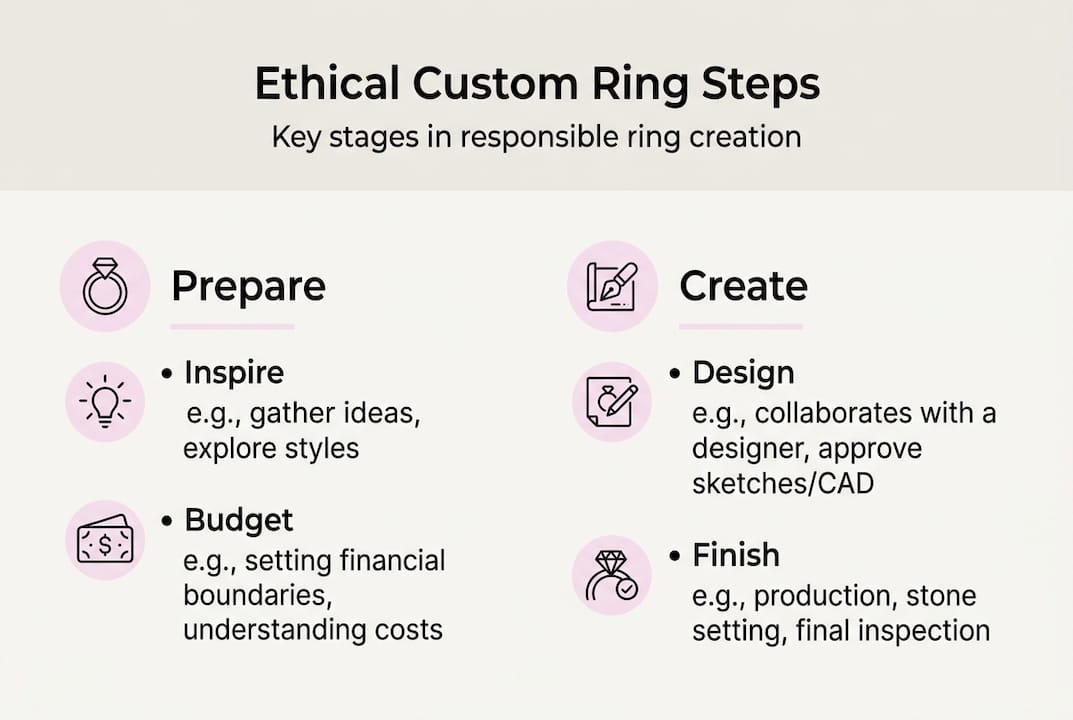
| Preparation item | Why it matters |
|---|---|
| Inspiration photos | Helps jeweler understand your aesthetic |
| Budget range | Guides stone size, metal, and complexity |
| Lifestyle notes | Influences setting height and stone hardness |
| Band compatibility | Avoids redesign costs later |
For a deeper look at why going custom is worth the extra planning, the custom ring benefits are well worth reviewing before your first meeting. You can also find an in-depth process guide that covers the full journey from concept to completion.
Pro Tip: Trust your jeweler to tell you what’s feasible, but come in with strong ideas. A prepared client gets a better ring.
Step-by-step: The custom ring creation process
With your prep work done, it’s time to navigate each creation stage. The standard process involves 6 to 7 key steps: consultation, deposit and stone selection, CAD design approval, production, quality control, and delivery. Here’s what each stage actually looks like:
- Initial consultation: Share your vision, lifestyle, and budget. Your jeweler assesses feasibility.
- Design deposit: Secures your spot in the production queue and funds the design phase.
- Stone sourcing: Your jeweler presents options based on your ethical preferences and budget.
- CAD rendering: A computer-generated 3D model shows you the ring from every angle.
- Wax or resin model: A physical prototype lets you feel the proportions before metal is poured.
- Lost-wax casting: Molten metal fills the mold. Hand-finishing and polishing follow.
- Quality check and delivery: Final inspection, appraisal, and secure shipping or pickup.
Understanding why go custom helps you appreciate why each step exists. Every approval point protects you from expensive surprises. When reviewing your CAD, look at the prong placement, stone proportions, and band thickness, not just the overall shape.
| Type | Process length | Flexibility | Price range |
|---|---|---|---|
| Bespoke custom | 6 to 10 weeks | Fully unlimited | Higher |
| Semi-custom | 3 to 5 weeks | Limited options | Mid-range |
| Ready-made | Immediate | None | Lower |
The design deposit details at Bel Viaggio outline exactly what’s included in each phase so there are no surprises.
Pro Tip: Ask to see a wax or resin model before approving casting. Changing a detail at that stage costs far less than altering finished metalwork.
Choosing ethical and sustainable materials
With the process steps mapped out, material choice is where your values shine through. Ethical sourcing isn’t just a marketing phrase. It means knowing where your stone came from, who mined it, and whether fair labor practices were followed at every point in the chain.
Here’s what to look for and ask about:
- Conflict-free certification: Ask for a Kimberley Process certificate for mined diamonds
- RJC membership: The Responsible Jewellery Council sets rigorous standards; brands like Cartier hold this certification
- GIA grading report: Confirms a stone’s quality and origin documentation
- Lab-grown diamonds: Chemically identical to mined stones, with full traceability and a lower environmental footprint
- Recycled metals: Reclaimed gold and platinum reduce the need for new mining
- Gemstone alternatives: Sapphires, emeralds, and moissanite each have their own sourcing profiles
Luxury brands invest heavily in traceability because consumers increasingly demand it. Tiffany now shares the entire diamond journey with buyers, and Cartier holds RJC certification across its supply chain. That level of transparency is now something independent jewelers can and should match.
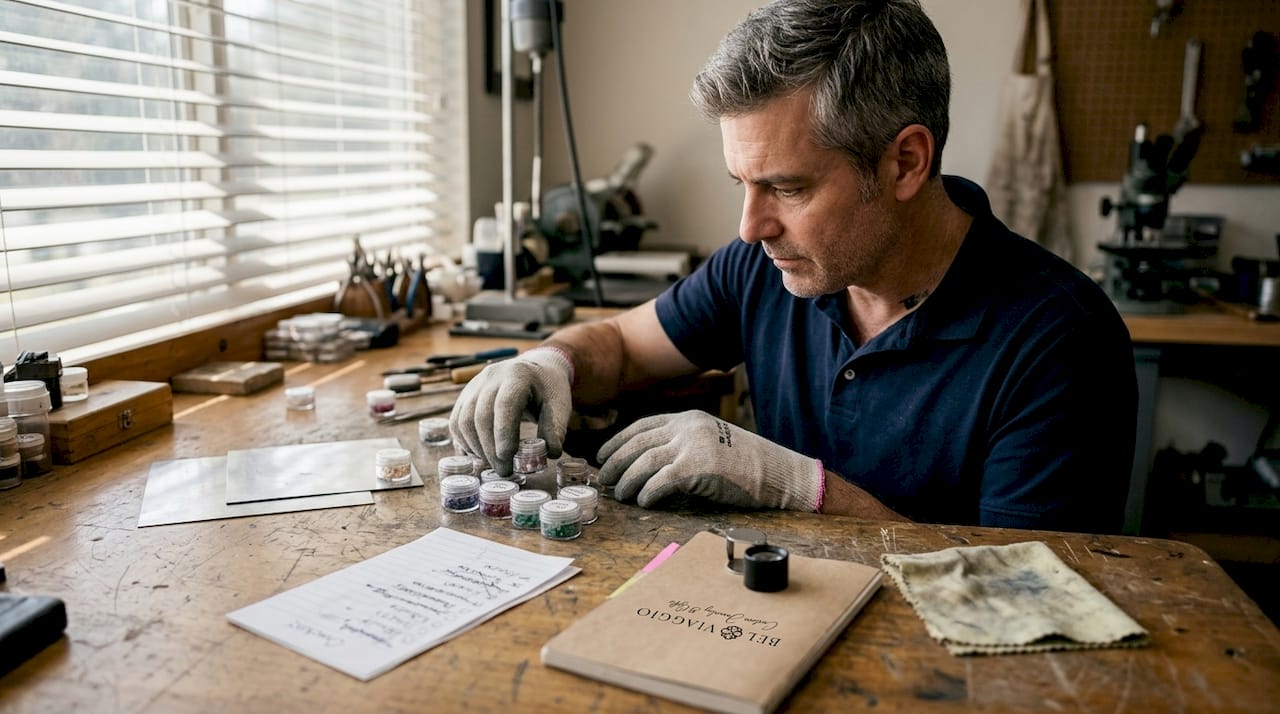
Our ethical gemstone selection guide breaks down each stone type by sourcing complexity, so you can match your values to your choice. For couples open to non-diamond options, exploring gemstone alternatives opens up a world of color, meaning, and sustainability.
Consumer demand for traceable, eco-friendly rings has grown sharply in recent years, with surveys showing over 70% of millennial and Gen Z buyers now factor sustainability into jewelry decisions. That shift is reshaping what responsible luxury actually looks like.
Fitting and finishing: Ensuring perfection
After your ring is crafted, final steps ensure a perfect, lasting result. This stage is often rushed, but it shouldn’t be.
Here’s what a thorough final review covers:
- Quality check: Inspect prong security, stone seating, surface finish, and overall symmetry
- Independent appraisal: Get a certified appraisal for insurance purposes before the ring leaves the jeweler
- Insurance: Add the ring to a jewelry policy or homeowner’s rider immediately
- Secure delivery: Confirm tracking, signature requirements, and insurance coverage during shipping
Common post-delivery issues include minor fit problems, small surface scratches from shipping, and occasionally a loose prong. Most reputable jewelers offer a short adjustment window after delivery. Use it.
“The final review stage is not a formality. It’s your last opportunity to catch anything before the ring becomes a permanent part of your life.”
Resizing a custom ring is possible in many cases, but some designs have real limits. Eternity bands with stones all the way around cannot be resized without removing and resetting stones. Tension settings are also difficult to alter. Discuss resizing potential with your jeweler before the design is finalized.
For long-term care, follow these basics:
- Clean with mild soap and warm water every few weeks
- Avoid wearing the ring during heavy physical activity
- Schedule a professional inspection once a year
- Store in a fabric-lined box when not wearing
Our personalized ring tips cover maintenance in more detail, including which cleaning methods to avoid for specific stone types.
Common mistakes, edge cases, and expert tips
Even as you follow the main steps, sidestepping common pitfalls makes your experience smoother. The most expensive mistakes in custom ring creation usually come from rushing, poor communication, or ignoring practical realities.
Here are the most common errors couples make:
- Skipping the wax model approval: Approving only a digital render can lead to surprises in the physical piece
- Underestimating timelines: Sourcing a specific ethical stone can add weeks to the process
- Ignoring lifestyle fit: A tall, intricate setting might catch on everything if you work with your hands
- Choosing pre-made settings: Pre-made settings often don’t fit stones as precisely as custom-built ones, which affects both security and appearance
- Not discussing wedding band compatibility early: Some ring profiles make it nearly impossible to find a flush-fitting band later
Edge cases deserve special attention. Using an heirloom stone sounds romantic, but not all vintage stones are cut to modern proportions. Your jeweler needs to assess whether the stone can be set safely in a new design. Extreme resizing, more than two sizes up or down, can weaken the metal structure. And if you lead an active lifestyle, certain stone types like emeralds or opals are simply too soft for daily wear without risk.
Pro Tip: Jewelers who handle design, casting, and setting in-house (vertically integrated) can often deliver faster and catch issues earlier. Ask about their production setup before committing.
For more on avoiding ethical design pitfalls and common custom mistakes, the expert guidance from certified jewelers is worth reading before you start.
Our perspective: What most guides miss about custom ring creation
Most guides focus on the steps. Fewer talk about the emotional reality of the process. Creating a custom ring together can be genuinely stressful. You’re making high-stakes decisions under time pressure, often with different aesthetic instincts between partners. That tension is normal, and it doesn’t mean the process is going wrong.
What we’ve seen repeatedly is that couples who struggle most are the ones who fixate on aesthetics and ignore wearability. A ring that photographs beautifully but catches on sweaters or feels heavy after six hours is a daily frustration. Long-term wearability should carry equal weight to visual impact.
We also think the custom journey insights most people overlook are about compromise. Both partners rarely want exactly the same thing. The best outcomes come from couples who treat the design process as a collaboration rather than a negotiation. Your jeweler is not a referee. They’re a creative partner.
Patience and expert guidance are genuinely your best tools here. Rushing a custom ring almost always costs more in the end.
Explore your custom ring options
Ready to take the next step? Here’s how Bel Viaggio brings your ring vision to life.
At Bel Viaggio Designs, every ring begins with your story. We work with ethically sourced stones, recycled metals, and fully traceable materials to create pieces that reflect both your love and your values. Whether you’re drawn to the bold drama of a black diamond halo ring or the vibrant elegance of a green emerald design, our team is ready to guide you through every step.

When you’re ready to move from inspiration to creation, start your design with a custom design deposit and let’s build something that’s entirely, unmistakably yours.
Frequently asked questions
How long does a custom ring usually take from start to finish?
Most custom rings take 4 to 8 weeks from consultation to delivery, depending on design complexity and how quickly ethical materials can be sourced. Build in extra time if you have a specific proposal date in mind.
Are lab-grown diamonds truly ethical and high quality?
Yes. Lab-grown diamonds are physically and chemically identical to mined stones and offer transparent sourcing with a significantly lower environmental impact. They’re graded by the same standards as mined diamonds.
Can an heirloom stone be used in a new custom design?
Sometimes. Heirloom stone compatibility depends on the stone’s cut, condition, and dimensions relative to the new setting. A certified jeweler must assess it before any design work begins.
What certifications should I ask for to ensure ethical sourcing?
Ask for RJC membership confirmation, a GIA grading report for diamonds, and full traceability documentation from your jeweler. These three together give you a solid foundation for confident, ethical buying.
Is resizing easy with a custom ring?
Many custom rings can be resized, but design-dependent limits apply. Eternity bands and tension settings are the hardest to alter. Always discuss resizing potential before finalizing your design.
Recommended
- What is luxury jewelry: bespoke and ethical guide – Bel Viaggio Designs, LLC
- Custom jewelry ideas for ethical engagement rings 2026 – Bel Viaggio Designs, LLC
- Custom jewelry ideas for ethical engagement rings 2026 – Bel Viaggio Designs, LLC
- Ethical engagement ring buying tips for personalized 2026 – Bel Viaggio Designs, LLC
- Custom jewelry benefits for ethical luxury in 2026 – Eternal Carat