

TL;DR:
- Solitaire rings account for 60% of all engagement ring sales due to their timeless simplicity.
- Different settings like prong, bezel, tension, and cathedral impact ring durability and appearance.
- They are an ethical, sustainable, and highly customizable choice, highlighting individual love stories.
Most people assume that elaborate, ornate engagement rings sit at the top of the popularity charts. The reality surprises almost everyone. Solitaire rings account for 60% of all engagement ring sales, making them the single most chosen style worldwide. Far from being a “plain” or “safe” option, a solitaire ring is a deliberate, confident statement that lets one stunning gemstone take center stage. Whether you are drawn to a classic round diamond or a vibrant emerald, understanding what makes this style so enduring helps you choose a ring that truly reflects your values and your love story.
Table of Contents
- What is a solitaire ring?
- Solitaire ring settings explained
- Pros and cons of solitaire rings
- Why solitaire rings are the ethical and sustainable choice
- Solitaire vs. other engagement ring styles
- The real beauty of the solitaire ring: A jeweler’s perspective
- Create your perfect solitaire or custom ring
- Frequently asked questions
Key Takeaways
| Point | Details |
|---|---|
| Single stone focus | A solitaire ring features one central gemstone, making the stone the true centerpiece. |
| Classic yet versatile | Solitaire rings suit every style and remain the top engagement choice for their timeless look. |
| Personalization potential | This style is perfect for bespoke, ethical, and handcrafted options using a variety of gems and metals. |
| Set for sustainability | Solitaire designs simplify sustainable sourcing and ethical craftsmanship. |
| Quality matters most | Because every detail shows, stone quality is crucial in a solitaire ring’s lasting beauty. |
What is a solitaire ring?
A solitaire ring is a ring built around a single, center gemstone. No side stones, no clusters. Just one beautiful gem set on a clean, simple band. That simplicity is its whole point. Every design decision flows from the belief that one exceptional stone, held with intention, says more than a dozen small ones combined.
The style carries real symbolic weight. A single stone represents singular love, focused and undivided. It speaks to clarity, commitment, and the idea that your relationship does not need embellishment to be extraordinary. Those ideas resonate deeply with couples who care about meaning over maximalism.
The core features that define a solitaire ring are worth knowing:
- One center gemstone as the exclusive focal point
- A minimal, clean band in yellow gold, white gold, rose gold, or platinum
- No side stones or halos around the main gem
- Versatile metal and stone options that support personalization
- Easy compatibility with stacking bands for future anniversary additions
“Solitaire rings comprise 60% of engagement ring sales, remaining the most popular style due to timeless versatility, ease of maintenance, and stacking compatibility.”
That statistic matters because it challenges a common misconception. People often assume they need something more complex to feel special. In practice, most couples ultimately return to the solitaire. Its appeal does not fade because it was never built around a trend in the first place. If you are exploring the reasons behind custom ring choices, the solitaire consistently shows up as the foundation couples personalize most confidently.
Solitaire ring settings explained
Knowing that a solitaire has one gemstone is just the beginning. How that stone is held dramatically changes the ring’s look, feel, and durability. The setting is the architecture of the ring, and each type serves a distinct purpose.
Prong setting: Small metal claws (usually 4 or 6) grip the gemstone at its girdle, lifting it above the band so light can enter from every angle. This maximizes brilliance, which is why it remains the most iconic solitaire setting. The six-prong style, pioneered by Tiffany in 1886, remains a classic benchmark even today.
Bezel setting: A smooth rim of metal wraps completely around the stone’s edge, securing it flush or slightly raised. It offers exceptional protection for active wearers and gives the ring a sleek, modern appearance. The tradeoff is slightly less visible surface area for the stone.
Tension setting: The stone appears to float between the two ends of the band, held in place by the pressure of the metal alone. The effect is striking and architectural. This setting works beautifully for modern, minimalist aesthetics but requires very precise craftsmanship.
Cathedral setting: Arched metal supports rise from the band to elevate the center stone, creating a dramatic, almost regal silhouette. The arch can also provide extra protection to the stone’s sides.
Here is a quick side-by-side comparison to help clarify the differences:
| Setting | Security | Light maximization | Cleaning ease | Best for |
|---|---|---|---|---|
| Prong | Moderate | Excellent | Easy | Classic, brilliant styles |
| Bezel | Excellent | Good | Very easy | Active lifestyles, modern look |
| Tension | Moderate | Excellent | Easy | Bold, architectural designs |
| Cathedral | Good | Very good | Moderate | Romantic, elevated styles |
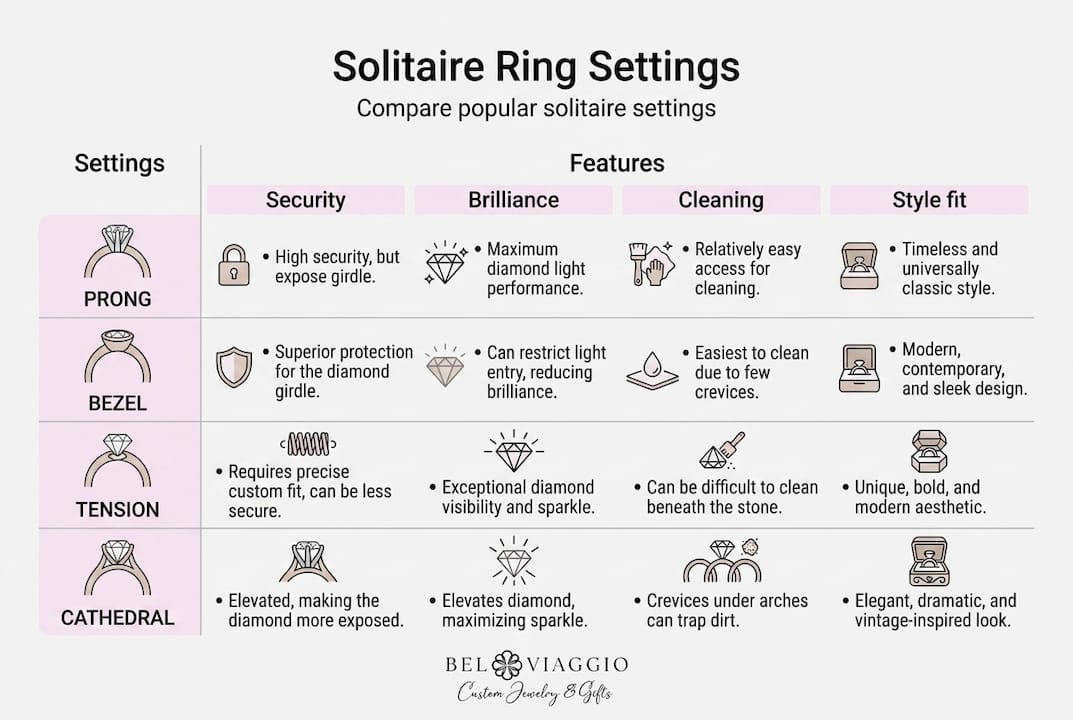
Understanding ring settings in detail gives you the language to describe exactly what you want when working with a jeweler on a custom design.
Pro Tip: Match your setting choice to your daily lifestyle. If you work with your hands frequently or prefer low-maintenance jewelry, the bezel setting offers serious protection without sacrificing elegance. If showing off maximum sparkle is your priority, the prong setting is your best friend.
Pros and cons of solitaire rings
Every style has tradeoffs. The solitaire is exceptionally strong in some areas and requires a little extra thought in others. Here is an honest look at both sides:
| Pros | Cons |
|---|---|
| Timeless design that does not go out of style | High prongs can snag on fabric |
| Showcases gemstone quality beautifully | Any visible flaw in the stone is exposed |
| Easy to clean and maintain | Less sparkle than a halo ring |
| Stackable with wedding bands and anniversary rings | Demands a higher-quality center stone |
| Highly versatile for personalization | Minimalist look is not for everyone |
The solitaire’s timeless appeal comes directly from its strength: it showcases your gemstone without competition. But that same strength creates its biggest challenge. When there is only one stone, everything about that stone is on display, including inclusions, color, and cut quality.
Here is how to address the most common concerns:
- Choose the right prong height. Lower-profile prong settings reduce snagging on clothing, bags, and bedding without compromising the stone’s visibility.
- Invest in stone quality. For a solitaire, prioritize cut above all else. A well-cut stone handles light brilliantly, even if its clarity grade is not perfect.
- Select ethical or lab-grown stones. Lab-grown diamonds and gemstones offer the same brilliance as mined stones with a cleaner sourcing story and often a lower price point for the same quality grade.
- Schedule regular maintenance. Prong tips wear down over time. Professional inspections every six to twelve months protect your stone from loosening.
- Learn proper care basics. Gentle care for fine jewelry keeps your solitaire looking brilliant for decades with minimal effort.
Pro Tip: Since the solitaire design spotlights every detail of your gemstone, spend the majority of your budget on stone quality before worrying about elaborate band details. A beautifully cut stone in a simple setting will always outshine a mediocre stone in an ornate one.
Why solitaire rings are the ethical and sustainable choice
For eco-conscious couples, the solitaire ring offers a structural advantage that goes beyond aesthetics. Its minimalist design uses less metal than more ornate styles. Less metal means a smaller environmental footprint, and it makes responsible sourcing considerably more straightforward.
When you commission a handcrafted solitaire, several ethical options open up naturally:
- Recycled precious metals. A simple solitaire band requires far less metal than a pavé or halo design, making it easier and more affordable to use fully recycled gold or platinum.
- Lab-grown diamonds and gemstones. These stones are created in controlled environments and carry none of the human rights or environmental concerns associated with certain mining operations.
- Heirloom stone setting. A solitaire is the ideal vehicle for reusing a family stone. The clean design keeps all attention on the gem itself, honoring the history it carries.
- Traceable natural stones. If you prefer a mined gemstone, the conflict-free sourcing process for a single stone is far simpler to verify than sourcing dozens of smaller accent stones for a more complex design.
The solitaire’s versatility for personalization is not just an aesthetic advantage. It is a practical one for anyone building a truly intentional ring. When your jeweler knows the entire budget and focus goes toward one exceptional stone, they can source with greater care and transparency.
This is also where custom, handmade rings shine. A skilled craftsperson building one ring from the ground up can make sourcing decisions stone by stone and metal by metal in a way mass production simply cannot replicate.
Solitaire vs. other engagement ring styles
Choosing a solitaire does not mean choosing the only good option. Understanding how it compares to other popular styles helps you confirm that it is genuinely the right choice for your priorities.
Solitaire vs. halo ring: A halo surrounds the center stone with a ring of smaller diamonds or gemstones. This amplifies sparkle and can make a smaller center stone look larger. However, a halo adds significant complexity to cleaning, maintenance, and ethical sourcing. The solitaire’s popularity at 60% of sales reflects how many couples ultimately prefer the directness and simplicity of a single stone over the maximalist drama of a halo.
Solitaire vs. three-stone ring: The three-stone ring features a center stone flanked by two smaller side stones. It carries symbolic meaning (past, present, future) and adds visual width to the ring. The tradeoff is more metal and more stones to source ethically. It also directs budget toward side stones rather than maximizing the quality of the center gem.
Solitaire vs. vintage or antique-inspired rings: These designs often incorporate milgrain edges, filigree metalwork, and intricate band detailing. They are beautiful, but the complexity makes custom crafting more expensive and ethical sourcing harder to manage cleanly. A solitaire with a subtly engraved band can capture a vintage spirit with far less complexity.
Solitaire vs. pavé band rings: Pavé bands line the band itself with tiny stones, adding sparkle along the sides of the finger. While stunning, this style wears down and loses stones over time. Replacing those accent stones is an ongoing maintenance cost many couples underestimate.
Here is a quick at-a-glance summary of when to consider each style:
- Choose solitaire if: You value timeless elegance, ethical simplicity, stacking potential, and letting your gemstone speak for itself.
- Choose halo if: You want maximum sparkle and the visual effect of a larger stone.
- Choose three-stone if: Symbolic storytelling through stone placement matters most to you.
- Choose vintage-inspired if: Intricate craftsmanship and old-world romance drive your aesthetic.
Exploring current engagement ring trends confirms that while other styles cycle in and out of fashion, the solitaire holds steady as the enduring choice across generations.
The real beauty of the solitaire ring: A jeweler’s perspective
After years of helping couples design custom rings, one truth stands out consistently. The couples who choose solitaires are not choosing simplicity because they cannot imagine something more elaborate. They are choosing clarity of intention.
A solitaire ring asks nothing of the eye except to look at the stone. That is a profoundly confident choice. It says, “This stone, this moment, this person is enough.” No distractions. No visual noise. Just the thing that matters most, held as beautifully as possible.
What strikes us most is how the solitaire actually becomes more personal when it is custom-made, not less. When there are no accent stones competing for attention, every detail of the band carries meaning. An engraved interior, a hand-hammered texture, a slightly thicker band in rose gold, each of these choices becomes visible and intentional in a way it never could be in a busier design.
We have seen couples set grandmother’s sapphire into a handcrafted solitaire and create something that feels both deeply sentimental and entirely modern. We have seen others choose a vivid green emerald over a diamond and build a ring that perfectly expresses who they are as individuals. The solitaire format welcomes all of that. It is a canvas, not a constraint.
There is also an honesty to solitaires that resonates with ethically minded couples. Sourcing one exceptional stone responsibly is a story you can tell with pride. Choosing custom engagement insights backed by real transparency is far easier when the entire focus is one carefully selected gem.
Trends shift. What feels daring today can feel dated in a decade. The solitaire, crafted with care and purpose, tends to feel exactly right at every stage of a life lived together.
Create your perfect solitaire or custom ring
Now that you have a thorough understanding of solitaire rings, their settings, and their unique advantages for ethical and personalized design, the next step is bringing your vision to life.

At Bel Viaggio Designs, every ring is handcrafted and built around your choices. Explore striking options like the bold black diamond solitaire or the vivid emerald solitaire ring as starting points for inspiration. Each piece reflects the brand’s commitment to ethically sourced materials, sustainable practices, and personalized craftsmanship. Whether you already have a clear vision or just know you want something real and meaningful, our team will work with you to create a ring that belongs to no one else but you.
Frequently asked questions
What is the difference between a solitaire ring and a halo ring?
A solitaire ring features one center stone with no additional stones, while a halo ring surrounds the center gem with a ring of smaller stones for extra sparkle. The solitaire remains the most popular style due to its timeless versatility and low-maintenance design.
Are solitaire rings only available with diamonds?
No. Solitaire rings can feature any gemstone, including sapphires, emeralds, moissanite, and aquamarine, making them an excellent choice for couples who want a unique or colorful center stone without sacrificing the clean solitaire silhouette.
What is the best setting for a solitaire ring?
The prong setting is the most popular choice, securing the stone while maximizing its brilliance from every angle. The prong design, pioneered by Tiffany in 1886, remains the benchmark for classic solitaire style.
Why do solitaire settings require high-quality stones?
Because the central stone stands completely alone, any visible inclusion, color tint, or poor cut is immediately apparent. As the solitaire design exposes every detail of the gem, investing in a high-quality stone is essential rather than optional.
How do I care for a solitaire engagement ring?
Gently clean your ring with mild soap and warm water using a soft brush, and schedule professional inspections every six to twelve months to ensure prong tips remain secure and the stone has not shifted.
Recommended
- Ring settings explained: types, styles & custom options – Bel Viaggio Designs, LLC
- Engagement Ring Trends That Will Become Timeless Bel Viaggio – Bel Viaggio Designs, LLC
- Why buy handcrafted rings? Unique value & lasting quality – Bel Viaggio Designs, LLC
- Custom ring guide: step-by-step ethical luxury (2026) – Bel Viaggio Designs, LLC