

TL;DR:
- Traceable jewelry provides verified proof of a ring’s entire supply chain, ensuring ethical sourcing from mine to finish. Certification standards like RJC COC audit every link, giving couples confidence in responsible practices and long-term value. Choosing traceable pieces safeguards both ethical integrity and the lasting story of your engagement ring.
When couples begin searching for an engagement ring, most encounter two words that sound reassuringly similar but mean very different things: “conflict-free” and “traceable.” Understanding what is traceable jewelry, and why it sets a higher standard than a simple conflict-free label, is one of the most useful things you can do before you buy. Traceable jewelry gives you verifiable proof of where every gram of gold, every gemstone, and every link in the supply chain originated. For a ring meant to represent a lifetime commitment, that kind of documented integrity matters more than most buyers realize.
Table of Contents
- Understanding traceable jewelry and its certification standards
- How traceability enhances ethical sourcing in engagement and wedding jewelry
- Technological advances powering traceability in diamonds and metals
- Comparing traceable jewelry claims: what couples should look for
- How to apply traceability knowledge when choosing your engagement and wedding jewelry
- Why traceability is the new heirloom guarantee for conscientious couples
- Explore traceable and ethically sourced engagement rings at Bel Viaggio Designs
- Frequently asked questions
Key Takeaways
| Point | Details |
|---|---|
| Traceability defined | Traceable jewelry tracks metals and gems fully from mine to retail, verified by certifications like RJC Chain-of-Custody. |
| Beyond conflict-free | Traceability includes social and environmental audits that go beyond basic conflict-free claims for deeper ethical assurance. |
| Tech powers trust | Blockchain and AI technologies create tamper-proof records that enhance transparency and authenticity for diamonds and metals. |
| Use traceability in buying | Couples should verify certificates and request provenance documentation to ensure truly ethical and sustainable jewelry choices. |
| Traceability as legacy | Traceable jewelry offers provenance and value that can turn engagement rings into treasured heirlooms for generations. |
Understanding traceable jewelry and its certification standards
Traceable jewelry refers to precious metals and gemstones whose entire journey, from the mine to the ring on your finger, is documented, verified, and auditable. This is not a marketing phrase. Responsible Jewellery Council Chain-of-Custody (COC) certification is the industry’s most recognized standard, confirming that gold, silver, and platinum group metals have been handled and traded in a fully traceable manner across every stage of the supply chain.
The COC standard is voluntary, but that does not make it less rigorous. It requires every certified entity, whether a mine, refinery, or retailer, to maintain documented records showing exactly where material came from and where it went. Think of it as a passport that travels with the metal, getting stamped at each stop along the way. Any gap in that chain breaks the certification.
This matters for you as a couple because the label “responsibly sourced” appears on a staggering range of products with very different levels of verification behind it. COC certification adds brand value and builds real consumer trust because it goes beyond an internal company claim and requires third-party auditing. Our responsible jewelry guide breaks down how these sourcing labels apply specifically to engagement and wedding rings, and our overview of ethical gold mining explains what responsible extraction actually looks like in practice.
Pro Tip: When a jeweler says their gold is “responsibly sourced,” ask specifically whether they hold RJC COC certification or can provide documentation from a COC-certified refinery. A confident answer is a good sign. Hesitation is information.
How traceability enhances ethical sourcing in engagement and wedding jewelry
To understand why traceability matters beyond certification, here is how it elevates ethical sourcing in the jewelry you choose. The RJC COC enables brands to verify human rights and environmental compliance far beyond what the Kimberley Process alone requires. The Kimberley Process, which many couples have heard of, certifies only that diamonds did not finance rebel movements against governments. That is a meaningful but narrow filter.
Here is what comprehensive traceability validation includes that basic conflict-free claims do not:
- Human rights audits verifying that miners and workers receive safe conditions, fair wages, and freedom from coercion at every stage of production.
- Environmental compliance checks ensuring responsible land use, water management, and restoration commitments at mining sites.
- Chain-of-custody documentation confirming that certified material is never mixed with unverified material during refining or manufacturing.
- Third-party verification conducted by independent bodies rather than self-reported by the company selling you the ring.
- Retailer-level accountability meaning the store you buy from must also participate in the certified chain, not just the mine.
For couples who want to ethically source wedding jewelry, this distinction is critical. If you care about the conditions in which your ring was made, a conflict-free diamond in a gold band with no traceability documentation only tells half the story. Learning the difference between conflict-free vs traceable jewelry is the first real step toward ethical jewelry choices you can feel confident about.
Pro Tip: Ask your jeweler for their COC certificate number. Legitimate certification holders can provide it, and you can often verify it directly with the RJC.

Technological advances powering traceability in diamonds and metals
As technology evolves, these innovations sharply enhance traceability and the integrity of your jewelry’s origins. The most significant advancement is blockchain, a digital record-keeping system where each entry is time-stamped and cannot be altered retroactively. This creates a tamper-proof log of every transaction a stone or metal passes through.
De Beers’ Tracr platform uses blockchain and AI to create detailed records from the moment a rough diamond is discovered, assigning it a unique digital identity that follows it through cutting, polishing, and sale. Each diamond’s physical characteristics are scanned and matched to its digital record, making substitution or fraud detectable.
Here is a summary of the technologies currently in use:
| Technology | What it does | Why it matters for couples |
|---|---|---|
| Blockchain | Creates immutable records of each transfer | Confirms no substitution occurred between mine and ring |
| AI scanning | Matches physical stone characteristics to digital ID | Detects fraud or swapping during cutting and polishing |
| Laser inscription | Engraves a microscopic ID on the girdle of a diamond | Physically links stone to its certificate |
| RFID tagging | Tracks metal batches through refining and manufacturing | Verifiable trail for gold and platinum |
Key benefits this technology creates for buyers:
- Provenance reliability you can verify independently, not just trust on a retailer’s word
- Heirloom protection because future generations can confirm the ring’s history
- Resale confidence since documented origin supports long-term value
Understanding how ring certification works alongside these digital tools helps you ask the right questions when you are standing in front of a collection.
Comparing traceable jewelry claims: what couples should look for
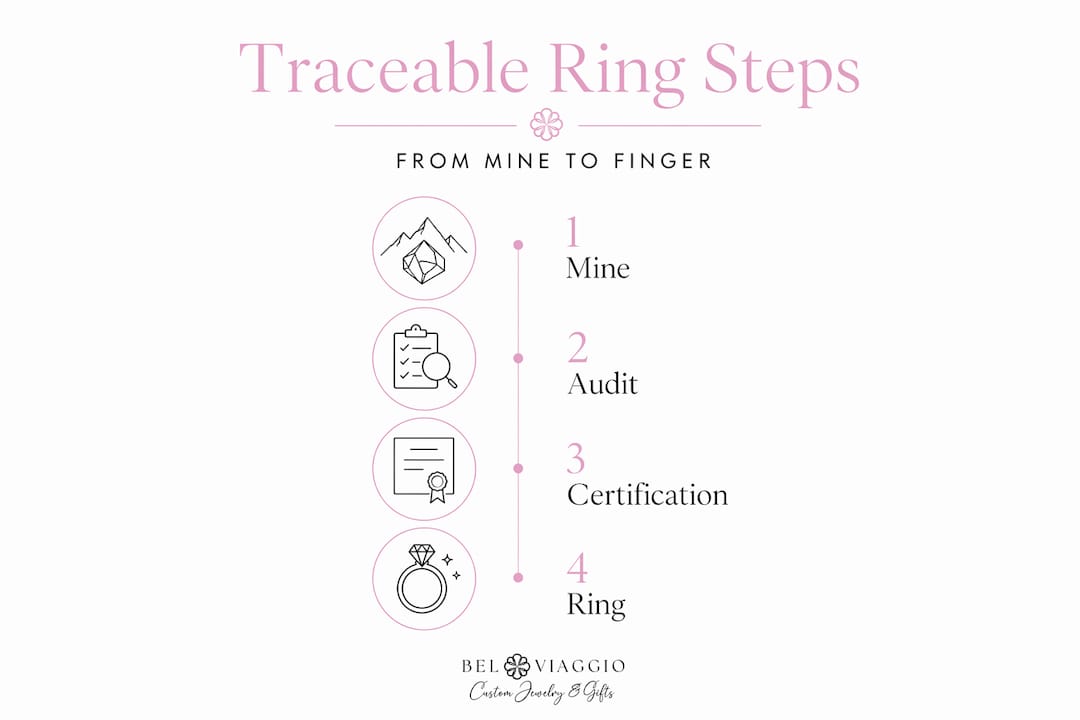
To bring clarity to these terms, here is a detailed comparison for your decision-making. Traceability via COC certification differentiates brands by adding genuine value and building consumer trust beyond basic conflict-free claims.
| Claim type | What is verified | Third-party audited | Covers full supply chain | Includes environmental and human rights standards |
|---|---|---|---|---|
| Conflict-free | Diamond origin only | Partially (Kimberley Process) | No | No |
| Responsibly sourced | Varies by brand definition | Sometimes | Sometimes | Sometimes |
| Traceable | Every transfer of material | Yes (RJC COC) | Yes | Yes |
| RJC COC certified | Complete chain from mine to retail | Yes | Yes | Yes |
When evaluating ethical jewelry choices, keep these points in front of you:
- “Conflict-free” is a floor, not a ceiling. It confirms the diamond did not fund armed conflict, but says nothing about labor conditions, environmental impact, or where the gold came from.
- “Traceable” without third-party verification is a claim, not a standard. Some brands use the word loosely. Ask for the specific certification backing it.
- COC certification is the clearest signal that a jeweler has invested in verifying the entire journey of their materials, not just the headline.
Our breakdown of transparency in jewelry sourcing goes further into how to read these claims across different retailers and what questions cut through vague language quickly.
How to apply traceability knowledge when choosing your engagement and wedding jewelry
With this understanding, here is how you can confidently choose traceable, ethical jewelry that suits your unique love story. The good news is that applying this knowledge is not complicated once you know what to ask for.
- Request documented provenance. Ask for written records or digital certificates showing the origin of the metal and stone. A credible jeweler can produce these.
- Verify certifications independently. Look up the jeweler’s RJC membership or COC certification status on the RJC website directly. Do not rely solely on a logo on their website.
- Ask about blockchain or digital records. Some jewelers, particularly those working with newer supply chain technology, can provide a digital record linked to your specific stone or metal batch.
- Factor traceability into customization decisions. When choosing metals for a custom ring, selecting traceable precious metals means provenance documents can enhance resale value and heirloom potential decades down the line.
- Understand that sustainable jewelry options exist at different price points. Traceability does not automatically mean a premium price. Many certified jewelers offer fully traceable pieces across a wide range of budgets.
For couples navigating these choices, ethical jewelry education gives you the vocabulary to have direct, confident conversations with any jeweler. When you can see the story behind your ring, as explored in visual storytelling in ethical jewelry, the piece carries an entirely different weight.
Pro Tip: Create a short checklist of three questions before visiting any jeweler: What certification does your gold carry? Can you provide documentation of the stone’s origin? Are you an RJC member? The answers reveal volumes about how seriously a brand takes traceability.
Why traceability is the new heirloom guarantee for conscientious couples
Most conversations about traceable jewelry focus on ethics in the present tense, whether current mining practices are humane, whether the environment is being protected right now. That matters enormously. But there is a longer argument for traceability that almost nobody talks about: it is the single most powerful way to protect the long-term meaning and value of your ring.
Consider what makes an heirloom. It is not just age. It is documented story. A ring passed down through generations carries emotional weight in proportion to what is known about it, where it came from, who wore it, what it represents. Traceability adds a verifiable layer to that story before the ring even reaches you. Your grandchildren will be able to confirm not just that it is beautiful, but exactly where in the world the gold was mined and under what conditions.
The ethical gemstone selection guide makes a compelling case that provenance is already rivaling cut and carat as a quality indicator among informed buyers. We believe this shift will only accelerate. As demand for jewelry supply chain transparency grows, the industry will have no choice but to treat full traceability as a baseline rather than a distinguishing feature. Early adopters, meaning the couples who ask for this today, are setting the standard that future buyers will expect.
That is why understanding ring certification insights is not just about feeling good at the point of purchase. It is about buying something whose value, both financial and sentimental, holds up across generations.
Explore traceable and ethically sourced engagement rings at Bel Viaggio Designs
At Bel Viaggio Designs, traceability is not a label we add after the fact. Every piece in our collection is crafted using ethically sourced precious metals and verified gemstones, with documentation to support the provenance of each ring we create. Our custom design process means your ring reflects your values and your story, built from materials you can account for.

If you are ready to find a ring with real provenance behind it, explore our curated collections. Our black diamond engagement ring makes a striking statement with responsibly sourced stones and fine craftsmanship. For color lovers, the green emerald diamond ring combines vivid, ethically sourced gemstones with expert setting. Or consider the timeless elegance of our aquamarine emerald cut engagement ring, where the stone’s origin is as beautiful as the ring itself. Every piece ships with documentation supporting its sustainability and provenance.
Frequently asked questions
What does “traceable jewelry” mean?
Traceable jewelry means every step of the precious metal or gemstone sourcing and processing can be tracked and verified from mine to final retail product, with RJC COC certification providing independent assurance across the full supply chain.
How is traceable jewelry different from conflict-free jewelry?
While conflict-free jewelry avoids sourcing from conflict zones, traceable jewelry goes further by auditing the full supply chain including human rights conditions and environmental standards at every stage of production.
Can traceable jewelry increase the value of my engagement ring?
Yes. Traceable pieces with provenance documentation enhance resale value and heirloom potential by proving ethical sourcing and providing an independently verifiable history for future buyers or inheritors.
Are all traceability certifications mandatory for jewelers?
No. RJC COC certification is voluntary, but many leading brands pursue it to demonstrate a genuine commitment to responsible sourcing that goes beyond minimum legal requirements.
How can I verify that a jewelry piece is truly traceable?
Request certificates from your supplier, seek digital provenance linked to blockchain records, and confirm that your jeweler participates in a recognized program such as RJC COC. Undocumented traceability claims weaken both the ethical value and the long-term heirloom potential of your ring.
Recommended
- What is responsible jewelry? A 2026 guide for ethical wedding rings – Bel Viaggio Designs, LLC
- Custom ring guide: step-by-step ethical luxury (2026) – Bel Viaggio Designs, LLC
- What Is Fair Trade Jewelry? A Guide for Ethical Couples – Bel Viaggio Designs, LLC
- Ethical gemstone selection guide for engagement rings 2026 – Bel Viaggio Designs, LLC