

TL;DR:
- Most jewelry brands lack comprehensive transparency despite high consumer demand for ethical sourcing.
- True transparency involves verifiable traceability through certifications, audits, and technology like blockchain.
- Ethical jewelry offers emotional and practical benefits, supporting fair practices and building trust.
Sixty-five percent of millennials now demand certified ethical sourcing from jewelry brands, yet 60% of brands score only “adequate” on transparency. That gap between what couples want and what brands actually prove is where confusion and heartbreak live. You might be holding a ring that carries a “conflict-free” label and still have no idea whether the miners who unearthed that stone were paid fairly or worked safely. This guide breaks down what genuine transparency looks like in the jewelry world, how responsible brands prove it, and exactly what you should demand before saying yes to any piece.
Table of Contents
- What is transparency in jewelry sourcing?
- How do brands implement transparency?
- Benefits of transparency for couples
- Nuances, limitations, and pitfalls in jewelry transparency
- A fresh perspective: Why transparency is the true luxury in modern jewelry
- Discover ethical choices at Bel Viaggio Designs
- Frequently asked questions
Key Takeaways
| Point | Details |
|---|---|
| Transparency defined | True transparency means verifiable traceability from mine to market via certifications and audits. |
| Consumer benefits | Transparency gives couples peace of mind that their jewelry matches their values. |
| Check beyond labels | Don’t just trust ‘conflict-free’ claims; seek comprehensive proof of ethical sourcing. |
| Nuances exist | Not all gems and certifications are equally traceable—ask detailed questions. |
What is transparency in jewelry sourcing?
Transparency in jewelry sourcing means you can trace every step your ring took, from the moment a gemstone left the earth to the moment it arrived on your finger. It is not a feeling or a marketing phrase. It is a documented, verifiable chain of evidence.
Traceability from mine to market relies on a combination of certifications, third-party audits, and technology. The most credible frameworks include:
- Kimberley Process Certification Scheme (KPCS): Tracks rough diamonds to prevent conflict funding, though its scope is limited.
- Responsible Jewellery Council (RJC) Code of Practices: Covers 45 provisions for responsible sourcing, including human rights, labor standards, environmental impact, and business ethics.
- Fairmined Certification: Applies specifically to artisanal gold mining communities, ensuring fair wages and safe conditions.
- Chain of Custody documentation: A paper or digital trail that follows materials from extraction through processing to retail.
- Blockchain and QR codes: Digital tools that create tamper-resistant records of a gem or metal’s journey.
- Third-party audits: Independent assessors who verify that a brand’s claims match its actual practices.
Here is a quick breakdown of what each major framework actually covers:
| Framework | Covers conflict? | Covers labor rights? | Covers environment? | Covers artisanal mining? |
|---|---|---|---|---|
| Kimberley Process | Yes | No | No | Partially |
| RJC Code of Practices | Yes | Yes | Yes | Partially |
| Fairmined | Yes | Yes | Yes | Yes |
| Blockchain traceability | Varies | Varies | Varies | Varies |
Brands that take transparency seriously invest in multiple layers, not just one label. A responsible jewelry guide can help you understand which certifications carry the most weight for your specific priorities. If you are narrowing down your options, reviewing ethical engagement ring tips will show you how these frameworks translate into real purchasing decisions.
The bottom line: transparency is not a single certificate. It is a system of overlapping verification that makes it nearly impossible for unethical practices to hide.
How do brands implement transparency?
Knowing what transparency means is one thing. Watching a brand actually build it into their operations is another. Responsible brands follow structured due diligence processes, and the gold standard comes from the OECD Due Diligence Guidance for Responsible Supply Chains.
The OECD framework outlines five core steps:
- Establish strong management systems: Create internal policies and supplier codes of conduct.
- Identify and assess risks: Map the supply chain and flag potential ethical red flags at each stage.
- Design and implement risk responses: Suspend or exit relationships with suppliers who fail to meet standards.
- Conduct independent audits: Bring in third parties to verify that internal claims hold up.
- Report publicly: Share findings with consumers and stakeholders, not just internal teams.
The OECD guidance and RJC standards together cover roughly 80% of major global jewelry supply chains, which means brands operating within these frameworks are accountable at nearly every node. That is significant.
Technology is also changing the game fast. Over 50,000 jewelry pieces were traced using blockchain in 2023 alone. When you scan a QR code on a ring and see the mine of origin, the refinery, and the craftsperson who set the stone, that is blockchain doing its job. It creates a record that cannot be quietly edited.
Here is how traditional transparency compares to tech-enabled transparency:
| Method | Verifiable by consumer? | Risk of fraud? | Cost to brand? |
|---|---|---|---|
| Paper certifications | Partially | Moderate | Low |
| Third-party audits | Yes | Low | Moderate |
| Blockchain traceability | Yes | Very low | High |
| Marketing claims only | No | Very high | Very low |
Pro Tip: When you ask a brand about their sourcing, request actual documentation, not a landing page. A reputable brand will share audit reports, certification numbers, and supplier names. Vague answers like “we only work with trusted partners” are a red flag.
For a deeper look at where specific stones come from, our ethical gemstone guide walks through traceability by gem type. You can also explore top gemstone choices that pair beauty with verified sourcing.
Benefits of transparency for couples
Here is something most jewelry guides skip: transparency is not just an ethical checkbox. It changes how you feel about your ring every single day.
When you know your stone was mined under fair conditions, that your gold was refined without toxic runoff, and that the artisan who set your center stone was paid a living wage, your jewelry carries a different emotional weight. It becomes a symbol of your values, not just your love.
“Transparency means you know exactly what’s on your finger and what it stood for.”
The practical benefits are just as real:
- Avoiding greenwashing: Brands with real documentation cannot fake their way through an audit. Vague claims collapse under scrutiny.
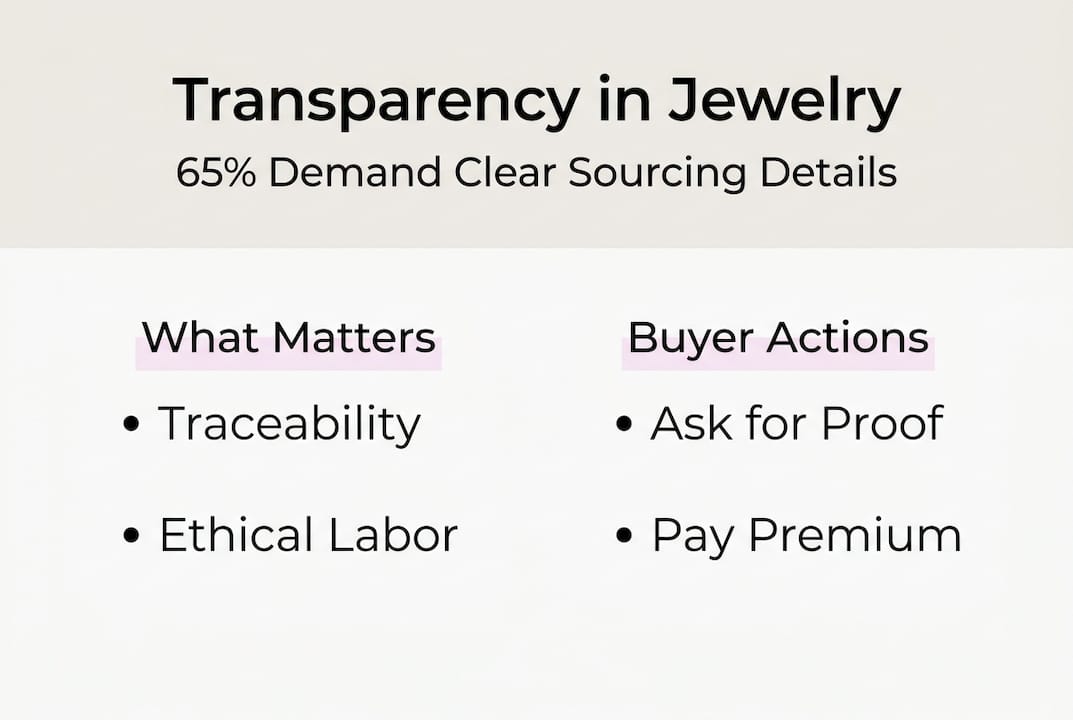
- Building trust: 65% of millennials demand certification before purchasing, and brands that deliver earn lasting loyalty.
- Aligning with shared values: Your engagement ring is one of the most personal objects you will ever own. It should reflect who you both are.
- Protecting your investment: Certified ethical jewelry often holds its value better because provenance documentation adds to its story and legitimacy.
- Supporting fair communities: Every verified purchase sends a signal that ethical practices are worth funding.
And the financial reality? 34% of buyers will pay a small premium for verified ethical sourcing. That is not a niche attitude. That is a mainstream shift.
For couples who want their ring to reflect something deeper, exploring custom ethical jewelry ideas is a natural next step. You can also browse ethical gemstone choices to find stones whose origins you can actually verify.
Nuances, limitations, and pitfalls in jewelry transparency
Here is where things get uncomfortable. The jewelry industry has a transparency problem that certifications alone cannot fix.

70% of colored gemstones lack any meaningful traceability, and 85% of diamonds are not ethically certified in any rigorous sense. The Kimberley Process, which many brands cite as proof of ethical sourcing, does not cover labor rights or environmental damage. It only addresses whether a stone funded armed conflict. That is a narrow definition of “ethical.”
Common pitfalls to watch for:
- The “conflict-free” label: This phrase means almost nothing beyond the Kimberley Process scope. It does not tell you about wages, child labor, or water contamination.
- Certification gaps in artisanal mining: Many small-scale mines operate outside any certification framework. When a gem passes through these hands, traceability breaks and ethical stones can be mixed with unethical ones.
- High costs for small suppliers: Smaller ethical miners often cannot afford RJC certification, which means they may be excluded from verified supply chains even when their practices are sound.
- Lab-grown debate: Lab-grown stones offer the best traceability available today, but some argue their energy footprint and lower resale value complicate the ethical picture.
| Red flag | What it might mean |
|---|---|
| “Conflict-free” with no other certification | Minimal ethical verification |
| No third-party audit available | Claims are unverified |
| Vague supplier information | Supply chain is not mapped |
| Only one certification cited | Gaps likely exist |
Pro Tip: Always ask what a certification actually covers. An RJC-certified brand meets a high bar. A brand that only cites the Kimberley Process is meeting a much lower one. Knowing the difference protects you.
For practical guidance on navigating these gray areas, our guide on buying conflict-free rings gives you specific questions to ask and answers to watch for.
A fresh perspective: Why transparency is the true luxury in modern jewelry
The jewelry industry has spent decades defining luxury through materials: the size of the stone, the purity of the gold, the prestige of the brand name. We think that definition is overdue for a rethink.
For couples in 2026, real luxury is knowing. It is the ability to look at your ring and trace its story without a single gap. It is a brand that hands you documentation instead of deflecting with marketing language. That kind of confidence is rare, and it costs something to build. Which is exactly why it signals genuine quality.
The digital age has made this shift possible and irreversible. Blockchain, public audit reports, and consumer-facing traceability tools mean that brands can no longer hide behind vague claims. Couples who demand proof are not being difficult. They are being smart.
What moves us most is the emotional layer. When you know your ring lifted up a mining community, supported fair wages, and left a smaller environmental footprint, it carries meaning that no amount of carats can replicate. That is the story you tell for decades.
Future-forward couples are already leading this shift, moving the conversation from “conflict-free” to “proven ethical.” Explore custom ethical engagement rings to see what that standard looks like in practice.
Discover ethical choices at Bel Viaggio Designs
If this guide has shown you anything, it is that the bar for genuine transparency is high and worth reaching for. At Bel Viaggio Designs, every piece is handcrafted with sourcing you can actually trace, not just claim.
From a stunning emerald and diamond engagement ring to a bold black diamond engagement ring, each design comes with the transparency modern couples deserve. You will find certifications, detailed sourcing information, and customization options that let your ring reflect your shared values from the inside out. Your love story deserves jewelry with a story worth telling.
Frequently asked questions
How can I verify a jeweler’s transparency claim?
Request third-party certifications like RJC or Fairmined, and ask for a supply chain document or blockchain tracking record specific to your piece. Marketing language is not a substitute for documentation.
Are lab-grown gems always more transparent?
Lab-grown stones offer complete traceability and a low environmental footprint, but you should still check for accompanying audits and certifications to confirm the full picture.
What does ‘conflict-free’ really mean?
‘Conflict-free’ means a stone was not used to fund armed conflict under the Kimberley Process, but it says nothing about labor conditions, environmental damage, or fair wages at the mine.
Is ethical jewelry sourcing more expensive?
It can cost slightly more, but 34% of buyers are willing to pay a small premium for verified ethical origin, and many find the peace of mind well worth it.
Recommended
- Ethical gemstone selection guide for engagement rings 2026 – Bel Viaggio Designs, LLC
- Ethical gemstone selection guide for engagement rings 2026 – Bel Viaggio Designs, LLC
- Custom jewelry ideas for ethical engagement rings 2026 – Bel Viaggio Designs, LLC
- Custom jewelry ideas for ethical engagement rings 2026 – Bel Viaggio Designs, LLC
- Top ethical jewellery trends for a sustainable 2026 – blackwellonline