

TL;DR:
- Finding personal and ethical jewelry options is achievable through careful prioritization and choosing transparent, certified sources. Knowing your values, non-negotiables, and design preferences guides you to sustainable materials like recycled metals and lab-grown stones, making each piece meaningful and eco-friendly. Building a detailed inspiration list rooted in your story ensures your custom jewelry reflects genuine personal significance and ethical commitment.
Finding jewelry that’s both deeply personal and genuinely ethical can feel like navigating a maze with no map. You want something that reflects your relationship, respects the planet, and stands apart from the mass-produced designs crowding every display case. The good news: custom ethical jewelry is more accessible than ever, with real options for couples who care about where their stones come from, who crafted their ring, and what story it tells. This guide walks you through the full process, from setting your priorities to building a concrete inspiration list, so your design decisions feel exciting rather than overwhelming.
Table of Contents
- How to choose a custom jewelry design that aligns with your values
- Top sources of ethical custom design inspiration
- Design choices that make a positive impact
- Crafting your custom inspiration list: Checklist for couples
- Why following your own story leads to the best custom jewelry
- Bring your unique vision to life with Bel Viaggio Designs
- Frequently asked questions
Key Takeaways
| Point | Details |
|---|---|
| Values drive design | Start by defining ethical, practical, and personal style priorities for your jewelry. |
| Choose ethical partners | Seek out jewelers with certifications and a proven commitment to responsible sourcing. |
| Balanced beauty and impact | Select stones and crafting methods that minimize environmental impact while expressing your style. |
| Use a checklist | Capture your design inspiration and values clearly before consulting with a jeweler. |
| Personal meaning lasts | Jewelry inspired by your story and relationship outshines fleeting trends. |
How to choose a custom jewelry design that aligns with your values
With the challenge framed, let’s lay out concrete criteria to guide your design journey.
The first question isn’t “What style do I love?” It’s “What do I stand for?” Some couples prioritize ethical sourcing above all else. Others care most about visual originality. Many want both, but knowing which value comes first helps you make better decisions when trade-offs arise. For example, a truly rare gemstone from a small ethical mine might cost more than a lab-grown alternative. Knowing your hierarchy makes that choice easier.
Before you speak to any jeweler, it helps to define three things: your non-negotiables, your nice-to-haves, and your dealbreakers. Non-negotiables might include recycled metals only, or stones that come with documentation. Nice-to-haves might include a specific cut or a particular color palette. Dealbreakers might be any brand that doesn’t publish its sourcing standards.
Ethical material options to consider:
- Lab-grown diamonds: Created in controlled environments, they share the same physical properties as mined diamonds with a significantly lower environmental footprint.
- Moissanite: A lab-created gemstone with brilliant fire, lower cost than diamonds, and a minimal ecological impact.
- Recycled metals: Gold, platinum, and silver reclaimed from existing jewelry or industrial sources eliminate new mining entirely.
- Fairmined certified gold: Sourced from artisanal small-scale miners who meet strict environmental and social standards.
- Ethical colored gemstones: Sapphires, rubies, emeralds, and other stones sourced from miners with transparent, traceable supply chains.
When it comes to documentation, you have every right to ask for it. Certifications like Kimberley Process, GIA/IGI grading, and Fairtrade or Fairmined standards establish a baseline for ethical sourcing. Requesting chain-of-custody documents tells you exactly where your stone traveled before it reached your finger.
Pro Tip: Ask your jeweler for a sourcing sheet before you fall in love with a specific stone. This gives you confidence in your choice and eliminates the awkward back-and-forth later in the process.
Exploring ethical custom jewelry inspiration early in your search helps you see how couples have successfully combined beautiful design with responsible sourcing. And if you want specific starting points, personalized ring ideas with ethical foundations can spark genuine creative directions you might not have considered.
Top sources of ethical custom design inspiration
Armed with a framework for making choices, get inspired by real ethical brands pushing custom design forward.
The ethical jewelry space has expanded dramatically. There are now dozens of designers who treat sustainability not as a marketing add-on but as a core design philosophy. Knowing who they are and what makes them distinct helps you identify which aesthetic direction resonates with you.
The Good Trade highlights 17 ethical engagement ring brands for 2026, including well-known names like Brilliant Earth, which offers conflict-free diamonds, lab-grown options, recycled metals, and custom design services. Bario Neal specializes in custom cluster rings using Fairmined gold and ethically sourced gems. Valerie Madison works with recycled gold and diamonds and accepts custom orders. WWAKE is known for delicate, nature-inspired pieces with transparent sourcing. Automic Gold, a queer-owned brand, focuses on inclusive sizing and recycled gold.
| Brand | Signature practice | Custom options |
|---|---|---|
| Brilliant Earth | Lab-grown and conflict-free diamonds | Full custom design |
| Bario Neal | Fairmined gold, ethical gems | Cluster rings, custom commissions |
| Valerie Madison | Recycled gold and diamonds | Custom orders available |
| WWAKE | Nature-inspired, ethical sourcing | Limited custom |
| Automic Gold | Recycled gold, inclusive sizing | Custom sizing and styles |
What stands out about these brands is that their ethical commitments shape their aesthetics. You can see the values in the visual language of the jewelry itself. Cluster rings made with Fairmined gold have a certain organic, unhurried beauty. Lab-grown diamond settings often lean into modern, architectural lines because the designers have the freedom to innovate without the constraints of traditional supply chains.
“The most meaningful piece of jewelry isn’t the most expensive one. It’s the one you can trace back to your own values and your own story.”
For broader visual inspiration before you narrow down your direction, exploring visual wedding ring inspiration offers a curated look at how ethical materials translate into real, finished pieces. You can also browse engagement ring styles organized by aesthetic to match designs to your personal taste.
What to look for in an ethical designer:
- Published sourcing policies available on their website
- Certifications listed per product or collection, not just as a general statement
- Real customer photos showing finished custom pieces
- Transparency about their workshop and craftspeople
- Clear communication about timelines for custom orders
Design choices that make a positive impact
With brand inspiration in mind, it’s time to dig into the design decisions that shape beauty and impact.
Every choice you make in the design process carries an environmental weight. Stone type, metal selection, complexity of the setting, and surface finish all affect both the look of your ring and its ecological footprint. Understanding these trade-offs doesn’t mean you have to sacrifice beauty for sustainability. It means you can make informed decisions that feel good at every level.
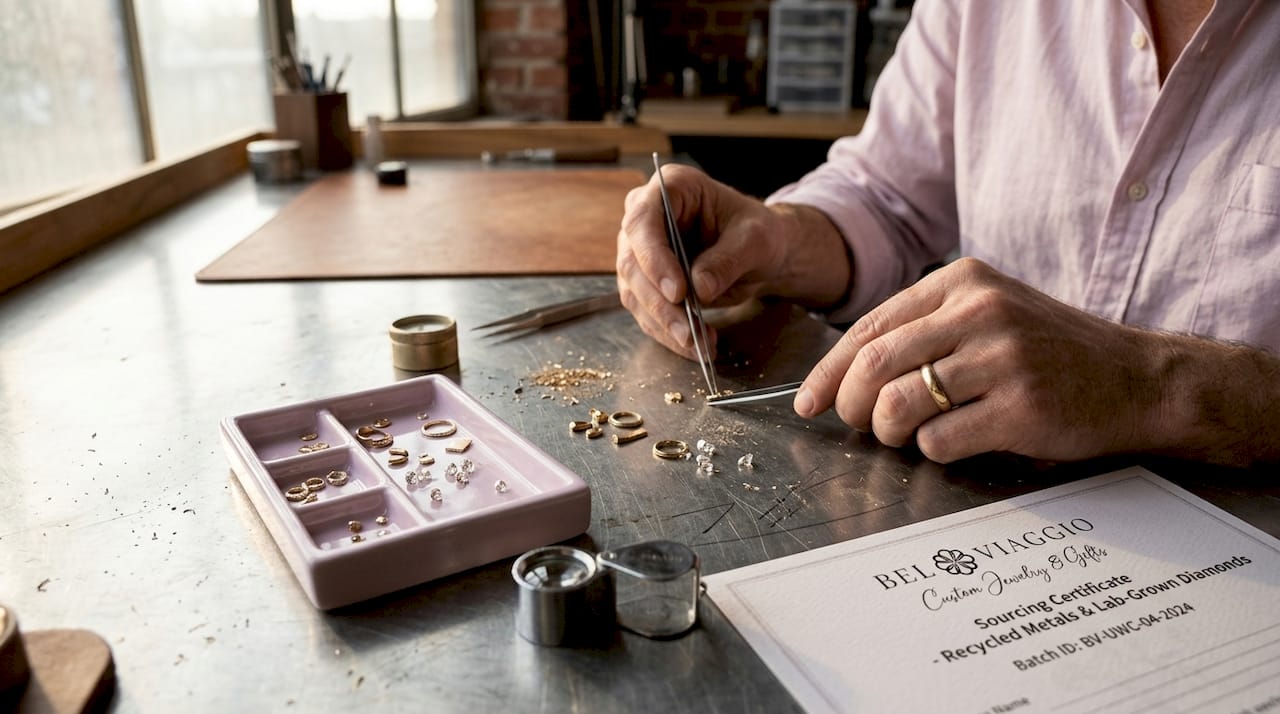
Research published in Nature on sustainable jewelry carbon footprints provides real benchmarks: biomaterials such as ligno-cellulosic alternatives generate approximately 1.1 to 1.2 kg of CO2, compared to 2.1 kg for traditional precious metals. Even more striking, simplified jewelry designs produce around 0.8 kg of CO2, while intricate, heavily worked designs generate up to 3.1 kg. That’s nearly four times the carbon impact from design complexity alone.
| Design factor | Lower impact option | Approximate CO2 | Higher impact option | Approximate CO2 |
|---|---|---|---|---|
| Material | Biomaterials | 1.1 to 1.2 kg | Precious metals | 2.1 kg |
| Complexity | Simplified design | 0.8 kg | Intricate design | 3.1 kg |
This doesn’t mean you should avoid intricate designs. It means you can choose to offset complexity elsewhere. A delicate, sculptural setting could use recycled metal to lower its overall impact. A more detailed band could feature a lab-grown center stone to balance the equation.
Four design decisions worth thinking through carefully:
- Stone selection: Lab-grown diamonds and moissanite carry the smallest ecological footprint. Ethically mined sapphires, rubies, and tourmalines from certified sources are also strong options. Explore ethical gemstone options to compare stones by both visual impact and sourcing standards.
- Metal choice: Recycled gold and platinum eliminate new mining. Fairmined gold ensures artisanal miners are paid fairly and work in safe conditions. Both are available in yellow, white, and rose gold tones.
- Setting complexity: A solitaire or bezel setting uses less metal than a pavé or halo and has a lower carbon footprint. If you love a more elaborate look, consider a pavé band paired with a cleaner center setting.
- Surface finish: Matte or brushed finishes typically require less processing than high-polish or engraved surfaces, though the difference is small compared to material and complexity choices.
Pro Tip: If you want a visually dramatic piece without the environmental weight of an intricate setting, focus your design energy on the stone itself. A bold, unusually cut center stone in a clean setting creates a striking result with less material and fewer production steps.
For a complete walkthrough of how these decisions come together, the custom ring guide breaks the process into clear, manageable steps.
Crafting your custom inspiration list: Checklist for couples
Now that you know the options and what matters most, here’s how you can bring your ideas to life and make confident, values-driven decisions.
Building an inspiration list isn’t just about collecting Pinterest images. It’s about translating your values, your aesthetic instincts, and your practical needs into a format that a jeweler can actually work with. The most effective lists include both visual references and written notes about what you value in each image.
Step-by-step checklist for building your custom jewelry brief:
- Start a shared mood board. Use Pinterest, a Google doc, or even a folder of screenshots. Include images that excite you, but also note why each one appeals to you. Is it the stone shape? The metal color? The overall simplicity or drama?
- Write down your three non-negotiables. These might be “recycled metal only,” “lab-grown stone,” or “under a certain budget.” Having them written makes it easier to stay grounded when you see something beautiful that doesn’t quite fit.
- List your ethical priorities. Decide which certifications like Kimberley Process, Fairmined gold, and ethical colored gemstones matter most to you, then confirm your jeweler can actually provide documentation for each before the design process begins.
- Choose your style direction. Vintage, modern, nature-inspired, geometric, minimalist. Narrowing this down helps your jeweler suggest appropriate stone cuts and setting styles without you having to evaluate every option.
- Consider wearability. Think about your daily life. A ring with a very high setting can snag on fabric and may not suit someone who works with their hands. A lower profile setting in a harder metal like platinum will hold up better over decades.
- Draft a written brief. Combine your visual references and written notes into a single document. Include your budget range, timeline, preferred materials, and any symbolic elements you want incorporated.
Example pairings that work well for ethical custom designs: an oval lab-grown sapphire in recycled yellow gold with a slim band, a round moissanite in a bezel setting with a recycled white gold band, or a Fairmined rose gold band with ethically sourced ruby side stones and a minimalist silhouette.
For additional direction, 2026 jewelry inspiration collects current design trends filtered through an ethical lens. And for practical guidance before you commit, buying tips for custom rings covers what to ask, what to avoid, and how to protect your investment.
Why following your own story leads to the best custom jewelry
After building your list, here’s a hard-won truth most guides overlook:
Almost every article about custom engagement ring design tells you to follow trends, study what’s popular, or reference the most-pinned images of the year. That approach produces beautiful rings. It also produces rings that feel like someone else’s beautiful ring.
The couples who end up most satisfied with their custom jewelry are the ones who brought something real to the design conversation. A stone in a color that matches the sky during their first trip together. A metal that connects to a family heirloom. An engraving in a language that holds personal meaning. These details aren’t decorative extras. They’re the reason the piece still feels alive ten years later.
Trends in jewelry shift roughly every five to seven years. What reads as modern and fresh today will feel dated in the next decade. But a ring designed around your actual relationship has no expiration date. The stone doesn’t become less meaningful because round cuts are no longer the most popular choice.
The ethical dimension of your ring works the same way. Making the choice to use Fairmined gold or a lab-grown stone because those values genuinely matter to you is completely different from doing it because it’s on trend. The first choice ages well. The second one can start to feel arbitrary once the trend moves on.
When you explore finding personal meaning in design, the goal isn’t to collect more visual references. It’s to identify what actually resonates with your story so your brief gives your jeweler something real to work with.
Bring your unique vision to life with Bel Viaggio Designs
To turn inspiration into reality, here’s how Bel Viaggio can help you create something truly one-of-a-kind.
At Bel Viaggio Designs, every piece starts with your story. Whether you’re drawn to bold alternative stones, clean modern lines, or romantic vintage-inspired settings, the collections are built around genuine personalization and ethical sourcing you can trace.

Explore standout options like the dramatic black diamond engagement ring at 1.75 ctw, or the luminous aquamarine engagement ring in an elegant emerald cut. For a wider range of color-forward, ethically sourced designs, the full gemstone ring collection offers styles that stand apart from conventional diamond-only options. Custom consultations are available so you can translate your inspiration list into a finished design that reflects exactly what matters most to you.
Frequently asked questions
What are the most important certifications for ethical jewelry?
Look for Kimberley Process, Fairtrade, Fairmined, and Responsible Jewellery Council certifications, and always request chain-of-custody documentation for your specific stone or metal.
Do lab-grown diamonds count as ethical?
Lab-grown diamonds generally carry a lower environmental and ethical impact than mined diamonds, and many top ethical brands like Brilliant Earth offer them alongside recycled metals for a fully traceable piece.
How much can design complexity affect a ring’s sustainability?
Quite significantly: simplified jewelry designs produce around 0.8 kg CO2 compared to approximately 3.1 kg for intricate designs, making complexity one of the biggest controllable sustainability factors in custom jewelry.
What makes a custom jewelry piece truly unique?
Personalized details rooted in your relationship, such as stones that echo a meaningful place, motifs tied to a shared memory, or engravings in a language that holds significance for you, make a piece genuinely irreplaceable rather than just visually distinctive.
How do I start a custom jewelry project if I care about sustainability?
Begin by writing down your values and non-negotiables, then research brands that provide documented certifications like Kimberley Process and Fairmined standards before your first consultation so you can ask the right questions from the start.
Recommended
- Custom jewelry ideas for ethical engagement rings 2026 – Bel Viaggio Designs, LLC
- Custom jewelry ideas for ethical engagement rings 2026 – Bel Viaggio Designs, LLC
- How thoughtful design shapes ethical, unique fine jewelry – Bel Viaggio Designs, LLC
- Unique custom jewelry designs for your engagement 2026 – Bel Viaggio Designs, LLC