

Choose moissanite if you want maximum sparkle and the most visual size for your budget. Choose diamond if you want the highest possible hardness, the strongest resale market, or a stone with centuries of tradition behind it. Both are legitimate, beautiful choices for an engagement ring, and neither is the “fake” version of the other. They’re two different gemstones with two different personalities.
The decision usually comes down to three things:
- Optical character. Moissanite throws more colorful fire; diamond gives a whiter, more restrained brilliance.
- Hardness and durability. Diamond sits at the top of the Mohs scale at 10; moissanite comes in close behind at 9.25, which still handles daily wear well.
- Price and resale. Moissanite costs a fraction of a diamond’s price per carat, but diamonds hold better resale value in the secondary market.
Keep reading for the numbers behind each of those points, plus a buyer’s checklist near the end that maps your priorities directly to a recommendation.
Key Takeaways
Moissanite delivers more fire and far more visual size per dollar, while diamond offers superior hardness at 10 on the Mohs scale and a stronger established resale market.
| Point | Details |
|---|---|
| Optical difference | Moissanite’s dispersion (≈0.104) more than doubles diamond’s (≈0.044), producing more colorful fire versus diamond’s white brilliance. |
| Hardness gap is small in practice | Diamond rates 10 on the Mohs scale versus moissanite’s 9.25, both durable enough for daily wear. |
| Budget stretches further with moissanite | Moissanite commonly costs 85% to 90% less per carat, allowing a larger visual stone for the same price. |
| Certification matters for both | Request a GIA or IGI report for diamonds and a written grade for moissanite before buying. |
| Bel Viaggio Designs supports either choice | The brand hand-crafts custom rings in moissanite and diamond with documented ethical sourcing and payment plan options. |
Table of Contents
- Moissanite vs Diamond: What Each Stone Is Actually Made Of
- How Do Moissanite and Diamond Compare in Sparkle?
- Is Moissanite as Durable as a Diamond for Daily Wear?
- Do the 4Cs Apply to Moissanite the Way They Do to Diamond?
- What Does a Moissanite or Diamond Ring Actually Cost?
- Which Stone Is More Ethical: Lab-Grown Moissanite or Diamond?
- How Can You Tell Moissanite From a Real Diamond?
- How Should You Clean and Care for Either Stone?
- How Do I Decide Between Moissanite and Diamond?
- Sources
- FAQ
Moissanite vs Diamond: What Each Stone Is Actually Made Of
Diamond is pure carbon, arranged in a crystal lattice formed under intense heat and pressure deep in the earth over geological time. Moissanite is silicon carbide, a completely different mineral first discovered in fragments of a meteorite in 1893. Natural silicon carbide crystals large enough to cut into gemstones are exceptionally rare, so virtually every moissanite on the market is lab-created rather than mined.
Diamonds sold today split into two categories: natural, mined stones and lab-grown diamonds produced using CVD (chemical vapor deposition) or HPHT (high-pressure, high-temperature) methods. Lab-grown diamonds are chemically and structurally identical to mined ones. The difference is growth history, not composition, and GIA can separate the two using specialized lab instruments even though a jeweler’s loupe cannot.
That chemical difference between carbon and silicon carbide matters more than it sounds. It’s the reason moissanite bends light differently than diamond, scratches slightly easier, and throws more color under a bright light. Composition is the root cause behind almost every practical difference covered below.
How Do Moissanite and Diamond Compare in Sparkle?
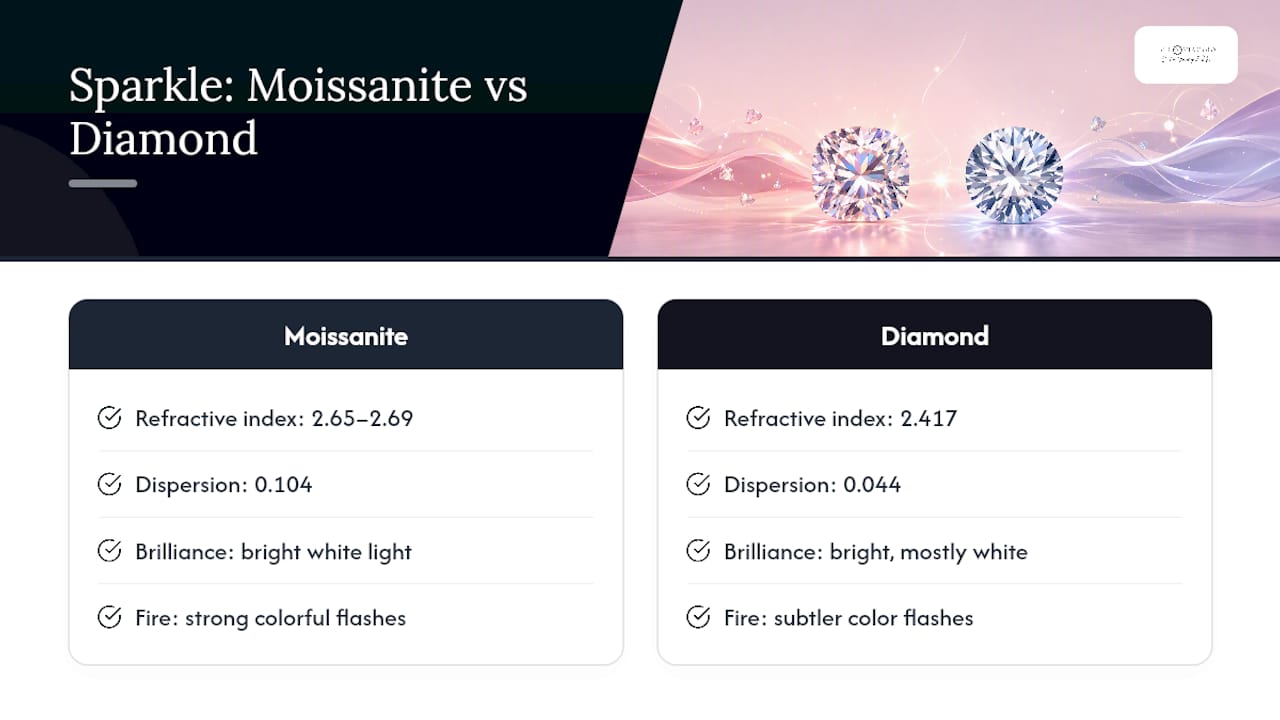
Moissanite has a refractive index of roughly 2.65 to 2.69, compared to diamond’s 2.417, and a dispersion rating of about 0.104 against diamond’s 0.044. In plain terms, moissanite bends light more sharply and splits it into spectral colors more aggressively than diamond does, according to the International Gem Society’s comparison data. That gap in dispersion, more than double diamond’s rating, is why moissanite throws visible flashes of red, blue, and green even in ordinary indoor light.

The numbers translate to a real visual difference. Diamond produces what jewelers call “brilliance”: bright, mostly white light bouncing back at you. Moissanite produces more “fire”: colorful flashes that shift and dance as the stone moves. Neither is objectively better. Some buyers find diamond’s cooler, whiter sparkle more classic. Others want the disco-ball effect moissanite delivers under restaurant lighting or dance floor spotlights.
Cut proportions matter here too. Diamond cutters have followed the Tolkowsky ideal cut for roughly a century, a set of angles calculated to maximize brilliance for diamond’s specific optical properties. Moissanite is doubly refractive, meaning light splits into two rays as it passes through the stone, and it needs different facet angles entirely. Cutters who simply apply diamond proportions to moissanite often end up with a stone that looks glassy or overly “disco ball” rather than balanced, according to JCK’s analysis of moissanite cutting. A well-cut moissanite tempers the fire into something more refined; a poorly cut one can look like a bag of glitter.
On camera, the difference shows up clearly. Moissanite’s stronger dispersion tends to photograph and film with more visible color flash, while diamond’s whiter brilliance reads as more understated in photos and video, a distinction worth knowing if your engagement photos or wedding videography are a priority. You can see this play out directly in side-by-side comparisons of how moissanite looks next to a diamond under different lighting conditions.
Pro Tip: If you’re choosing a stone partly for how it’ll look in engagement photos or a proposal video, ask to see it under both warm indoor light and outdoor daylight before you buy. The fire that looks stunning at a candlelit dinner can read as busy in bright sun.
Is Moissanite as Durable as a Diamond for Daily Wear?
Diamond is the hardest natural material on earth, rated a full 10 on the Mohs hardness scale. Moissanite sits close behind at approximately 9.25. On paper that gap looks small. In practice, it means both stones resist scratching from nearly everything you’ll encounter in daily life, including quartz countertops, sand, and most household surfaces.
Where the gap actually matters is edge cases:
- Manual laborers, mechanics, and gardeners who work with abrasive materials daily may see moissanite pick up more surface wear over years than a diamond in the same setting.
- Cleavage risk is a separate issue from hardness. Diamond can chip if struck at the wrong angle along its grain, while moissanite is actually more resistant to chipping and cracking under impact because it lacks diamond’s cleavage planes.
- Setters account for moissanite’s double refraction when designing prongs and bezels, since the doubling effect can make facet junctions look slightly blurred under magnification at certain angles.
For the overwhelming majority of everyday wearers, either stone will look pristine for decades with normal care. Diamond only pulls meaningfully ahead for people whose hands take a real physical beating on the job.
Do the 4Cs Apply to Moissanite the Way They Do to Diamond?
Diamond grading runs on the 4Cs framework: cut, color, clarity, and carat weight, typically documented in a GIA or IGI lab report for both natural and lab-grown stones. That report is your proof of what you’re actually buying, and it’s worth requesting regardless of your budget.
Moissanite doesn’t carry the same standardized third-party grading system, so most vendors use their own scale to describe color and clarity, often labeling stones “colorless,” “near-colorless,” or by a tier system unique to that seller. Because moissanite can carry a faint gray, green, or yellow undertone depending on quality, it’s worth asking to see the stone under natural daylight before committing, since undertones are easiest to spot outside artificial lighting.
Before buying either stone, request:
- A grading report (GIA or IGI) for any diamond, natural or lab-grown.
- The vendor’s own color and clarity grade for moissanite, in writing.
- Carat weight and measurements in millimeters, since moissanite and diamond of the same carat weight can look visually different due to density differences.
- Return or upgrade policy in case the stone doesn’t match expectations once you see it in person.
What Does a Moissanite or Diamond Ring Actually Cost?
Budget is where moissanite makes its strongest case. Moissanite typically runs a small fraction of a diamond’s price per carat for a stone with comparable face-up size, with market comparisons commonly citing moissanite priced much lower than a similarly sized diamond. That gap means a buyer working with a fixed budget can typically afford a noticeably larger moissanite center stone than the diamond equivalent at the same price point.
| Priority | Moissanite | Diamond |
|---|---|---|
| Cost per carat (illustrative) | Significantly lower | Significantly higher |
| Visual size per dollar | Larger stone for the same budget | Smaller stone for the same budget |
| Resale market | Limited secondary market | Established resale channels |
| Long-term value perception | Valued for beauty, not investment | Retains cultural and market recognition |
Resale is the honest asterisk on moissanite’s value pitch. Diamonds, particularly natural ones with strong certification, hold a place in an established resale and trade-in market that moissanite simply doesn’t have yet. If you’re buying a stone purely as a store of value, that’s a real consideration. But most engagement ring buyers aren’t buying an investment vehicle. They’re buying a ring they’ll wear every day for decades, and few couples ever resell an engagement ring regardless of what’s set in it.
The practical takeaway: if resale value isn’t a real factor in your decision (and for most buyers, it genuinely isn’t), moissanite lets you go bigger, bolder, or fancier on setting design without stretching your budget. If you specifically want a stone that functions partly as a long-term asset, diamond’s track record is longer and more predictable.
Which Stone Is More Ethical: Lab-Grown Moissanite or Diamond?
Moissanite’s near-total reliance on lab production gives it a straightforward sourcing story: no mining, no supply chain tied to conflict zones, and a smaller physical footprint per carat. Lab-grown diamonds offer a similar ethical profile within the diamond category itself, since they carry no mining footprint despite being chemically identical to natural stones.
Ask any seller these questions before you buy:
- Is this stone lab-grown or mined, and can you provide documentation either way?
- What certification or traceability system does the seller use to back sourcing claims?
- What is the seller’s stated environmental policy on energy use, waste, or offsets in production?
Reputable jewelers back these claims with documentation, not just a line in the product description. If a seller can’t answer specifics about sourcing, treat that as a red flag rather than an oversight. Belviaggiodesigns’ ethical moissanite guide walks through how the brand documents its own sourcing practices for buyers who want the paper trail before they commit.
How Can You Tell Moissanite From a Real Diamond?
Handheld thermal testers, once the go-to trick, aren’t reliable anymore. Moissanite conducts heat similarly enough to diamond that early thermal probes frequently misread it, which is why the jewelry trade shifted toward electrical conductivity testers and, increasingly, optical instruments.
The most reliable consumer-facing signal is birefringence: moissanite’s double refraction can sometimes be seen as a faint doubling of facet edges under magnification, something diamond never shows because it’s singly refractive. But that’s a trained-eye observation, not a guarantee.
For anything beyond casual curiosity, a lab report settles the question. Professional appraisers rely on GIA or IGI lab reports and instruments like the GIA iD100 rather than store-bought testers, because those tools can reliably separate natural diamond, lab-grown diamond, and simulants like moissanite at the atomic level.
Watch for these red flags when shopping online:
- Listings that call a stone a “diamond” with no mention of moissanite, lab-grown status, or carat weight.
- Photos that are suspiciously over-lit or filtered to exaggerate fire.
- No return policy or grading documentation offered on request.
How Should You Clean and Care for Either Stone?
Both stones handle warm water, mild dish soap, and a soft toothbrush just fine, done weekly or whenever the stone looks dull.
- Check prongs and the mounting every few months for looseness, since a chipped or shifted stone often traces back to a worn setting rather than the gem itself.
- Ultrasonic and steam cleaners are generally safe for both moissanite and diamond, but skip them if the ring has other, softer gemstones set alongside the center stone.
Pro Tip: Book a professional prong check once a year, even if the ring looks fine. Loose prongs are the leading cause of lost center stones, and it’s a five-minute fix when caught early.
How Do I Decide Between Moissanite and Diamond?
Match your top priority to the stone that actually serves it:
- Maximum sparkle and value for your budget: moissanite. You’ll get more fire and more visual size per dollar.
- Absolute hardness and long-term resale: diamond. No stone beats it on the Mohs scale, and its resale market is far more established.
- Camera and social media presence: moissanite tends to photograph with more visible color flash.
- Ethical sourcing without extra research: either stone works well if lab-grown, since both skip the mining supply chain entirely.
- Classic heirloom setting for a vintage-inspired ring: diamond’s cooler, whiter brilliance tends to suit antique-style settings better than moissanite’s fire.
On setting style, a larger moissanite center stone often works beautifully in a bold halo or a solitaire with a wide band, where its size and fire become the focal point. Diamond tends to shine in more delicate, minimalist settings where subtlety is the goal.
Before you buy either stone, get in writing: the grading report or vendor grade, carat weight and measurements, return policy, and sourcing documentation. Belviaggiodesigns’ guide on choosing the right moissanite ring walks through exactly what to ask for, setting by setting.
Why Stacy and Bel Viaggio Designs Know This Comparison Well
Buyers don’t need to choose between beauty and their budget, or between ethics and elegance. The right stone is the one that matches how you actually live and what you actually value.
Bel Viaggio Designs hand-crafts custom engagement rings in both moissanite and diamond, guiding buyers through sourcing, setting, and certification decisions at every step.
A Personal Note on Choosing Your Center Stone
I’ve come to believe there’s no universally “correct” answer here, only the right answer for your priorities. A budget-conscious couple who wants maximum sparkle shouldn’t feel like they’re settling with moissanite, and a traditionalist who wants a diamond’s resale security shouldn’t feel pressured into a trend they don’t want. If you’re stuck, reach out. We’ll talk through your priorities and help you land on the stone that actually fits your life.
— Stacy
Custom Rings in Moissanite or Diamond, Built Around You
Whichever stone you land on, the setting is where a ring goes from nice to genuinely yours. Bel Viaggio Designs hand-crafts engagement rings and wedding bands in both moissanite and diamond, with custom design options for buyers who want a stone in a setting no one else is wearing.
Our collection includes distinctive pieces like the black diamond halo engagement ring for buyers drawn to diamond’s classic durability with a modern twist, along with colored-stone options such as the emerald and diamond engagement ring for those blending diamond accents with other gemstones. Building a set? Explore men’s wedding bands in gold or platinum or titanium to complete the pair. Every custom order includes documentation on sourcing and grading, and payment plans are available so budget never has to dictate design. Start a custom design consultation today and get a quote built around the stone, setting, and budget that fit you.
Sources
For verifying claims independently: GIA’s guide to simulants and lab-grown diamonds covers identification standards; the International Gem Society’s comparison chart lists gemological metrics; JCK’s cut analysis explains moissanite’s unique faceting needs; Jewelry Towns’ market comparison summarizes current pricing trends.
- Simulants, Moissanite and Lab-Grown Diamonds | GIA 4Cs
- Properties of Diamond Simulants - International Gem Society
- Explaining Moissanite’s Cut - JCK
- Moissanite vs Diamond for Engagement Rings — The 2026 Comparison – Jewelry Towns
FAQ
Is Moissanite Better Than Diamond?
Neither is objectively better. Moissanite offers more fire and far more size for your budget, while diamond offers greater hardness and a stronger resale market, so the right choice depends on your priorities.
Does Moissanite Look Fake Next to a Diamond?
No, but it looks different. Moissanite throws more colorful fire, while diamond emphasizes white brilliance, so a side-by-side comparison shows two distinct optical personalities rather than one looking “less real.”
How Do You Tell Moissanite From a Diamond Without a Lab Report?
Trained eyes sometimes spot faint facet doubling in moissanite under magnification due to its double refraction, but this isn’t reliable for casual buyers. A GIA or IGI lab report is the only dependable method.
Is White Sapphire a Better Diamond Alternative Than Moissanite?
White sapphire is more affordable but rates only 9 on the Mohs scale and has far lower dispersion than moissanite, so it shows noticeably less sparkle and slightly less scratch resistance.
Do Moissanite Engagement Rings Hold Their Value?
Moissanite doesn’t carry the established resale market that diamonds do, so it’s better viewed as a beauty and budget choice rather than a long-term financial asset.