

TL;DR:
- Responsible sourcing integrates environmental, social, ethical, and economic criteria into procurement, extending accountability across the entire supply chain. It aims to manage risks, improve product quality, and build long-term value through active supplier engagement and transparent practices. Implementing responsible sourcing involves multi-tier mapping, cross-functional governance, and continuous assessment to ensure sustainable and ethical supply chain practices.
Responsible sourcing is defined as the practice of integrating environmental, social, and ethical criteria into procurement decisions alongside traditional metrics like price, quality, and delivery. It requires businesses to evaluate not just what they buy, but how and from whom they buy it. Organizations like Amazon Business, Sedex, and the Forest Stewardship Council (FSC) have built entire frameworks around this principle. Where conventional procurement stops at cost and lead time, responsible sourcing extends accountability across the full supply chain, from raw material extraction to final delivery.
What is responsible sourcing and why does it matter?
Responsible sourcing is built on three interconnected pillars: environmental safeguards, social and ethical safeguards, and economic resilience. Each pillar carries equal weight. Neglecting any one of them creates gaps that can expose a business to reputational damage, regulatory penalties, or supply disruptions.

The environmental pillar covers carbon emission reduction, ecosystem protection, and sustainable resource use. A clothing brand sourcing cotton from farms that deplete groundwater is not practicing responsible sourcing, regardless of how competitive the price is. The social and ethical pillar addresses fair labor practices, human rights protections, and respect for local communities. The economic pillar goes beyond paying invoices on time. It includes fair wages for workers, support for diverse supplier bases, and building supply relationships that remain viable over years, not quarters.
What makes responsible sourcing distinct from a standard supplier code of conduct is its scope. Codes of conduct are documents. Responsible sourcing is a management system. It requires active monitoring, supplier engagement, and continuous improvement rather than a signed agreement filed away after onboarding.
Pro Tip: Move beyond compliance checklists. A supplier who passes an annual audit but operates in a region with weak labor enforcement still represents a risk. Build ongoing dialogue with key suppliers rather than relying on point-in-time assessments.
Here are the core criteria businesses typically evaluate under a responsible sourcing framework:
- Environmental: Carbon footprint, water usage, waste management, biodiversity impact, use of certified sustainable materials (such as FSC-certified wood or Rainforest Alliance-certified crops)
- Social and ethical: Child labor prohibition, safe working conditions, freedom of association, non-discrimination policies, community impact
- Economic: Fair pricing that covers true production costs, supplier financial stability, local economic contribution, payment terms that do not squeeze smaller suppliers
- Governance: Anti-corruption policies, supply chain transparency, third-party certifications, traceability systems
Responsible sourcing also considers supply chain sustainability certifications, supplier diversity, local economic impact, and governance structures that go well beyond traditional cost metrics. This holistic approach reduces risk, improves supplier performance, and creates long-term efficiencies that pure cost-cutting cannot replicate.
How does responsible sourcing differ from ethical and sustainable sourcing?
These three terms appear interchangeably in corporate reports and supplier guides, but they carry distinct meanings. Understanding the differences helps businesses choose the right framework for their goals.
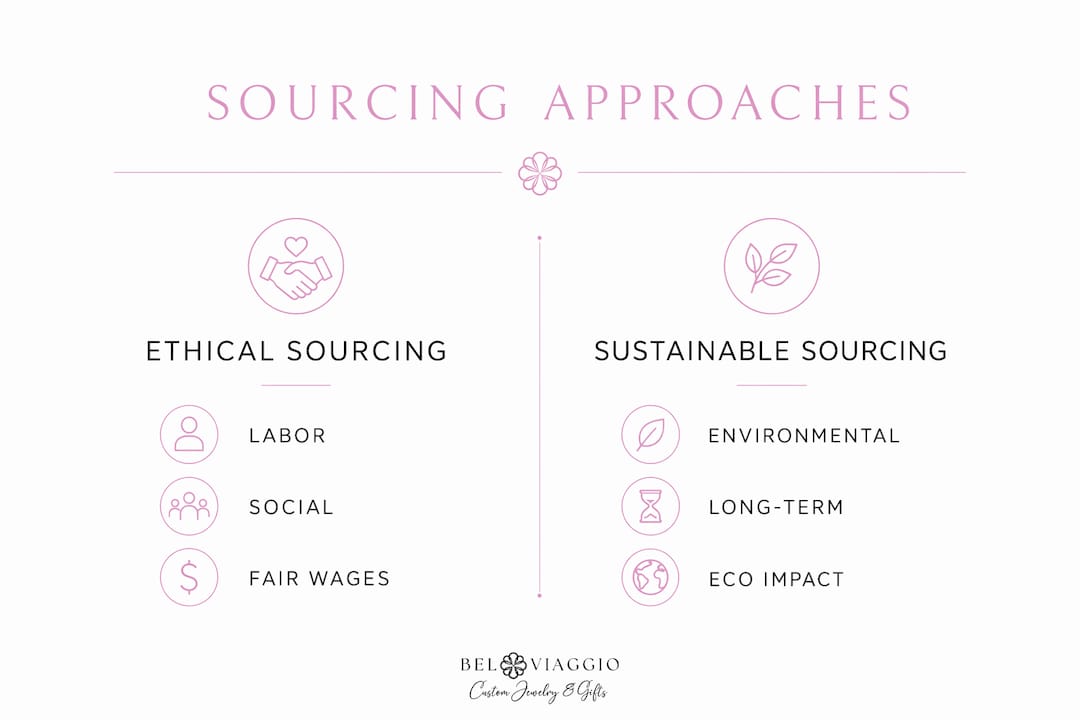
Ethical sourcing focuses primarily on labor and social conditions. It asks: are the people making this product treated fairly? Ethical sourcing frameworks target forced labor, child labor, unsafe working conditions, and wage theft. Organizations like the Fair Labor Association and the Business and Human Rights Resource Centre operate squarely within this domain.
Sustainable sourcing shifts the lens toward environmental and long-term impact. It asks: can this supply chain continue operating without degrading the natural systems it depends on? Certifications like the FSC label for timber or the Marine Stewardship Council (MSC) label for seafood are sustainable sourcing tools.
Responsible sourcing functions as the umbrella term that incorporates both. It adds economic criteria, governance requirements, and a systems-level view that neither ethical nor sustainable sourcing fully captures on its own. The table below summarizes the key distinctions:
| Concept | Primary focus | Key criteria | Example frameworks |
|---|---|---|---|
| Ethical sourcing | Labor and social conditions | Fair wages, no forced labor, safe workplaces | Fair Labor Association, SA8000 |
| Sustainable sourcing | Environmental and long-term impact | Carbon reduction, biodiversity, resource efficiency | FSC, MSC, Rainforest Alliance |
| Responsible sourcing | All of the above plus economic and governance factors | Full ESG alignment, supply chain transparency, diversity | Sedex, UN Global Compact, ISO 20400 |
The practical implication is this: a company can claim ethical sourcing by auditing its direct factory partners, and claim sustainable sourcing by purchasing carbon offsets. But responsible sourcing requires both, plus visibility into lower-tier suppliers, governance structures that hold the whole system together, and economic relationships that are genuinely fair rather than just contractually compliant.
For individuals buying jewelry, food, or clothing, understanding this distinction helps decode marketing claims. “Ethically sourced” on a product label addresses labor. “Sustainably sourced” addresses environment. “Responsibly sourced” should address both, and more.
Why the benefits of ethical sourcing extend beyond good intentions
The business case for responsible sourcing is grounded in risk management, not idealism. Suppliers adhering to ethical standards produce higher-quality goods with fewer defects. That single fact translates directly into lower return rates, fewer warranty claims, and stronger customer satisfaction scores.
Supply chain transparency reduces exposure to disruption. When a business knows exactly where its materials come from and under what conditions, it can identify vulnerabilities before they become crises. The 2021 global supply chain disruptions exposed how many companies had no visibility beyond their Tier 1 suppliers. Businesses with responsible sourcing programs in place recovered faster because they had mapped their supply chains in advance.
Brand reputation is increasingly tied to sourcing behavior. Consumers, particularly younger demographics, research the supply chains behind the products they buy. A single viral story about labor abuses in a supplier’s factory can erase years of brand equity. Responsible sourcing is, among other things, a form of reputational insurance.
Responsible sourcing is a strategic lens for delivering long-term customer value, not just a compliance exercise. The companies that treat it as a core business function, rather than a legal obligation, consistently outperform those that treat it as a checkbox.
Regulatory pressure is also accelerating. The EU Corporate Sustainability Due Diligence Directive and the U.S. Uyghur Forced Labor Prevention Act both impose legal obligations on companies to demonstrate responsible sourcing practices. Businesses that have already built these systems face far lower compliance costs than those scrambling to catch up.
Pro Tip: The most common misconception about responsible sourcing is that it raises costs. In practice, true production costs include environmental and social externalities that irresponsible sourcing simply defers. Responsible sourcing makes those costs visible and manageable rather than hidden and catastrophic.
How to implement responsible sourcing in your supply chain
Implementation requires a structured approach, not a policy document. The following steps reflect how organizations that have built effective programs actually operate.
-
Map your supply chain beyond Tier 1. Most businesses know their direct suppliers. Responsible sourcing requires multi-tier visibility to identify hidden risks in subcontractors and raw material sources. Tools like Sourcemap, EcoVadis, and supply chain mapping software help build this picture.
-
Assess suppliers against defined criteria. Develop a supplier assessment framework that covers environmental performance, labor practices, governance, and economic fairness. Sedex’s SMETA audit methodology and the UN Global Compact’s principles are widely used starting points. Score suppliers and segment them by risk level.
-
Build cross-functional governance. Cross-functional collaboration between procurement, legal, and sustainability teams is not optional. Without it, responsible sourcing becomes a sustainability team project that procurement ignores when cost pressure rises. Create a governance structure with shared accountability and clear escalation paths.
-
Engage suppliers as partners, not just vendors. Share your responsible sourcing expectations early and provide support for suppliers who need to improve. Large buyers like Unilever and Patagonia have demonstrated that supplier development programs produce better long-term outcomes than punitive auditing alone.
-
Measure, report, and iterate. Treat responsible sourcing as an adaptive management system with continuous metrics updates and feedback loops. Track supplier performance scores over time, report progress against ESG targets, and update your criteria as regulations and best practices evolve.
-
Communicate transparently with stakeholders. Publish supplier lists, sourcing policies, and progress reports. Transparency builds trust with customers, investors, and regulators. It also creates accountability within your own organization.
Pro Tip: Avoid siloed departmental approaches. When procurement owns cost, sustainability owns ESG, and legal owns compliance, responsible sourcing falls through the gaps between all three. Intentional governance structures that link these teams are what separate programs that work from programs that look good on paper.
Key takeaways
Responsible sourcing integrates environmental, social, ethical, and economic criteria into procurement, making it the most complete framework for managing supply chain risk and building long-term business value.
| Point | Details |
|---|---|
| Responsible sourcing definition | It integrates environmental, social, ethical, and economic criteria into procurement alongside price and quality. |
| Umbrella term | Responsible sourcing encompasses both ethical sourcing (labor focus) and sustainable sourcing (environmental focus). |
| Business benefits | Suppliers meeting ethical standards produce fewer defects, reducing returns and improving customer satisfaction. |
| Implementation priority | Multi-tier supply chain mapping uncovers hidden risks that Tier 1 audits alone cannot detect. |
| Governance structure | Cross-functional teams linking procurement, legal, and sustainability are required for responsible sourcing to function. |
Why responsible sourcing is a business strategy, not a side project
I have watched companies spend significant resources building responsible sourcing policies that never change how a single purchase order gets written. The policy exists. The practice does not. That gap is the central challenge of this field, and it is far more common than most corporate sustainability reports admit.
The turning point I have seen in organizations that get it right is when responsible sourcing criteria enter the supplier selection process before a contract is signed, not after. When a procurement manager is evaluated on supplier ESG scores alongside cost savings, behavior changes. When legal and sustainability teams sit in on supplier negotiations, the conversation changes. The challenge of turning ESG goals into operational daily supplier engagement is real, but it is solved through governance design, not training programs.
The other thing worth saying plainly: responsible sourcing is not a finished state. Global supply chains shift constantly. A supplier that was compliant last year may have changed ownership, moved production, or cut corners under margin pressure. The organizations that treat this as a living system, with regular reassessment and genuine supplier relationships, are the ones that catch problems before they become headlines. The ones that treat it as an annual audit cycle are the ones that get surprised.
Technology is accelerating what is possible. Blockchain-based traceability, AI-powered supplier risk monitoring, and platforms like EcoVadis and Sedex are making multi-tier visibility achievable for mid-size businesses, not just multinationals. The tools exist. The question is whether leadership is willing to build the governance structures that put those tools to use.
— Stacy
Responsible sourcing in jewelry: how Belviaggiodesigns puts it into practice
Responsible sourcing is not an abstract principle in fine jewelry. It determines whether the diamond in an engagement ring came from a conflict zone or a certified ethical source, and whether the gold was mined under safe conditions or not. Belviaggiodesigns applies responsible sourcing principles directly to its collections, with lab grown diamonds that eliminate mining entirely and traceable gemstone sourcing that customers can verify. Every piece is handcrafted with materials selected for both quality and ethical integrity. If you are shopping for an engagement ring or wedding band and want to understand exactly what responsible jewelry sourcing looks like in practice, Belviaggiodesigns’ collections are a concrete starting point. Explore the full range of ethically sourced options at Belviaggiodesigns.com.
FAQ
What is the responsible sourcing definition?
Responsible sourcing is the practice of integrating environmental, social, and ethical criteria into procurement decisions alongside traditional factors like price, quality, and delivery. It functions as an umbrella framework that includes both ethical sourcing and sustainable sourcing, with added emphasis on economic fairness and governance.
How does responsible sourcing differ from ethical sourcing?
Ethical sourcing focuses specifically on labor and social conditions, such as fair wages and safe workplaces. Responsible sourcing is broader, incorporating environmental protection, economic resilience, governance standards, and supply chain transparency in addition to labor ethics.
What are the main benefits of responsible sourcing for businesses?
Responsible sourcing reduces supply chain risk, improves product quality, strengthens brand reputation, and supports regulatory compliance with frameworks like the EU Corporate Sustainability Due Diligence Directive. Suppliers meeting ethical standards consistently produce goods with fewer defects, which lowers operational costs over time.
How do you implement responsible sourcing in a supply chain?
Start by mapping your supply chain beyond direct suppliers to identify hidden risks in lower tiers. Then assess suppliers against defined environmental, social, and governance criteria, build cross-functional governance linking procurement, legal, and sustainability teams, and treat the process as a continuous management system rather than a one-time audit.
Is responsible sourcing only relevant for large corporations?
Responsible sourcing applies to businesses of any size. Mid-size companies can use platforms like EcoVadis and Sedex to assess supplier performance without enterprise-level resources. For individual consumers, understanding responsible sourcing helps decode product labels and make purchasing decisions aligned with personal values.
Recommended
- What is responsible jewelry? A 2026 guide for ethical wedding rings – Bel Viaggio Designs, LLC
- How to ethically source jewelry for your wedding – Bel Viaggio Designs, LLC
- Ethical gemstone selection guide for engagement rings 2026 – Bel Viaggio Designs, LLC
- Ethical gemstone selection guide for engagement rings 2026 – Bel Viaggio Designs, LLC