

TL;DR:
- Educating yourself about jewelry basics, certifications, and ethical sourcing builds confidence and helps you ask smarter questions. This knowledge enables you to verify documentation, prevent overpaying, and align your purchase with your values. Ultimately, informed shopping transforms a stressful process into a meaningful partnership and lasting confidence.
Picking an engagement or wedding ring feels exciting until it doesn’t. Suddenly you’re surrounded by certifications you can’t decode, retailers using words like “conflict-free” without any proof, and price tags that seem impossible to compare. Most couples make this purchase once in a lifetime, with little prior knowledge and a lot of emotional investment. The good news is that even a modest investment in jewelry education transforms that confusion into genuine confidence, helping you ask smarter questions, spot misleading claims, and walk away knowing your ring truly reflects both your love and your values.
Table of Contents
- Why education matters: Confidence, clarity, and control
- Demystifying diamonds, gemstones, and documentation
- From labels to evidence: Education and ethical jewelry choices
- Limits of buyer education: Not the only factor
- How to educate yourself: Essential resources and steps
- Our take: Why education is the best insurance for your jewelry journey
- Find your perfect, personalized piece with expert guidance
- Frequently asked questions
Key Takeaways
| Point | Details |
|---|---|
| Education drives confidence | Understanding key attributes and documents gives couples more control and clarity when shopping for jewelry. |
| Proof beats promises | Verifying third-party certifications and ethical sourcing is essential for trust and value. |
| Education enables diligence | Knowing what questions to ask and what records to request is crucial for personalized, ethical jewelry choices. |
| Culture and value matter too | While education helps, personal values and budget can be just as influential in final decisions. |
| Actionable learning steps | Couples can quickly become informed shoppers by using straightforward resources and checklists. |
Why education matters: Confidence, clarity, and control
Let’s explore why education is the real game-changer for couples shopping for jewelry.
Walking into a jewelry store or browsing a retailer’s website without any foundational knowledge puts you at an immediate disadvantage. Sellers know their products inside and out. You might not even know what questions to ask. That information gap can cost you money, peace of mind, or both.
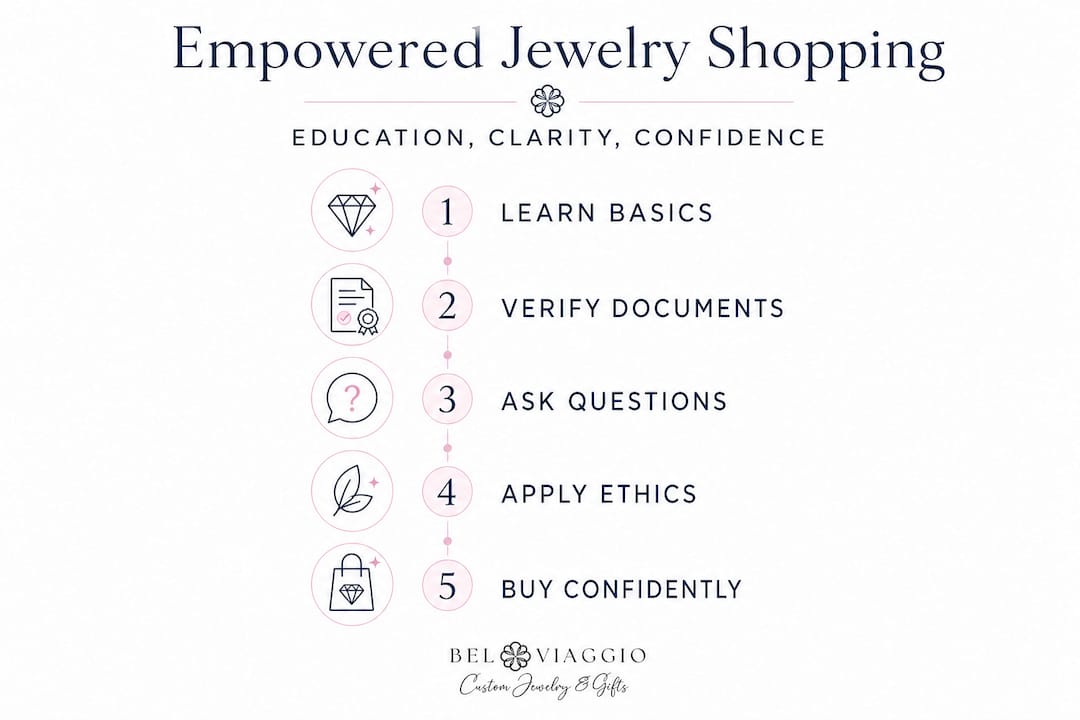
Education flips that dynamic entirely. Buyer-facing jewelry education reduces confusion and helps couples shop with far more confidence, especially for high-stakes engagement ring purchases where both emotion and money are on the line. When you understand the basics, you become an engaged, proactive shopper rather than a passive one who simply trusts whatever the salesperson says.
Here’s what foundational jewelry education actually covers:
- The 4Cs: Cut, color, clarity, and carat are the four pillars of diamond grading. Understanding the 4Cs allows you to compare stones accurately and understand why two diamonds with similar carat weights can have dramatically different prices.
- Certifications and grading reports: Not every certificate is created equal. Knowing who issued the certificate and what it actually confirms is critical.
- Stone origin: Whether a diamond is mined or lab-grown affects both price and environmental footprint. Understanding the difference lets you make a choice aligned with your values.
- Market pricing norms: Knowing average price ranges for specific grades prevents overpaying.
“The couple who does their homework before stepping into a showroom will always leave with a better ring, at a better price, with fewer regrets.”
Pro Tip: Before you visit any jeweler or browse a single product page, spend just two hours reading about the 4Cs and how certifications work. That small investment will immediately protect you from the most common and costly buying mistakes.
Couples who take time to learn consistently report fewer regrets after their purchase. They feel ownership over the decision, not just the ring. That confidence carries forward into the wedding planning process and beyond.
Demystifying diamonds, gemstones, and documentation
If education is so important, what exactly does it teach you to look for and ask about?
Certifications are the single most misunderstood element of jewelry shopping. Many buyers assume that any certificate attached to a ring is equally trustworthy. It isn’t. There’s a significant difference between a report issued by an independent gemological lab and one produced in-house by a retailer.
| Feature | GIA certification | Seller-only certification |
|---|---|---|
| Issuing body | Independent gemological lab | Retailer or brand |
| Reliability | Globally recognized standard | Varies widely |
| Stone-specific report number | Yes, laser-inscribed on stone | Often not verified |
| Cost impact | Slightly higher upfront, better resale | Lower initial cost, less trust |
| Useful for comparison | Highly reliable | Difficult to compare across stores |
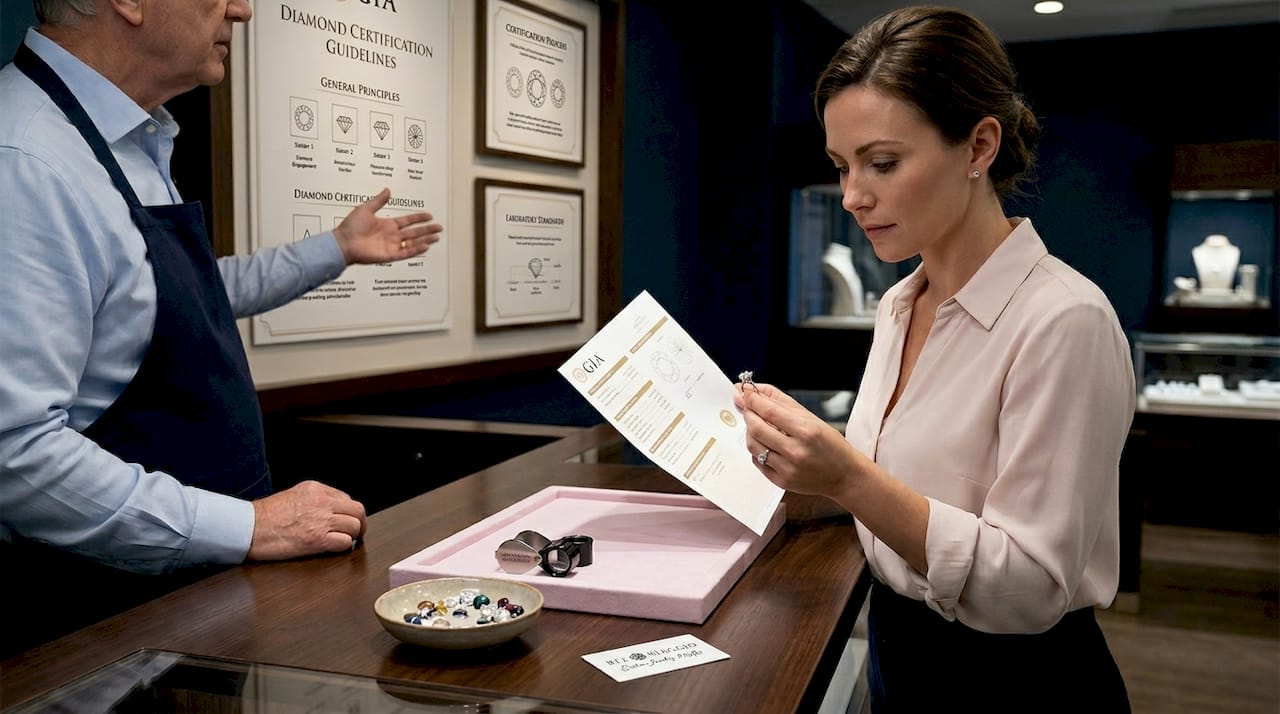
The difference matters practically. A GIA-graded diamond gives you a report number that can be verified online within minutes, matched directly to the stone you’re holding. This certification guidance is essential for ensuring you receive exactly what you paid for, not a close approximation.
Here are the key questions every couple should ask before purchasing:
- Who issued the grading report, and can I verify it independently?
- Does the report number match the laser inscription on the stone itself?
- What is the documented origin of this stone?
- If the ring is custom-made, what documentation covers the metal and any secondary stones?
- What is the return or upgrade policy if certification details are ever disputed?
Education also teaches you about the differences between gemstone types. Moissanite, sapphires, rubies, and emeralds each have distinct grading systems and origin considerations. Understanding those systems, even at a basic level, prevents the common mistake of comparing unlike items at similar price points.
Pro Tip: Always verify that the certification matches the actual stone, not just the paperwork. Ask a jeweler to confirm the report number matches the inscription under a loupe. Reputable retailers welcome this question. Those who hesitate are a red flag.
Engagement ring documentation is both emotional and operational: it teaches buyers which questions to ask and which documents to require, such as grading reports and report-number matching. This process directly reduces the information gap between buyer and seller, which is where most costly mistakes originate.
From labels to evidence: Education and ethical jewelry choices
Equipped with an understanding of gemstones and documents, you can now apply that same scrutiny to ethical considerations.
Words like “ethically sourced,” “sustainable,” and “conflict-free” are everywhere in the jewelry market. They feel reassuring. But in an industry with a complex, global supply chain, these terms are only meaningful when backed by verifiable evidence. Education teaches you to move from label acceptance to genuine diligence.
Consumer education on ethical jewelry shifts buyers from trusting marketing claims to understanding what “ethical” should actually mean and what proof to request across the entire value chain, from mine or lab to retail counter.
| Common claim | What to ask for | Acceptable documentation |
|---|---|---|
| Conflict-free | Kimberley Process certificate | Third-party verified chain of custody |
| Ethically sourced | Origin traceability | Audit reports, supplier certifications |
| Lab-grown | Lab of origin documentation | IGI or GIA lab-grown report |
| Sustainable metal | Recycled gold documentation | Certified by recognized recycler |
| Fair trade | Fair trade certification | Fair Trade certification number |
These are not difficult requests to make. A retailer committed to ethical sourcing will have these documents ready and will appreciate that you’re asking. Those who deflect or use vague language in response to specific requests deserve closer scrutiny.
Practical cues to help you decide when to dig deeper versus when you’ve reached reasonable confidence:
- Dig deeper when a retailer uses ethical language on marketing materials but can’t provide documentation on request.
- Reasonable confidence when you receive third-party certification with verifiable report numbers, clear supplier information, and a transparent return policy.
- Dig deeper when the price seems far below market rates for ethically sourced materials (low prices and ethical supply chains rarely coexist).
- Reasonable confidence when the retailer proactively shares audit documentation and welcomes your verification process.
“Ethical shopping isn’t about trusting the right brand. It’s about building the skill to verify any brand.”
Using a diligence checklist before purchasing gives you a reliable structure for applying your ethics without getting overwhelmed. For personalized ethical rings, the same principles apply: every customization option should come with clear documentation about the origin of each component.
Limits of buyer education: Not the only factor
While education clearly plays a major role, it’s important to address where its influence has limits.
Education is powerful. It’s also not the only thing shaping a jewelry purchase. Research on consumer priorities shows that cultural tradition, budget constraints, and brand recognition can each outweigh educational factors when it comes to the final buying decision.
One study on gold jewelry purchase drivers found no significant relationship between respondents’ educational qualifications and multiple purchase criteria, including price, branded quality, product variety, and delivery speed. Education level, in the formal academic sense, doesn’t automatically translate to better jewelry decisions. It’s specifically jewelry education that makes the difference.
Here are real situations where other factors take precedence:
- A family with strong cultural ties to a specific gemstone or metal may prioritize tradition over certification details.
- A couple working within a strict budget may accept a retailer certificate over a GIA report to save money on the immediate purchase.
- Brand loyalty or a recommendation from a trusted family member may override independent research for some buyers.
- Time pressure, such as an upcoming anniversary or proposal deadline, can short-circuit the research process entirely.
None of these scenarios mean education is useless. They mean education is one powerful tool in a more complete decision-making process. Couples benefit most when they pair jewelry knowledge with realistic budgeting, cultural self-awareness, and time planning.
“Knowing what matters most to you personally is the foundation. Education helps you protect and honor that foundation.”
For those working with a budget, exploring ethical shopping on a budget can show you how to maintain your values without overextending financially. Good choices exist at every price point when you know what to look for.
How to educate yourself: Essential resources and steps
To make all of this practical, here’s a clear road map for how couples can take the first steps without getting overwhelmed.
The most common barrier to jewelry education is not complexity. It’s not knowing where to start. The resources that exist are excellent, but the sheer volume can feel paralyzing. The answer is structure.
Follow these steps in order:
- Start with the 4Cs. Read the official GIA resource on diamond grading to get a reliable foundation. Twenty minutes here saves hours of confusion later.
- Explore your gemstone options. Use an ethical gemstone selection guide to understand differences between mined diamonds, lab-grown diamonds, moissanite, and colored gemstones.
- Build your question list. Write down at least five questions you want to ask any jeweler before purchasing. Include certification, origin, customization options, and return policy.
- Research customization. Browse custom engagement ring ideas to understand what’s possible at various price points and how to communicate your vision effectively.
- Verify using third-party tools. When a retailer provides documentation, use online verification tools to confirm report numbers before finalizing your purchase.
- Consult a trusted expert. Once you’ve done your own research, speak with a knowledgeable jeweler who welcomes your questions rather than deflecting them.
Education works by making verification easier, teaching couples to look for third-party documentation and understand what it covers so that ethical and quality claims can be checked rather than trusted blindly. That’s not skepticism. It’s smart, empowered shopping.
Pro Tip: Keep a dedicated notes document or folder on your phone where you track the questions you’ve asked, the answers you received, and the documentation you’ve collected from each jeweler. Reviewing this side by side across multiple retailers makes comparison much clearer and prevents you from forgetting key details in the excitement of the moment.
Our take: Why education is the best insurance for your jewelry journey
Most couples invest significant energy into venue research, catering choices, and floral arrangements for their wedding. Very few invest the same energy into understanding the piece of jewelry they will wear every single day for the rest of their lives. That imbalance is worth naming.
The jewelry industry, like any industry, operates more profitably when buyers don’t ask hard questions. Vague ethical claims, proprietary certifications, and complex grading language can all create a fog that benefits the seller, not the buyer. We’re not saying retailers are dishonest. We’re saying the system rewards buyers who show up prepared.
Here’s the contrarian truth: learning just a little about diamonds, certifications, and ethical sourcing is more valuable than shopping at the “right” brand. A couple with basic 4Cs knowledge and a short verification checklist will consistently outperform an uninformed buyer spending twice as much at a luxury retailer.
Education also reframes the entire experience. Instead of feeling anxious about being taken advantage of, you feel engaged. You feel like a partner in the process. That shift in agency matters deeply for a purchase this personal and this permanent.
We also believe that the process of educating yourself about your jewelry can become part of your relationship story. Researching together, discussing what matters most to each of you, and aligning on values before you even look at rings builds a stronger foundation than simply pointing to something beautiful in a showcase.
Look into a responsible jewelry guide together. Make it a shared project. The ring is a symbol, and the way you choose it can carry meaning too.
Find your perfect, personalized piece with expert guidance
Ready to shop with full confidence? Here’s how to find your ideal piece, backed by trusted guidance.
At Bel Viaggio Designs, we believe that an informed customer is the best kind of customer. Every piece in our collection, from lab-grown diamond engagement rings to custom wedding bands and personalized gemstone jewelry, comes with full transparency on sourcing, certification, and craftsmanship. We welcome your questions because we’ve built our process to answer them.
Whether you’re looking for a fully custom design that reflects your unique story or exploring our ready-to-personalize collections, our team supports your decision at every step. Browse our ethically sourced engagement rings, moissanite options, and handcrafted wedding bands. Every piece pairs beauty with accountability, and every purchase is backed by documentation you can verify. When you’re ready to move from learning to choosing, we’re here to make that step feel as exciting as it should be.
Frequently asked questions
What are the 4Cs and why do they matter for engagement ring shopping?
The 4Cs, which are cut, color, clarity, and carat, are the four grading pillars that determine a diamond’s beauty and value, and knowing them helps you compare options accurately and avoid overpaying for qualities that are invisible to the naked eye.
How can I be sure my jewelry is ethically sourced?
Request third-party certifications and origin documentation directly from your jeweler, since education on ethical sourcing teaches you to move past marketing language and ask for the specific proof that verifies each claim.
Does my education level affect how well I shop for jewelry?
Formal academic education doesn’t automatically improve jewelry decisions, as one gold jewelry study found no significant link between educational qualifications and purchase criteria, but targeted jewelry education genuinely helps any buyer make more informed choices.
Can I trust all jewelry certifications?
Not all certifications carry equal weight; prioritize reports from independent labs like GIA, and always verify that the report number matches the inscription on your specific stone before finalizing your purchase.
What is the first step to becoming an informed jewelry shopper?
Start by reading trusted gemological lab guides to build your foundation, because education makes verification easier by teaching you which documents to request and how to confirm their authenticity before committing to any purchase.
Recommended
- Smart Tips for Shopping On-Sale Jewelry Ethically and Affordably – Bel Viaggio Designs, LLC
- How visual storytelling elevates ethical, personalized jewelry – Bel Viaggio Designs, LLC
- Visual Jewelry Inspiration: Ethical Engagement & Wedding Rings – Bel Viaggio Designs, LLC
- Stunning gemstone jewelry examples for ethical couples – Bel Viaggio Designs, LLC