

TL;DR:
- Visual storytelling strengthens the emotional and ethical connection between couples and their jewelry.
- Techniques like process videos, origin visuals, and authentic UGC build trust and authenticity.
- Genuine visual narratives reflect true craftsmanship and ethics, reducing buyer skepticism.
Beauty alone has never been the reason a ring becomes irreplaceable. The moment you see where a stone was born, watch an artisan shape the band with their hands, or read the story of a couple whose values mirror your own, something shifts. That ring stops being a purchase and starts becoming a promise. For couples who care about ethics, individuality, and lasting meaning, visual storytelling is the bridge between a product page and a genuinely personal commitment. This article breaks down exactly how those visuals work, what makes them trustworthy, and how to use them confidently in your own jewelry journey.
Table of Contents
- Why visual storytelling matters for modern jewelry couples
- Key visual storytelling techniques in fine jewelry
- How visual stories build trust in ethical, personalized jewelry
- Common pitfalls: authenticity, trends, and over-staging
- Our take: True visual storytelling goes beyond trends and technology
- Discover meaningful, ethical jewelry with us
- Frequently asked questions
Key Takeaways
| Point | Details |
|---|---|
| Visuals build trust | Origin journeys and ethical materials shown through visuals help couples feel confident in their jewelry purchase. |
| Personal stories matter | Showcasing your unique milestones or designs through imagery makes rings more meaningful for engagements and weddings. |
| Authenticity is essential | Look for visuals backed by real evidence like provenance docs and artisan stories to avoid inauthentic marketing. |
| Smart techniques drive connection | Using lifestyle, process, and origin-focused visuals leads to higher engagement and trust for both buyers and brands. |
Why visual storytelling matters for modern jewelry couples
Something has changed in how couples choose their rings. It is no longer enough for a stone to sparkle or a band to shine under studio lighting. Today’s couples, especially those planning ethically grounded, personalized celebrations, want to understand where their jewelry comes from, who made it, and what it stands for. That shift in expectation has made visual storytelling one of the most powerful forces in the fine jewelry world.
Younger couples in particular arrive at the jewelry buying process with sharp questions. Is this stone conflict-free? Was the gold mined responsibly, or is it recycled? Can I see the artisan’s hands shaping this setting? These are not abstract preferences. They reflect deeply held values about representation, accountability, and the kind of world you want your love story to live inside. Jewelry purchases, for many couples, are among the most emotionally significant they will ever make. The visual experience surrounding that purchase either supports those values or undermines them.
“Visual storytelling transforms jewelry from commodity to emotional symbol, ideal for couples valuing personalization and ethics.” 6 jewelry visual strategies
Here is why visuals carry so much weight in this specific context. Words on a product page can describe a stone’s carat weight or a ring’s metal type with precision, but they cannot make you feel the relationship between a couple and the piece they chose together. Visuals can. A photograph of two hands interlocked, both wearing simple, ethically sourced bands, communicates an entire value system without a single word. A short video of a goldsmith pouring recycled metal into a mold tells you everything about that brand’s commitment to sustainability.
This is why lifestyle imagery in jewelry is not just a marketing tactic. It is a form of communication that resonates at an emotional frequency that words simply cannot reach on their own.
What makes visual storytelling especially powerful in jewelry purchasing is its ability to do several things at once:
- Reflect your values. Visuals signal ethics, sustainability, and craftsmanship without requiring a deep read of policy pages.
- Mark milestones. Lifestyle photos place a ring inside real romantic moments, helping you imagine it as part of your own story.
- Foster authenticity. Behind-the-scenes shots and origin imagery remove the artifice that often surrounds luxury products.
- Build an emotional bridge. Narrative visuals connect the artisan’s intention with your personal meaning.
For ethical jewelry inspiration that genuinely reflects your values, visual storytelling is where that search begins and where it becomes meaningful.
Key visual storytelling techniques in fine jewelry
With the need for visual storytelling clearly established, the logical next question is: what does it actually look like in practice? There are several proven techniques that jewelry designers and ethical brands use to bring their stories to life, and understanding them helps you recognize quality and intention when you see it.
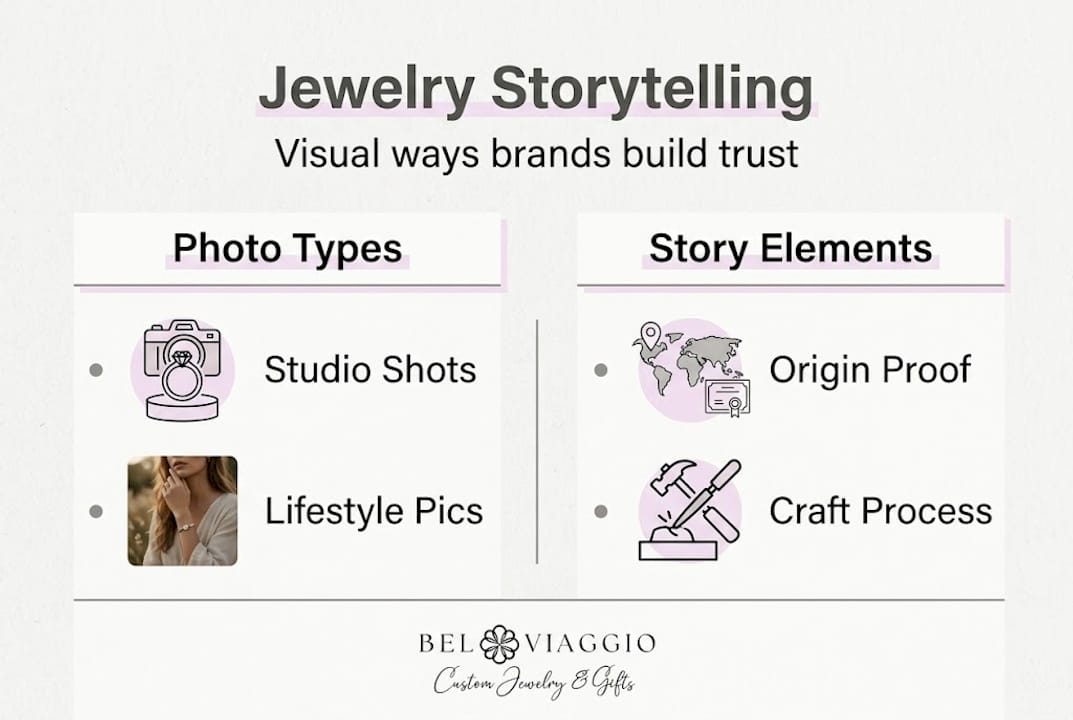
1. Professional still photography Close-up, high-resolution images remain the backbone of fine jewelry presentation. They reveal texture, setting quality, and stone clarity in ways that a generic product render never could. A well-lit photograph of a cushion-cut moissanite sitting in a hand-crafted pavé setting communicates craftsmanship immediately.
2. Lifestyle and narrative photography This is where emotion enters. Rather than isolating the ring against a white background, lifestyle photography places it within a human moment: a morning coffee, a quiet beach, a candlelit proposal. These images make the ring feel lived-in and real before it is even purchased.
3. Behind-the-scenes and process content Short videos or photo sequences showing the design and crafting process, from hand-drawn sketches to finished settings, provide a transparent look at how a piece comes to life. This type of content is among the most trusted by ethically conscious consumers because it is difficult to fabricate convincingly.
4. Origin journey visuals Images or videos that trace a stone’s path from ethical source to finished ring are increasingly common among responsible brands. These might include certifications, sourcing maps, or footage from partner mines and labs.
5. User-generated content (UGC) When real couples share their rings in authentic, everyday settings and tag the brand, that content functions as both social proof and storytelling. UGC is unscripted, which makes it uniquely persuasive.
Key methodologies such as professional photography, lifestyle shots, process videos, origin journeys, and UGC are seen across successful campaigns from brands like Pandora and Mizuki, each reinforcing the brand’s ethical and craft narrative differently.
| Visual technique | Description | Engagement impact |
|---|---|---|
| Professional stills | High-resolution, controlled lighting shots | Builds initial confidence in quality |
| Lifestyle photography | Ring placed in real-world, emotional settings | Drives personal emotional connection |
| Process and craft videos | Shows artisan hands, tools, design stages | Signals transparency and craftsmanship |
| Origin journey content | Stone sourcing visuals, certifications | Builds ethical trust |
| User-generated content | Real couples sharing their own ring stories | Provides social proof and relatability |
Understanding these techniques also helps you recognize the benefits of custom jewelry more clearly. When you see the process behind a custom piece visualized in detail, it becomes obvious why bespoke designs carry emotional weight that mass-produced rings simply cannot match.
Pro Tip: When browsing a jewelry brand’s website or social media, look specifically for process photos and origin imagery. If a brand can show you the journey of your stone or band from raw material to finished piece, that transparency is one of the strongest signals of genuine ethical commitment. Pair that with ethical sourcing tips to strengthen your buying confidence.
The brands doing this best understand that ethical origin storytelling is not a campaign. It is a continuous, visible commitment that shows up in every image they publish.
How visual stories build trust in ethical, personalized jewelry
Knowing the techniques is one thing. Understanding how they build genuine trust is where the real purchasing power lies. For couples who are investing significant money and emotion into an ethically sourced, personalized ring, trust is not optional. It is the foundation of the entire decision.
Transparency through visuals works in a very specific way. When a brand shows you a Responsible Jewellery Council certification alongside an image of the specific mine or lab your stone originated from, you are no longer relying on marketing copy. You are looking at evidence. That visual evidence does something that a “we believe in ethics” tagline never can: it shifts the experience from persuasion to proof.
Jewelry visual storytelling that highlights origin journeys, sustainability proofs like recycled gold imagery, and personalization details builds the kind of trust that converts browsers into lifelong customers. Couples who see their values reflected in a brand’s visual language feel seen, not sold to.

Ethical transparency in jewelry increases trust significantly, especially in the heirloom category, where the long-term meaning of a piece is as important as its immediate beauty. Research consistently shows that authenticity efforts tied to real documentation and visible process reduce buyer skepticism and increase satisfaction after purchase.
Here is what ethical, personalized visual storytelling concretely signals to buyers:
- Stone origin imagery showing lab-grown or traceable gemstone sources
- Recycled metal proofs including before-and-after imagery or sourcing partnerships
- Artisan portraits and hands-on craft shots that confirm human skill over mass production
- Certification visuals displayed alongside product images, not buried in fine print
- Custom design previews showing your specific engraving, stone choice, or setting style before production begins
These elements, when woven into a brand’s visual language consistently, communicate that what you are buying is exactly what it claims to be. That consistency is critical for couples choosing between brands.
| Visual trust signal | What it communicates | Buyer impact |
|---|---|---|
| Origin imagery | Stone source is traceable and ethical | Reduces purchase anxiety |
| Recycled metal documentation | Sustainability is a real practice | Aligns with eco-conscious values |
| Artisan process shots | Craftsmanship is genuine | Justifies premium pricing |
| Certification imagery | Third-party ethics validation | Builds credibility |
| Custom preview visuals | Your design is personalized | Increases emotional investment |
For couples specifically seeking transparency in sourcing, visual proof is the fastest path to confidence. And for those designing custom ethical rings, seeing that personalization process visualized at every stage makes the final piece feel genuinely earned.
Common pitfalls: authenticity, trends, and over-staging
After understanding what excellent visual storytelling looks like, it is equally important to recognize what can go wrong. The jewelry market has no shortage of brands that mimic the language and aesthetics of ethical, artisan storytelling without the substance to back it up. For couples who are paying close attention, the difference is detectable.
The most common trap is over-polished narrative. When every image looks flawlessly retouched, every story sounds scripted, and every “artisan” appears in perfectly lit, perfectly composed behind-the-scenes footage, something feels off. That feeling is worth trusting. Overly polished narratives actively risk skepticism among discerning buyers, and the counter is not better editing. It is research-backed transparency: real documentation, honest imagery, and stories that include imperfection.
Seasonal trend pressure is another genuine risk. When brands align their visual storytelling to whatever aesthetic is trending on social platforms, they can produce beautiful content that feels entirely disconnected from any real ethical or craft narrative. You might see stunning imagery styled around a current color palette or a popular photography filter, but when you look for actual information about where the stones came from or how the ring was made, it simply is not there. Popularity, in this context, works against meaning.
The same research that praises visual storytelling also warns that hybrid human-AI visuals, used purely for efficiency without preserving the craft narrative, undermine the authenticity that ethical jewelry buyers are specifically seeking. The risk is real. Beautiful images that feel human but are algorithmically generated remove the very soul from what should be a deeply personal story.
Here is how to spot authentic visual storytelling as a buyer:
- Check whether origin claims link to verifiable sources, certifications, or third-party documentation.
- Look for realistic imperfection in process shots. Real artisan work looks like real work.
- Search for genuine UGC. Are real couples sharing this brand’s rings unprompted?
- Read the about page. Does the brand’s story have specific names, places, and dates, or is it generic?
- Ask directly. Brands confident in their ethics will answer sourcing questions without hesitation.
Pro Tip: Look for QR codes on packaging or product pages that link directly to a stone’s certification or origin record. Some brands now offer blockchain-based provenance records. These are among the strongest signals of genuine thoughtful design for authenticity in the industry, and they are nearly impossible to fake.
Our take: True visual storytelling goes beyond trends and technology
We have watched the jewelry industry evolve rapidly, and one pattern is clear: brands that treat visual storytelling as a marketing channel rather than a genuine expression of craft and ethics eventually lose the trust of the very couples they hoped to attract. The rings that endure, the ones passed down through families with pride, are the ones whose stories are honest and whose visuals reflect real human choices.
We believe jewelry is, as trend forecaster Paola De Luca describes it, a cultural barometer for self-expression, which means the visuals that surround it carry a responsibility to balance artistry with genuine ethics. That is not a technical challenge. It is a values challenge.
The most meaningful rings are not the ones that photographed best during a trend cycle. They are the ones where a couple could trace every visual back to a real decision: the recycled gold chosen consciously, the artisan who shaped the prongs by hand, the stone that came from a lab committed to minimal environmental impact. When those visuals are honest and consistent, they become part of the ring’s story forever. That is worth choosing intentionally. For couples ready to make that investment, fine jewelry worth keeping starts with understanding what genuine visual storytelling reveals.
Discover meaningful, ethical jewelry with us
At Bel Viaggio Designs, every piece begins with your story. Our collections are handcrafted with ethically sourced materials, and our visuals are designed to give you the transparency and emotional connection that matter most during this decision.

Whether you are drawn to the bold depth of a black diamond halo ring or the cool elegance of an aquamarine engagement ring, each piece tells a story that starts with responsible sourcing and ends with something uniquely yours. For couples seeking a shared symbol, our men’s gold or platinum band options bring the same ethical craftsmanship to both sides of the aisle. Explore our collections and start telling your story through jewelry that means exactly what you intend it to mean.
Frequently asked questions
How does visual storytelling help me choose an ethical engagement ring?
Visual storytelling showcases origin journeys and sustainability proofs behind each ring, making it far easier to connect your values to a specific piece rather than relying on brand claims alone.
What should I look for to know a jewelry brand’s visuals are authentic?
Authentic brands back their visuals with research-backed transparency including provenance documents, QR codes linking to certifications, and real artisan stories with verifiable details rather than generic aesthetic content.
Do visual stories actually influence jewelry purchasing decisions?
Absolutely. AI-enhanced photography has been shown to increase e-commerce conversions by 32%, and visuals aligned with ethical and personalized values drive significantly stronger long-term customer engagement and lower return rates.
How can couples use visual storytelling for personalized wedding bands?
Focus on brands that show custom design previews, detailed element close-ups, and milestone-based lifestyle imagery so you can see exactly how your shared story translates into a finished, meaningful band before committing to a design.
Recommended
- Visual Jewelry Inspiration: Ethical Engagement & Wedding Rings – Bel Viaggio Designs, LLC
- How thoughtful design shapes ethical, unique fine jewelry – Bel Viaggio Designs, LLC
- 8 key benefits of custom jewelry for unique engagements – Bel Viaggio Designs, LLC
- Personalized ethical rings: 40% savings, unique designs – Bel Viaggio Designs, LLC