

TL;DR:
- Fair trade jewelry is certified through independent standards ensuring transparency and accountability.
- Certification models differ, with physical traceability providing more rigorous proof than mass balance.
- Combining multiple certifications helps ensure ethically sourced materials for meaningful jewelry.
Walking into a jewelry store and seeing “ethical” stamped on a display tag feels reassuring, but that word alone guarantees nothing. The fair trade jewelry landscape is full of sincere-sounding claims that rest on very different foundations, ranging from rigorous third-party audits to little more than a brand’s own promise. When you’re choosing a ring that represents a lifetime commitment, knowing the difference is not optional. It’s the kind of knowledge that lets your values show in every detail of your wedding or engagement jewelry, from the mine to the moment you slip it on.
Table of Contents
- Understanding fair trade jewelry: What it actually means
- Fair trade certifications and traceability: How to verify claims
- Fair trade jewelry vs. other ethical standards
- Practical guide: How couples can choose authentic fair trade jewelry
- Why fair trade jewelry matters even more for couples today
- Find your perfect fair trade or ethical jewelry piece
- Frequently asked questions
Key Takeaways
| Point | Details |
|---|---|
| Certified sourcing matters | Not all ‘ethical’ jewelry is third-party verified, but fair trade certifications offer transparent standards. |
| Fair trade mainly covers gold | Fair trade standards focus on gold, so couples should check for additional certifications on gemstones. |
| Traceability protects values | Physically traceable fair trade jewelry ensures your piece supports responsible and fair labor practices. |
| Look for real marks | Always ask for proof of third-party fair trade certification before you buy jewelry. |
Understanding fair trade jewelry: What it actually means
Not all ethical claims are created equal, and that’s the core issue couples run into when shopping for meaningful pieces. Terms like “responsibly sourced,” “conflict-free,” or “sustainably made” appear on packaging and websites constantly, but they’re not regulated terms. Anyone can use them. Fair trade jewelry is different because it operates within a structured, internationally recognized framework with defined criteria and independent verification.
At its most precise, fair trade jewelry refers to jewelry made with materials that have been certified by a recognized standard-setting body. The most well-known example is the Fairtrade Gold Mark, which applies to gold mined at Fairtrade-certified small-scale mines. These mines operate under strict social, environmental, and economic conditions. Workers receive a fair minimum price for their gold, plus a Fairtrade Premium that funds community development projects like schools, health clinics, and clean water access. The Fairtrade Gold Mark also requires specific environmental protections, including restrictions on mercury use and requirements for reclamation of mined land.
So what separates this from a generic ethical claim? Specificity, and accountability. A vague “ethical” label may mean a brand has a supplier code of conduct, which is a step forward, but that code is self-policed. Fair trade certification requires external auditing, documented supply chains, and renewable compliance. That’s a meaningful structural difference.
“Fair trade jewelry uses certified materials meeting specific standards, such as the Fairtrade Gold Mark for traceability and worker protection.”
What certification actually covers is worth examining closely. Under Fairtrade Gold:
- Who is protected: Artisanal and small-scale mining cooperatives and their workers, including provisions against child and forced labor
- Environmental requirements: Limits on toxic chemical use, land restoration obligations, and water protection
- Economic benefits: A guaranteed minimum price floor plus a development premium paid to mining communities
- Traceability: Physical separation of certified gold through the supply chain, so the gold in your ring genuinely came from a certified source
- Limitations: Certification typically covers gold and some silver, but diamonds and colored gemstones are not included under this particular scheme
That last point matters a lot for couples. If your ring has a gemstone set in fair trade gold, only the metal is verified. The stone may require separate assurances. For a thorough look at how responsible sourcing extends to gemstones and other ring components, our responsible jewelry guide walks through what couples should be asking before they buy.
Understanding the framework gives you a strong foundation, but the next question couples always ask is: how do I know if a jeweler’s claim is actually true?
Fair trade certifications and traceability: How to verify claims
Understanding the definition is a good start, but how can you tell what’s truly certified? Let’s explore how fair trade claims are verified and enforced.
The most critical concept to understand here is the difference between physical traceability and mass balance. Physical traceability means the certified material is literally kept separate from non-certified material at every step of the supply chain, from the mine to the refinery to the jeweler’s workbench. You can follow that specific gold’s journey from the ground to your ring. Mass balance, by contrast, allows certified and non-certified materials to be mixed, as long as the volume of certified material sold equals the volume purchased. It’s more flexible, but it’s also less rigorous from a traceability standpoint.
Fairtrade Gold offers mine-to-finished-piece traceability, enforced through FLOCERT audits and contracts. FLOCERT is the independent certification body that conducts unannounced and scheduled audits of Fairtrade operators, reviewing records, visiting facilities, and checking that contractual standards are being upheld year after year.
Here’s how the two main verification models compare:
| Feature | Physical traceability | Mass balance |
|---|---|---|
| Certified material kept separate | Yes | No |
| Audit trail from mine to product | Complete | Partial |
| Consumer assurance level | Higher | Moderate |
| Common in scheme | Fairtrade Gold | Some other programs |
| Best for couples who want | Maximum verification | Broader availability |
To verify whether a fair trade claim is genuine, follow these steps:
- Ask for the specific certification name. “Ethical” is not a certification. Ask for Fairtrade Gold, RJC Chain of Custody, or another named scheme.
- Check the certifying body’s public database. Both Fairtrade and the Responsible Jewellery Council maintain searchable online registries of certified businesses.
- Ask which materials are covered. Does the certification apply to the gold, the diamonds, the silver, or all three? Get specifics in writing.
- Request documentation. Reputable jewelers will have certificates, license numbers, or supplier documentation they’re willing to share.
- Look for the physical mark. Certified jewelers are licensed to display the Fairtrade Gold Mark or RJC logo, and they can explain exactly what it applies to.
Pro Tip: When in doubt, look up the jeweler’s name directly in the Fairtrade or FLOCERT registry before you visit or make a purchase. A few minutes of research can save significant regret.
Understanding ethical jewelry sourcing at a deeper level helps you ask smarter questions, and reading about jewelry sourcing transparency will show you what real disclosure looks like when a brand is genuinely accountable.
Fair trade jewelry vs. other ethical standards
Certifications can be confusing, especially when buying a personalized piece. Let’s see how fair trade standards stack up against other ethical options.
The jewelry industry has developed multiple certification schemes over the past two decades, and they’re not interchangeable. Each covers different materials, different parts of the supply chain, and different ethical concerns. The two most important schemes to understand as a couple are Fairtrade Gold and the Responsible Jewellery Council, or RJC.
RJC standards provide coverage across the entire jewelry supply chain, including gems, whereas Fairtrade is commodity-specific and mainly covers gold. This is a critical distinction. If you want your diamond’s origin verified, the RJC’s Chain of Custody Standard is more relevant than Fairtrade Gold alone. If your primary concern is the welfare of small-scale gold miners in communities across West Africa or Latin America, Fairtrade Gold is the more targeted and impactful choice.
Here’s a side-by-side overview:
| Standard | Materials covered | Who it protects | Audit type | Best for |
|---|---|---|---|---|
| Fairtrade Gold | Gold, some silver | Small-scale miners | FLOCERT third-party | Couples focused on miner welfare |
| RJC Code of Practices | Metals and gems | Workers across supply chain | Annual third-party | Broad supply chain ethics |
| RJC Chain of Custody | Gold, silver, platinum, diamonds | Material traceability | Third-party audit | Verified material origins |
| Kimberley Process | Diamonds only | Conflict financing prevention | Government-level | Basic conflict-free assurance |
Some important caveats apply. The Kimberley Process, which focuses on diamonds, has been widely criticized for only addressing whether diamonds fund armed rebel groups, while ignoring labor rights, environmental damage, and other harms. Passing the Kimberley Process does not make a diamond ethically sourced in any broader sense.
Some programs, like Fairtrade, only cover certain materials, such as gold, and may require buyers to seek additional assurances for stones or other metals. That means a ring could carry a genuine Fairtrade Gold Mark for its band while the center stone has no independent ethical verification at all. Being an informed buyer means understanding these gaps and asking jewelers to address each component separately.
Key limitations to watch for:
- No universal standard covers every material in a single ring
- Self-certification is common in smaller brands without the budget for formal schemes
- Lab-grown diamonds fall outside most mining-focused certifications but have their own environmental advantages worth exploring in our ethical gemstone guide
- Greenwashing is real: look for specific marks, not aspirational language
The smartest approach for couples is to layer certifications. Seek Fairtrade Gold or RJC Chain of Custody for the metal, RJC Code of Practices for overall business ethics, and traceable sourcing or lab-grown origin for stones. No single mark covers everything, but together these give you a strong, responsible foundation.
Practical guide: How couples can choose authentic fair trade jewelry
Comparisons are helpful, but what does this mean for your purchase? Here’s how to turn insight into action when selecting wedding or engagement pieces.
Selecting an engagement ring or wedding band you feel genuinely proud of comes down to asking the right questions and knowing what real answers look like. Here’s a step-by-step approach:
- Identify your priorities first. Decide whether miner welfare, environmental impact, labor rights, or all three matter most to you. This helps you choose the most relevant certification to prioritize.
- Research jewelers before you shop. Check whether potential jewelers appear in Fairtrade, FLOCERT, or RJC public registries. A genuine commitment to fair trade is verifiable, not just claimed.
- Ask about each material separately. Request specifics for the metal (gold, platinum, silver) and the center stone. Ask whether gemstones are lab-grown, traceable mined, or covered by a certification like the RJC Chain of Custody.
- Evaluate customization options. Ethical jewelry and custom design are not mutually exclusive. Many certified jewelers offer custom design services that let you choose both the stone type and the sourcing standards you want to meet.
- Review pricing and what it reflects. Ethically certified jewelry often costs somewhat more because workers are paid fairly and audits are funded. A price that seems too low compared to alternatives is worth questioning.
- Request documentation in writing. Reputable jewelers will provide certification numbers, supplier chain documentation, or signed statements of compliance.
Buyers should look for specific marks and confirm which materials are covered. Avoid vague “ethical” labels that don’t point to a verifiable standard.
Pro Tip: When choosing a custom ring, ask your jeweler to walk you through the supply chain for each component individually. A jeweler who can answer confidently, with documentation, is a jeweler worth trusting.
Balancing aesthetics, ethics, and budget is genuinely achievable. Moissanite and lab-grown diamonds, for example, eliminate mining concerns entirely while offering beautiful, durable alternatives to mined stones. Pairing those stones with Fairtrade Gold settings gives you strong ethical coverage across the whole piece. You can explore how these choices come together in our guide to ethical engagement ring tips, or see what thoughtful custom jewelry for engagement looks like when sustainability is built into the design from the start.
Why fair trade jewelry matters even more for couples today
Here’s what many conventional jewelry guides miss entirely: the choice of fair trade jewelry isn’t just a responsible purchasing decision. It’s an extension of the same commitment you’re making to each other.
Most people think about ethics in jewelry as a checklist, a way to feel better about an unavoidable compromise. But the couples who choose fair trade jewelry intentionally are making a different statement. They’re saying that how something is made is inseparable from what it means. A ring crafted with fair trade gold carries the story of a mining community that was paid fairly, protected from toxic working conditions, and given resources to invest in its own future. That story becomes part of your story.
The conventional wisdom in jewelry shopping still centers on the “four Cs” of diamonds: cut, color, clarity, and carat. Fair trade thinking adds a fifth: conscience. And unlike the other four, conscience doesn’t depreciate. It compounds. Every time you look at your ring, you’re reminded not just of the day you got engaged, but of the kind of people you choose to be.
Choosing verified, personalized ethical rings isn’t about sacrifice or compromise. It’s about finding pieces that are as intentional and meaningful as the relationship they represent. That’s a standard worth holding to.
Find your perfect fair trade or ethical jewelry piece
Ready to take the next step? Here are beautiful, ethical options for your milestone moment.

At Bel Viaggio Designs, every piece is handcrafted with a commitment to ethical sourcing, transparency, and design that feels personal. Whether you’re drawn to the dramatic elegance of a black diamond engagement ring or the lush color of an emerald and diamond ring, you’ll find options that reflect both your aesthetic and your values. Our custom design process means you can work with us to choose your materials, verify sourcing, and create a piece that tells your unique story. Ethical doesn’t mean ordinary. It means extraordinary, done right.
Frequently asked questions
What materials are covered under fair trade jewelry standards?
Fairtrade Gold applies to gold content; not all gemstones are covered. Fair trade standards most commonly include gold and sometimes silver, while diamonds and colored gemstones typically require separate certification under schemes like the Responsible Jewellery Council.
Can I get a fair trade certified diamond ring?
Most fair trade schemes focus on gold rather than diamonds, so a fully certified diamond requires a different approach. RJC covers gems while Fairtrade mainly addresses gold, meaning you should ask specifically about RJC Chain of Custody or lab-grown origins for the stone itself.
How do I check if a jeweler offers genuine fair trade jewelry?
Look for specific third-party marks like the Fairtrade Gold Mark and ask to see proof of certification and traceability. You can also verify the jeweler’s name directly in the Fairtrade or RJC public registries before purchasing.
What is the difference between fair trade jewelry and ethical jewelry?
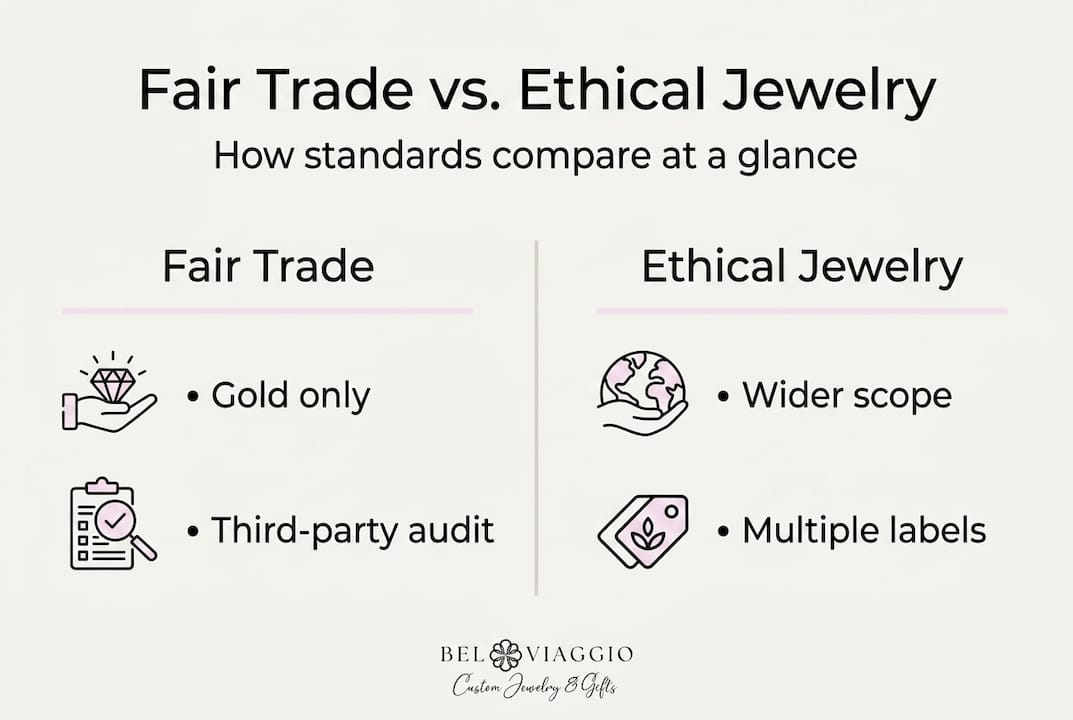
Fair trade is a well-defined, verified process with third-party auditing and specific standards, while “ethical jewelry” is a broader term that may or may not be backed by any independent verification. When you see “ethical,” always ask which certification or standard gives that claim its meaning.
Recommended
- Stunning gemstone jewelry examples for ethical couples – Bel Viaggio Designs, LLC
- How to ethically source jewelry for your wedding – Bel Viaggio Designs, LLC
- Smart Tips for Shopping On-Sale Jewelry Ethically and Affordably – Bel Viaggio Designs, LLC
- Wedding jewelry guide: Meaning, sustainability, custom design – Bel Viaggio Designs, LLC