

TL;DR:
- Recycled gold is chemically identical to newly mined gold and offers significant environmental benefits. Its impact depends on the source, with post-consumer and electronic waste providing true circular economy advantages. Buyers should verify certifications and source types to ensure genuine ethical and sustainable jewelry.
Recycled gold is genuine gold reclaimed from existing products, refined back to high purity, and reused in new applications without any loss in chemical identity or quality. The industry term you will also see is “reclaimed gold,” and both phrases describe the same material. Refined recycled gold is chemically and physically identical to newly mined gold, which means a recycled gold engagement ring carries the same durability and brilliance as one made from freshly extracted material. Sources range from old jewelry and electronic circuit boards to gold bars and industrial components. Understanding what recycled gold actually is, and where it truly comes from, is the first step toward making a purchase you can feel confident about.
What is recycled gold, and where does it come from?
Recycled gold is not a single uniform category, and that distinction matters more than most buyers realize. Four distinct input types exist: post-consumer gold, pre-consumer scrap, investment gold, and electronic waste. Each carries a different sustainability profile, and only two of them genuinely close the loop in a circular economy.

Post-consumer gold is the most impactful category. This includes old jewelry, dental gold, and coins that have already served their original purpose and re-enter the supply chain through consumers or recyclers. Electronic waste (WEEE) recovery, while technically complex, also qualifies as true recycling because it diverts gold from landfills and industrial disposal streams.
Pre-consumer scrap, by contrast, is the leftover material from manufacturing floors, the clippings and filings that never left the factory. Refiners and jewelers have always remelted this material as a standard cost-saving measure. Calling it “recycled gold” is technically accurate but misleading, because it was never a finished product and never displaced mining demand. Investment gold presents a similar issue. Gold bars or coins that were recently minted from newly mined material and then remelted are sometimes marketed as recycled, which stretches the term beyond its meaningful use.
| Input type | True circular economy impact | Common source |
|---|---|---|
| Post-consumer gold | High | Old jewelry, coins, dental gold |
| Electronic waste (WEEE) | High | Circuit boards, electronics |
| Pre-consumer scrap | Low | Factory floor clippings |
| Investment gold | Low to none | Remelted recently mined bars |
Pro Tip: When a jeweler claims their gold is recycled, ask specifically whether it is post-consumer recycled gold. That single question separates genuine sustainability from marketing language.
How is recycled gold processed and refined?
The refining process is what transforms scrap material back into jewelry-grade metal, and it is more rigorous than most people expect. Here is how the process works from collection to finished product.
- Collection and sorting. Recyclers sort incoming material by gold content and type. Jewelry scrap is separated from electronics because each requires a different processing route.
- Mechanical processing. Physical contaminants like solder, stones, and base metals are removed through cutting, grinding, and separation.
- Melting. The sorted material is melted in a furnace to produce a crude alloy. This step removes many impurities but does not achieve jewelry-grade purity on its own.
- Chemical refining. The Wohlwill electrolytic process or the Miller chlorination process is applied to reach 999 to 999.9 fineness, the same purity standard used for new gold bullion and fine jewelry.
- Purity testing. Assay testing confirms the final purity before the gold is cast into bars or wire for use by jewelers.
- Traceability documentation. Reputable refiners issue chain-of-custody records that track the gold from its source through each processing stage.
Electronics recycling follows the same broad steps but introduces a complication. Burning the plastic components embedded in circuit boards generates significant carbon emissions during the smelting phase. Pyrometallurgical processing of WEEE produces approximately 2,000 kg of CO2-equivalent per kilogram of gold recovered. That figure sounds alarming until you compare it to gold mining, which generates roughly 30,000 kg CO2-equivalent per kilogram. Electronics recycling is still far cleaner than mining, but it is not as clean as recycling jewelry scrap.
Pro Tip: Ask your jeweler for the name of the refinery that processed their recycled gold. Recognized refineries on the London Bullion Market Association (LBMA) Good Delivery List maintain documented chain-of-custody standards.
Recycled gold vs. new gold: environmental and economic benefits
The environmental case for recycled gold is backed by hard numbers, and the gap between recycled and mined gold is larger than most consumers expect.
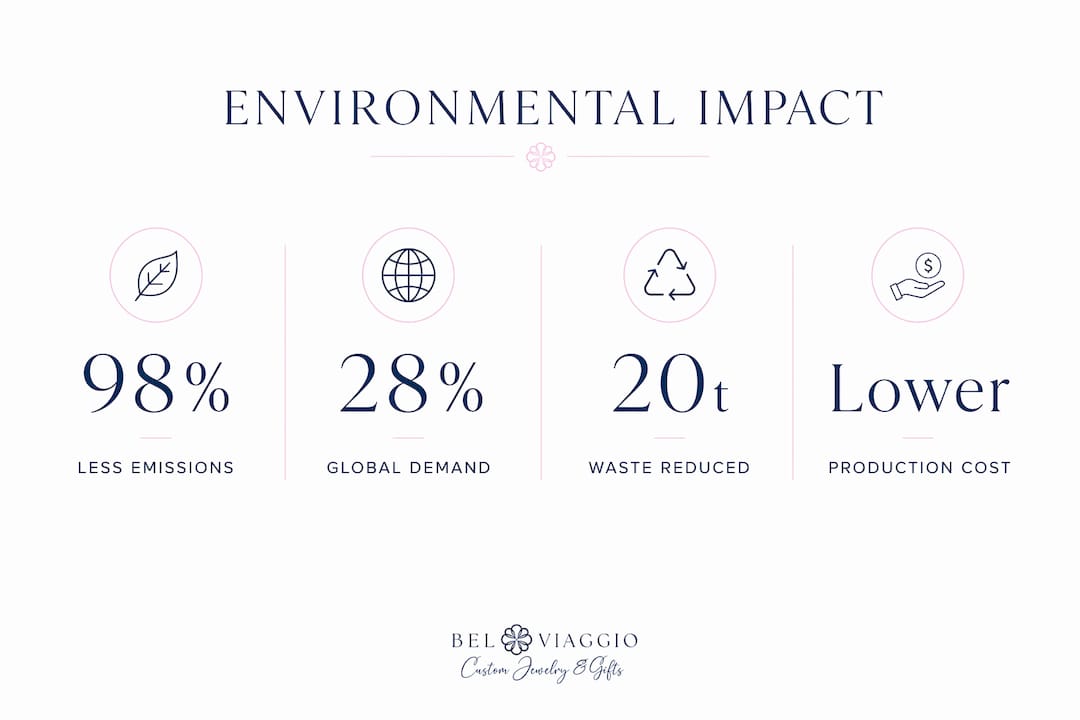
Recycling gold reduces greenhouse gas emissions by up to 98% compared to mining. To put that in concrete terms: mining a single gold wedding band generates approximately 20 tons of mining waste, including displaced rock, chemical runoff, and tailings. Recycling the same amount of gold produces a fraction of that waste footprint. The reductions extend to air pollution, water pollution, and water consumption as well, all of which are significant concerns in regions where open-pit gold mining operates near communities and watersheds.
“Mining a single gold wedding band generates approximately 20 tons of waste. Recycled gold eliminates that waste entirely by working with material that already exists above ground.”
The market scale of recycled gold is also significant. In 2023, recycled gold supplied roughly 28% of global gold demand, totaling approximately 1,157 metric tons. High-value jewelry recycling alone supplies nine times the volume of industrial recovery routes, which confirms that consumer jewelry is the most productive input stream for the recycled gold market.
On the economic side, recycled gold can be slightly cheaper than newly mined gold because production costs are lower. The savings are not dramatic since gold prices are set globally, but the cost efficiency makes recycled gold attractive to jewelers who want to manage material costs without compromising quality. For buyers, the price of a recycled gold ring is essentially the same as a mined gold ring of equivalent karat weight. The value you get is identical. The environmental cost you avoid is not.
One honest limitation deserves acknowledgment. Recycled gold does not automatically reduce the total volume of gold mining. As long as global demand for gold grows, mining will continue. Recycled gold reduces the marginal environmental impact of each piece of jewelry, but it does not shut down mines. Treating it as a partial solution, rather than a complete fix, is the accurate framing.
Common misconceptions about recycled gold and ethical claims
The phrase “recycled gold” carries no universal legal protection, which creates real risks for buyers who take marketing claims at face value. CIBJO, the World Jewellery Confederation, introduced stricter recycled gold definitions specifically to address greenwashing and improve supply chain transparency. These definitions are more stringent than those applied to other recycled materials, reflecting how seriously the industry takes the confusion around this term.
Several specific misconceptions are worth naming directly:
- “All recycled gold is equally sustainable.” Pre-consumer scrap and investment gold remelts do not reduce mining demand. Only post-consumer and WEEE sources represent genuine circular economy impact.
- “Recycled gold is always lower carbon.” Electronics-derived gold has a higher carbon footprint than jewelry scrap recycling due to plastic combustion during smelting, though both remain far cleaner than mining.
- “The recycled label guarantees ethical sourcing.” Without chain-of-custody documentation and third-party certification, the label is self-reported and unverified.
- “Recycled gold is lower quality.” This is false. Gold refined to 24k purity is chemically identical regardless of its origin.
The Responsible Jewellery Council (RJC) and CIBJO are the two most recognized bodies working to standardize definitions and certification requirements. Their frameworks give buyers a reference point, but only when jewelers actually pursue and maintain those certifications. Transparency in jewelry sourcing is something consumers are increasingly demanding, and 65% of buyers now expect clear sourcing disclosures from the brands they purchase from.
Pro Tip: Search for your jeweler’s RJC certification status directly on the RJC member database at responsiblejewellery.com. Certification is publicly listed and verifiable in minutes.
How to identify and choose ethical recycled gold jewelry
Choosing recycled gold jewelry that actually delivers on its ethical promise requires asking the right questions before you buy. The following criteria separate credible sourcing from surface-level claims.
- Verify the certification. Look for RJC certification or CIBJO-aligned sourcing policies. These are the recognized standards in fine jewelry. Understanding ring certification standards helps you evaluate what a jeweler’s claims actually mean.
- Ask for the source type. Request confirmation that the gold is post-consumer recycled, not pre-consumer scrap or investment remelts. A jeweler who cannot answer this question likely does not know their supply chain well enough.
- Request chain-of-custody documentation. Reputable refiners provide documentation that traces the gold from its source through refining to the finished product. Ask to see it or ask for the refinery name.
- Evaluate the brand’s broader sourcing practices. A jeweler committed to ethical gold sourcing will apply the same scrutiny to gemstones, labor practices, and packaging. Recycled gold in isolation does not make a brand ethical.
- Understand metal purity labeling. Recycled gold is sold at the same karat standards as new gold. A 14k recycled gold ring contains 58.3% gold by weight, the same as any 14k piece. Knowing how to decode metal purity labels prevents confusion when comparing pieces.
- Trust your instincts about transparency. Brands that publish sourcing policies, name their refiners, and welcome questions are demonstrably more trustworthy than those offering vague sustainability language with no supporting detail.
Key takeaways
Recycled gold is chemically identical to newly mined gold, but its environmental and ethical value depends entirely on the source type and the transparency of the supply chain behind it.
| Point | Details |
|---|---|
| Quality is identical | Recycled gold refined to 999 fineness matches new gold in every measurable property. |
| Source type determines impact | Only post-consumer and WEEE gold genuinely reduce mining demand and close the material loop. |
| Environmental savings are significant | Recycling gold cuts greenhouse gas emissions by up to 98% compared to mining the same amount. |
| Certification matters | RJC and CIBJO certifications are the most reliable way to verify recycled gold claims. |
| Market scale is real | Recycled gold supplied 28% of global gold demand in 2023, totaling roughly 1,157 metric tons. |
Why I think the recycled gold conversation is just getting started
The jewelry industry has made real progress on recycled gold, but I would be doing you a disservice if I told you the problem is solved. The term “recycled gold” is still largely unregulated in retail contexts, which means a brand can use it on a product page without any obligation to prove what it means. I have seen pre-consumer factory scrap marketed with the same enthusiasm as verified post-consumer gold, and most buyers have no way to tell the difference.
What gives me genuine optimism is the direction of pressure. CIBJO’s stricter definitions and the RJC’s certification framework are not just bureaucratic exercises. They reflect real demand from consumers who want their purchases to mean something. The more buyers ask specific questions, the faster brands are forced to either know their supply chains or stop making claims they cannot support.
My honest recommendation is this: treat recycled gold as a meaningful choice, not a guaranteed one. Buy from brands that name their refiners, hold active certifications, and publish sourcing policies. That combination is rare enough to be worth rewarding with your purchase. The brands that do this work deserve the business of buyers who care about responsible jewelry practices.
— Stacy
Ethical recycled gold jewelry from Belviaggiodesigns
At Belviaggiodesigns, ethical sourcing is not a marketing afterthought. Every piece is handcrafted with a commitment to transparency, from the gold settings to the stones they hold.

The Black Diamond Halo Engagement Ring and the Green Emerald and Diamond Ring are two standout examples of how recycled gold settings can carry exceptional stones without compromising on ethics or craftsmanship. If you are exploring options across styles and budgets, the full gemstone ring collection at Belviaggiodesigns offers recycled gold settings paired with lab-grown and ethically sourced stones. Every purchase supports a supply chain built around accountability, not just aspiration.
FAQ
What is recycled gold made from?
Recycled gold is made from post-consumer products like old jewelry, coins, and electronic components that are collected, sorted, and refined back to 999 or 999.9 fineness. The refining process removes all impurities, producing gold that is chemically identical to newly mined material.
Is recycled gold real gold?
Yes. Recycled gold is 100% genuine gold. After refining, it carries the same karat purity, durability, and appearance as gold sourced directly from a mine.
Is recycled gold better for the environment?
Recycled gold reduces greenhouse gas emissions by up to 98% compared to mining and eliminates the roughly 20 tons of waste generated per gold wedding band from mining operations. The environmental benefit is real, though it varies depending on whether the source is jewelry scrap or electronic waste.
How can I tell if recycled gold jewelry is genuinely ethical?
Ask for the source type (post-consumer vs. pre-consumer), request chain-of-custody documentation, and verify the jeweler holds an active Responsible Jewellery Council (RJC) certification. Self-reported claims without third-party verification carry significant greenwashing risk.
Does recycled gold cost less than new gold?
Recycled gold can be slightly cheaper to produce due to lower extraction costs, but retail prices are primarily driven by global gold market rates. The price difference at the consumer level is minimal, and resale value depends on prevailing gold prices rather than the gold’s origin.
Recommended
- Ethical Gold Mining Explained for Responsible Jewelry Choices – Bel Viaggio Designs, LLC
- What is repurposed jewelry? Ethical beauty with a unique story – Bel Viaggio Designs, LLC
- Decode jewelry metal titles: purity, ethics, and meaning – Bel Viaggio Designs, LLC
- Why Invest in Fine Jewelry: Ethical, Valuable & Lasting – Bel Viaggio Designs, LLC