

TL;DR:
- Ethical jewelry involves transparent supply chains, fair labor, human rights, and environmental protections.
- Combining multiple certifications and direct communication ensures more reliable ethical sourcing.
- Personalized, handcrafted pieces support ethical values and create meaningful, verifiable jewelry.
Finding jewelry that truly honors your values is harder than it sounds. You fall in love with a ring, then wonder: where did this diamond come from? Who mined it? What did that process cost the land and the people involved? These questions are real, and they matter. Ethical sourcing in jewelry means obtaining materials like gold, diamonds, and gemstones through transparent supply chains that ensure fair labor, human rights, and environmental protection. This guide walks you through exactly what ethical sourcing covers, which certifications to trust, how to verify claims, and how to design a piece that tells your love story without compromise.
Table of Contents
- What does ethical sourcing in jewelry really mean?
- How to prepare: Certifications, materials, and questions to ask
- Step-by-step: Choosing and verifying your ethical jewelry
- Personalization with a conscience: Custom, handcrafted, and meaningful designs
- Our take: Why the best ethical jewelry choices are rarely obvious
- Discover truly ethical, handcrafted designs with Bel Viaggio
- Frequently asked questions
Key Takeaways
| Point | Details |
|---|---|
| Know true ethical sourcing | Authentic ethical jewelry covers fair labor, no conflict funding, and environmental protection. |
| Check certifications | Certifications like RJC and Fairmined are essential for confident ethical purchases. |
| Watch for greenwashing | Always verify documentation and beware of vague or unsubstantiated claims. |
| Personalize ethically | Custom designs with artisanal, traceable materials let you honor your values and love story. |
What does ethical sourcing in jewelry really mean?
The phrase “ethical sourcing” gets thrown around constantly in jewelry marketing, but it covers several distinct things. Ethical sourcing in jewelry involves obtaining materials through transparent supply chains that ensure fair labor, human rights, environmental protection, and no conflict funding. That last part refers to diamonds and gemstones that have historically funded armed conflicts, often called blood diamonds.
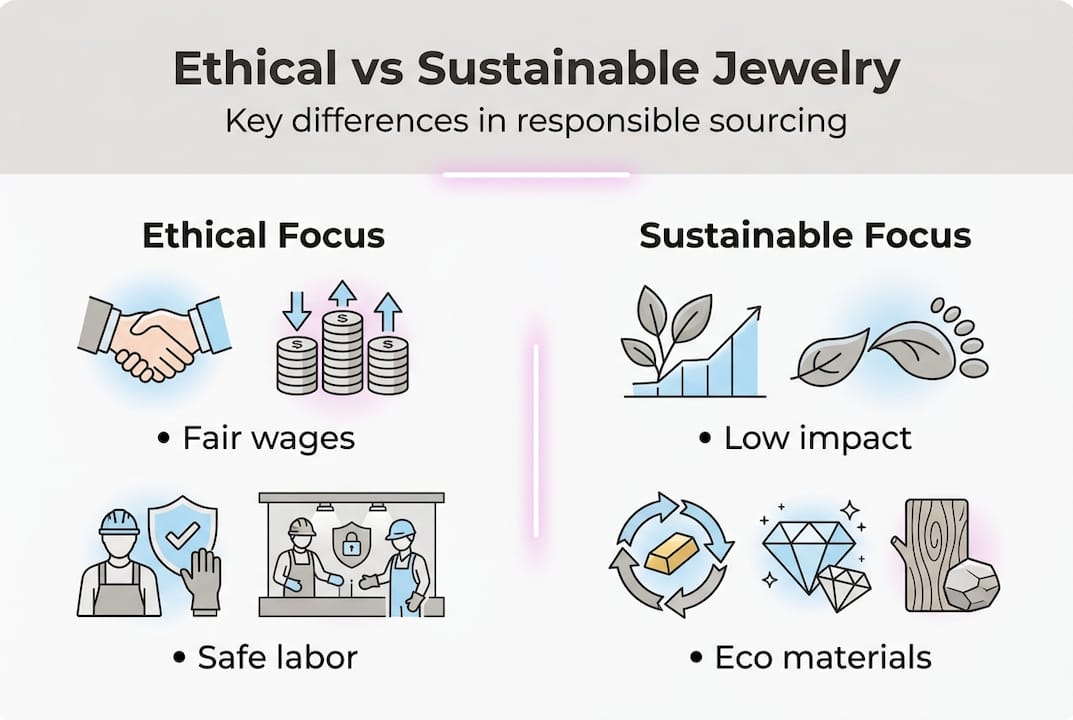
It is also worth knowing the difference between “ethical” and “sustainable” jewelry. Ethical focuses on people: fair wages, safe working conditions, no child labor. Sustainable focuses on the planet: reduced mining impact, lower carbon footprint, responsible waste management. The best jewelry choices address both. Think of it as a three-legged stool covering people, planet, and process. Remove one leg and the whole thing wobbles.
Here is a quick overview of what the term “ethical” actually covers:
| Category | What it includes |
|---|---|
| Labor | Fair wages, safe conditions, no child labor |
| Environment | Reduced mining damage, responsible waste |
| Traceability | Documented supply chain from mine to market |
| Certifications | Third-party verification of practices |
Some common misconceptions are worth addressing directly:
- Recycled gold does not automatically mean ethical. Labor conditions in the recycling process still matter.
- A “conflict-free” label does not cover environmental harm or unfair wages.
- High price does not signal ethical sourcing. Luxury brands can still use opaque supply chains.
- Country of origin alone is not enough. Practices vary widely within the same region.
The jewelry sourcing transparency conversation is growing fast. Ethical jewelry market statistics show the global ethical jewelry market is projected to reach $15 billion by 2030, driven by consumers who want to know where their pieces come from. Yet only about 15% of diamonds are currently certified through recognized ethical programs. That gap is exactly why doing your own homework matters so much. The responsible jewelry guide from Bel Viaggio breaks this down further if you want to go deeper.
How to prepare: Certifications, materials, and questions to ask
Before you walk into any jewelry store or open any website, knowing your certifications saves you from being dazzled by marketing language. Key certifications include the Responsible Jewellery Council (RJC), Fairmined/Fairtrade, and the Kimberley Process, each with important strengths and real limitations.
Here is a quick comparison to help you navigate them:
| Certification | What it covers | Strength | Known weakness |
|---|---|---|---|
| RJC | Full supply chain, labor, environment | Broad scope, third-party audited | Does not cover artisanal miners |
| Fairmined/Fairtrade | Artisanal gold mining communities | Strong labor and community focus | Limited geographic reach |
| Kimberley Process | Conflict diamonds only | Widely adopted | Does not address labor or environment |
For materials, prioritize these when shopping:
- Recycled gold or platinum: Reduces new mining demand
- Lab-grown diamonds: Chemically identical to mined diamonds, far lower environmental footprint
- Fairmined gold: Directly supports artisanal mining communities
- Traceable gemstones: Stones with documented origin from ethical mines
When you talk to a retailer, ask these questions before committing:
- Can you provide written documentation of where this metal and stone originated?
- Are you RJC certified, and can I see your audit results?
- What environmental practices does your supplier follow?
- Do you work with artisanal miners, and how are they compensated?
- Can you trace this specific stone back to its mine?
Pro Tip: No single certification covers everything. Combine an RJC-certified retailer with Fairmined gold and a lab-grown or traceable stone for the most thorough assurance. You can also explore our ethical gemstone guide for more detail on stone-specific sourcing.
Watch for greenwashing red flags: vague phrases like “responsibly made” with no documentation, certifications you cannot verify independently, and brands that refuse to share supply chain details. If a retailer gets defensive when you ask for proof, that is your answer. The resource at what to know before you buy is a solid reference to bookmark.
Step-by-step: Choosing and verifying your ethical jewelry
With your prep done, here is how to confidently carry out your search and make sure every detail holds up to scrutiny.
- Shortlist certified jewelers. Start with retailers who hold RJC certification or work exclusively with Fairmined suppliers. This narrows the field fast.
- Request documentation upfront. Before you fall in love with a piece, ask for the paper trail. A reputable jeweler will have it ready.
- Check third-party audit results. Certifications mean little without audits. Ask when the last audit occurred and who conducted it.
- Verify supply chain specifics. Ask where the metal was refined, where the stone was cut, and whether those facilities are independently reviewed.
- Cross-reference claims online. Look up the certifying body directly and confirm the jeweler is listed as a current member.
Pro Tip: Ask for origin documentation on both the metal and the stone separately. Many jewelers can verify one but not the other, and that gap matters.
“No single certification is perfect. The strongest approach combines multiple certifications, full lifecycle documentation, and handcrafted pieces sourced from reputable regions.” Sustainable and Ethical Jewelry
Handcrafted and custom pieces can actually be easier to verify because you are working directly with the maker. When a jeweler builds your ring from scratch, you can ask about each material at the point of selection, not after the fact. Our ethical engagement ring tips walk through this process in detail, and our guide on ethical gemstone choices covers which stones are easiest to trace.

If you encounter greenwashing mid-search, do not just walk away. Document what was claimed, what documentation was missing, and report it to the certifying body if applicable. Your feedback helps hold the industry accountable. The RJC code details explain exactly what certified members are required to disclose.
Personalization with a conscience: Custom, handcrafted, and meaningful designs
Beyond making the ethical choice, you can further embody your values by designing a piece as meaningful as your relationship. Personalization and ethics are not competing priorities. They actually reinforce each other.
Your options for meaningful customization include:
- Custom designs from scratch: Work with a jeweler to create something nobody else has
- Unique gemstones: Sapphires, emeralds, and morganite often have more traceable supply chains than diamonds
- Heirloom or recycled metal: Repurposing a family piece carries both sentimental and environmental value
- Local or regional artisans: Shorter supply chains are easier to verify and often support small communities
When vetting a small or artisan jeweler, ask these questions:
- Where do you source your metals and stones?
- Do you hold any certifications, or can you provide supplier documentation?
- How do you handle waste materials from the crafting process?
- Can I visit your studio or see your process in person?
Handcrafted unique pieces are entirely viable with ethical metals and gems, especially from Canadian, American, or certified artisanal sources. The story behind your materials becomes part of the ring itself.
Generational shifts are driving this movement fast. Gen Z is 3x more likely to choose lab-grown stones for ethical and sustainability reasons, and major brands like Pandora have committed to 100% recycled metals across their collections. The market is moving, and your choices as a consumer help push it further.
Explore ethical custom design ideas and check out sustainable jewelry brands for inspiration on what is possible when ethics and creativity meet.
Our take: Why the best ethical jewelry choices are rarely obvious
Here is something most guides will not tell you: perfect ethical sourcing does not exist. Every certification has gaps. The Kimberley Process ignores labor. The RJC does not reach every artisanal miner. Fairmined gold is only available from a narrow set of regions. Accepting this reality is not defeatist. It is honest.
The strongest approach we have seen is one that layers multiple safeguards: an RJC-certified retailer, Fairmined or recycled metal, a lab-grown or traceable stone, and direct communication with the maker. None of these alone is enough. Together, they create something close to genuine accountability.
We also believe that values-driven customization leads to better outcomes. When you work with an artisan to design your custom ethical engagement rings, you are not just buying a product. You are building a relationship with the person who made it, which makes every claim far easier to verify. The most responsible jewelry choices are rarely the most convenient ones. But they are always the most meaningful.
Discover truly ethical, handcrafted designs with Bel Viaggio
At Bel Viaggio Designs, ethical sourcing is not a marketing line. It is built into how we design, source, and create every piece. We work with traceable materials, responsibly sourced metals, and lab-grown or carefully selected gemstones so you can wear your ring with full confidence.

Whether you are drawn to the bold elegance of a black diamond engagement ring, the lush color of a green emerald diamond engagement ring, or the understated beauty of a men’s ethical wedding band, our collections are built around your values. Reach out to start a custom design conversation. We will walk you through every material choice so your ring tells the right story from the very first step.
Frequently asked questions
How do I know if a jewelry piece is truly ethically sourced?
Ask for certifications like RJC or Fairmined, request written documentation, and verify supply chain information directly with the retailer. Genuine ethical sourcing always comes with a paper trail.
Is recycled gold always ethical?
Recycled gold reduces environmental impact, but true ethical sourcing also requires fair labor practices and full supply chain transparency throughout the recycling process.
Are lab-grown diamonds considered ethical?
Lab-grown diamonds are free from conflict funding and carry a significantly lower environmental footprint. Gen Z is 3x more likely to choose them specifically for these ethical and sustainability reasons.
What are the red flags for greenwashing in jewelry?
Watch for vague claims like “responsibly made” with no supporting documentation, unverifiable certifications, and brands with no traceability or supply chain transparency. If they cannot show proof, the claim does not hold.
Recommended
- Wedding jewelry guide: Meaning, sustainability, custom design – Bel Viaggio Designs, LLC
- Custom jewelry ideas for ethical engagement rings 2026 – Bel Viaggio Designs, LLC
- Custom jewelry ideas for ethical engagement rings 2026 – Bel Viaggio Designs, LLC
- What is responsible jewelry? A 2026 guide for ethical wedding rings – Bel Viaggio Designs, LLC