

TL;DR:
- Always verify the certificate online by matching the report number and laser inscription before trusting any grade.
- Starting October 2025, GIA uses Premium and Standard labels instead of D–Z color grades for lab-grown diamonds.
Before you spend a dollar on a lab-grown diamond, run this eight-point lab diamond grading checklist against the certificate and listing. A graded stone is only as trustworthy as the report behind it, and the report is only as useful as you know how to read it.
Your eight-point checklist at a glance:
- Lab name and report type — confirm it’s GIA, IGI, or another recognized grading authority
- Unique report number — every certificate carries one; write it down
- Laser inscription — the girdle should be inscribed with the lab’s ID and that same report number
- Online certificate verification — look up the report number on the issuing lab’s portal before trusting any printed copy
- GIA Premium vs Standard designation (if GIA-graded) — understand which tier the stone received and what that means for color and clarity
- 4Cs fields — color, clarity, cut grade (when available), and carat weight all present and legible
- Polish, symmetry, fluorescence, and comments — the comments field often reveals growth method (CVD or HPHT) and any post-growth treatments
- Price vs market — cross-check the asking price against current market rates for the stated grade; a suspiciously low price is a red flag, not a deal
GIA’s updated lab-grown diamond services charge $15 per carat (minimum $15) for assessed stones, with a separate $5 evaluation fee for stones that don’t meet minimum criteria. Knowing that fee structure helps you spot sellers who claim a GIA report on a stone that likely never passed submission.
Pro Tip: Ask every seller for the report PDF and the report number before discussing price. If they hesitate, that tells you something.
Table of Contents
- What changed in 2025: GIA’s new Premium vs Standard labels
- Which gem labs should you trust, and what do their reports actually show?
- How the 4Cs apply to lab-grown diamonds, field by field
- How to read a lab-grown diamond certificate, field by field
- How to verify a certificate and what red flags mean walk away
- Practical minimums by budget: how to set your thresholds
- How Belviaggiodesigns applies this checklist when sourcing lab-grown diamonds
- Key Takeaways
- What an experienced jeweler actually checks in 90 seconds
- Belviaggiodesigns can help you apply this checklist
- Useful sources and further reading
- FAQ
What changed in 2025: GIA’s new Premium vs Standard labels
Starting October 1, 2025, GIA replaced natural-diamond letter grades for D–Z lab-grown colorless stones with two descriptive quality tiers: Premium and Standard. The old D–Z color scale and FL–I clarity scale still appear on IGI reports, but GIA now uses these labels instead.
What each tier requires:
- Premium: D color, VVS clarity or better, excellent polish and symmetry, excellent cut for round brilliants
- Standard: E–J color, VS clarity, very good polish and symmetry (good is acceptable for fancy shapes), very good cut for round brilliants
- No report issued for stones that fall below Standard minimums
- Minimum submission size: 0.15 carats
- Fee: $15 per carat, $15 minimum; $5 evaluation fee for rejected stones
$15 per carat is GIA’s fee for lab-grown diamond quality assessments, with a $15 minimum per stone and a $5 evaluation fee for stones that don’t qualify.
GIA’s reasoning is straightforward: lab-grown diamonds cluster in narrower color and clarity bands than naturals, so the full D–Z scale overstates the range of variation buyers actually encounter. Descriptive labels communicate quality more honestly for manufactured stones.
What this means when you’re shopping:
- Search filters on retail sites will shift from letter grades to Premium/Standard for GIA-graded stones
- Ask sellers explicitly whether a GIA stone is Premium or Standard, not just “GIA certified”
- A Standard stone is still a quality stone; the label means it met real minimum thresholds, not that it’s second-rate
- If a seller says “GIA graded” but can’t tell you the tier, ask for the report number and look it up yourself
JCK’s coverage of the GIA update notes that mixed-criteria stones default to Standard, so a stone with D color but VS clarity (not VVS) would be Standard, not Premium.
Which gem labs should you trust, and what do their reports actually show?
GIA and IGI are the two labs whose reports carry the most weight with U.S. retailers and resellers. Both offer online certificate verification and laser inscription on assessed stones. Here’s what each provides.
GIA lab-grown reports:
- Premium or Standard quality assessment (post-October 2025)
- Laser inscription of “Laboratory-Grown” plus the GIA quality assessment number on the girdle
- Online lookup via the GIA report check portal
- Distinct report format intentionally different from natural-diamond GIA reports
IGI lab-grown reports:
- Full D–Z color scale and FL–I clarity scale
- Clarity plot (diagram showing inclusion locations)
- Proportions graphic
- Online verification by report number
- Growth method and treatment disclosures in the comments section
| Feature | GIA | IGI |
|---|---|---|
| Report terminology | Premium / Standard | Full 4Cs (D–Z, FL–I) |
| Color range reported | Descriptive tier (D for Premium; E–J for Standard) | D–Z scale |
| Clarity threshold | VVS+ (Premium); VS (Standard) | FL through I |
| Cut grade availability | Excellent / Very Good (rounds); Good (fancy shapes) | Available for rounds; varies by shape |
| Online verification | Yes, GIA report check portal | Yes, IGI portal by report number |
| Laser inscription | Yes, “Laboratory-Grown” + assessment number | Yes, report number on girdle |
| Clarity plot | Not standard on quality assessment | Yes, included |
Other labs such as GCAL (Gem Certification and Assurance Lab) and AGS (American Gem Society) also issue lab-grown reports, though their market penetration is smaller. For most U.S. buyers, a GIA or IGI report is the practical standard.
Pro Tip: When a report lists the “report type” field, read it carefully. A GIA “Quality Assessment” is not the same document as a GIA “Grading Report” for natural diamonds. The format difference is intentional and matters for resale.
How the 4Cs apply to lab-grown diamonds, field by field
The 4Cs remain the core of any lab-grown diamond evaluation, but lab-grown grading has specific nuances worth knowing. Cut grades aren’t available for every shape at every lab. Color ranges are narrower than with naturals. And clarity plots can reveal inclusions that matter more in certain settings than the grade alone suggests.
Color
- Confirm the color scale the lab used (D–Z for IGI; Premium/Standard tier for GIA)
- For IGI reports, note whether the color grade was assessed face-up or face-down; standardized viewing conditions mean the grade reflects controlled expert opinion, not casual observation
- A G or H color stone looks near-colorless to the naked eye in most settings; D–F is visually meaningful mainly in solitaires with white metal
Clarity
- Read the clarity grade and then look at the clarity plot, not just the grade
- Note where inclusions fall: a VS2 stone with an inclusion under a prong can be riskier than an SI1 with inclusions away from stress points
- Confirm whether the report includes a photomicrograph or scope image for higher-value stones
Cut
- Cut is the single biggest driver of visual sparkle; prioritize it over color or clarity for most buyers
- Check whether the lab issued a cut grade at all; GIA and IGI both grade cut for round brilliants, but fancy shapes (ovals, cushions, pears) often receive only polish and symmetry grades
- Review the proportions diagram for table percentage, depth percentage, and crown/pavilion angles
Carat
- Confirm the stated carat weight against the listed measurements (length × width × depth)
- A 1.00 ct round brilliant should measure roughly 6.4–6.5 mm in diameter; significant deviation from standard proportions warrants a question
| Lab | Cut grade for rounds | Cut grade for fancy shapes | Color scale | Clarity scale |
|---|---|---|---|---|
| GIA | Yes (Excellent / Very Good) | Polish & symmetry only | Premium / Standard tier | VVS+ or VS minimum |
| IGI | Yes | Varies by shape | D–Z | FL–I |
Pro Tip: For a set stone in a halo or pavé band, you can often accept G–H color and VS2–SI1 clarity without any visible difference. Save the budget for cut quality instead.
How to read a lab-grown diamond certificate, field by field
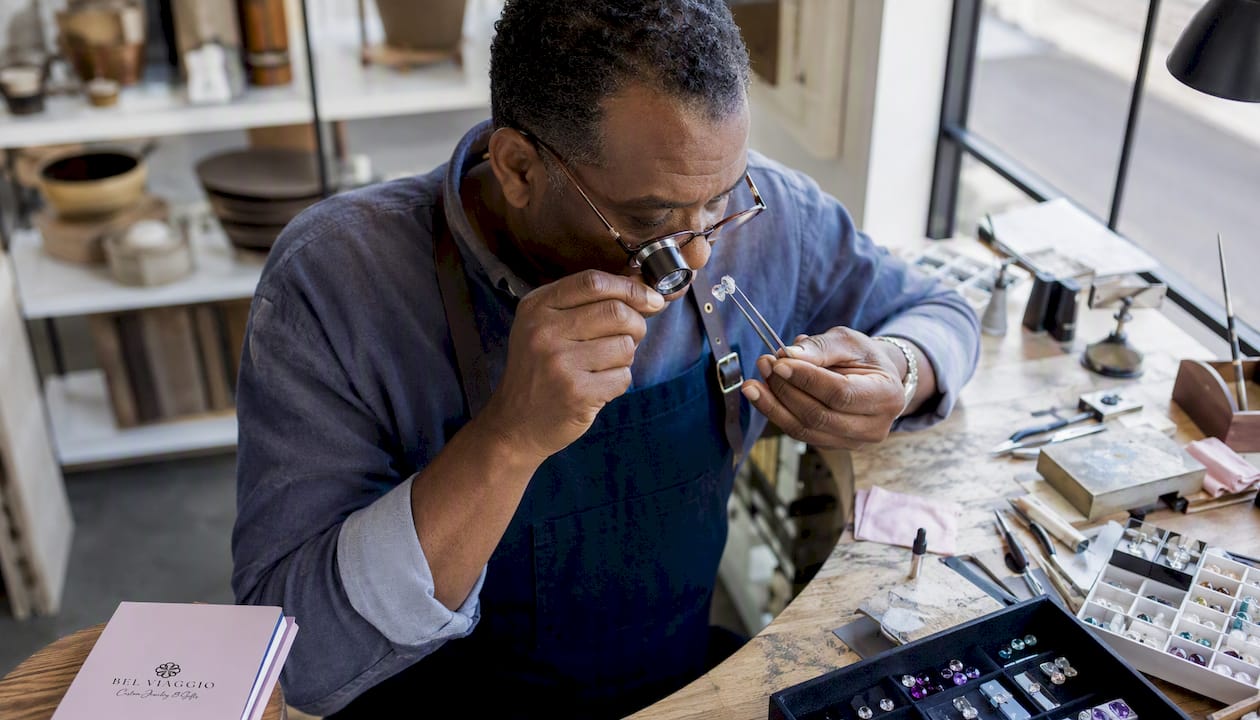
Read the lab name and report number first. Then confirm the laser inscription and run the online lookup before you trust anything else on the certificate.
| Certificate field | What it tells you | Why it matters |
|---|---|---|
| Lab name | Issuing grading authority | Determines which standards and verification portal apply |
| Report number | Unique identifier for this stone | Must match the laser inscription on the girdle |
| Date of report | When the stone was graded | Very old reports may predate current grading standards |
| 4Cs fields | Color, clarity, cut, carat | Core quality assessment |
| Polish & symmetry | Finish quality of facets and alignment | Affects light return; excellent/very good is the target |
| Fluorescence | Stone’s reaction to UV light | Strong blue fluorescence can affect appearance in sunlight |
| Clarity plot | Diagram of inclusion locations | Shows where inclusions fall relative to the setting |
| Proportions diagram | Table %, depth %, crown/pavilion angles | Confirms cut quality beyond the grade label |
| Comments | Growth method, treatments, special notes | Often the most underused field on the report — reveals CVD vs HPHT and any post-growth treatments |
| Laser inscription | Text on girdle | Must match the report number exactly |
Cross-verification checklist:
- Go to the issuing lab’s online portal and enter the exact report number
- Confirm the 4Cs and stone description on the portal match the printed certificate
- Ask the seller for a photo or short video of the girdle inscription under magnification
- Compare the listed measurements on the report to the stone’s actual dimensions in seller photos
- Check the comments field on the online report, not just the printed copy, since some labs update digital records
How to verify a certificate and what red flags mean walk away
Always verify the printed report via the issuing lab’s online lookup using the exact report number, and confirm the diamond’s laser inscription matches that number before you proceed.
Verification steps:
- Go to the lab’s official portal (GIA report check or IGI’s verification page) and enter the report number
- Ask the seller for a close-up photo of the girdle inscription
- Request a short video of the inscription under 10x magnification if buying online
- Compare the report’s stated measurements to the stone dimensions in listing photos
- Read the comments field on both the printed report and the online record
Red flags that justify walking away:
- Report number on the certificate doesn’t match the laser inscription
- No laser inscription at all on a stone claiming a GIA or IGI report
- Report number returns no result on the lab’s portal
- Asking price is significantly below market for the stated grade with no explanation
- Comments field is blank or vague on a stone where growth method should be disclosed
- Seller says the stone “failed minimum criteria” but still has a report number
Pro Tip: If the report number matches online but the clarity plot or measurements differ from the seller’s photos, stop. That’s a sign the certificate belongs to a different stone. Request an independent appraisal or walk away.
Practical minimums by budget: how to set your thresholds
The checklist tells you what to look for. Your budget tells you where to draw the line. Here are three tiers with realistic minimums.
Value tier (under $1,500 for a 1 ct equivalent):
- Color: G–H (IGI scale) or Standard (GIA)
- Clarity: VS2–SI1, with the clarity plot confirming inclusions away from prongs
- Cut: Very Good minimum for rounds; confirm polish and symmetry are at least Very Good
- Ask for: report PDF, laser inscription photo, and seller’s return policy in writing
Midrange tier ($1,500–$3,500):
- Color: F–G or Standard (GIA)
- Clarity: VS1–VS2
- Cut: Excellent for rounds; Very Good for fancy shapes
- Ask for: report PDF, inscription video, and proportions diagram confirmation
Premium tier (above $3,500):
- Color: D–E or GIA Premium
- Clarity: VVS2 or better
- Cut: Excellent across all grades; review the proportions diagram in detail
- Ask for: full report PDF, inscription video, and an independent appraisal if the stone exceeds $5,000
Trade-off guidance:
- Cut always comes first; a well-cut G/VS2 outperforms a poorly cut D/VVS2 visually
- For bezel or channel settings, color matters less because the metal masks body color
- Low clarity grades (SI2 and below) are acceptable only when the clarity plot confirms inclusions are eye-clean and away from structural stress points
- HPHT-grown stones and CVD-grown stones can both be excellent; the growth method in the comments field affects pricing more than appearance
Pro Tip: For halo settings, drop one color grade from what you’d buy for a solitaire. The surrounding stones visually “lift” the center stone’s apparent color, so an H in a halo looks like an F in isolation.
How Belviaggiodesigns applies this checklist when sourcing lab-grown diamonds
Belviaggiodesigns uses the same eight-point checklist for every lab-grown stone it lists. Before a stone goes live on the site, the team confirms the laser inscription against the lab’s online lookup and reviews the comments field for growth method and treatment disclosures.
What Belviaggiodesigns provides buyers:
- Report PDFs available on request for any listed stone
- Laser inscription confirmation before listing
- Setting compatibility review: inclusions near prong contact points are flagged before a stone is paired with a specific mounting
- Custom design consultation to match grade thresholds to your setting choice
- Payment plans for qualified buyers
- Lifetime warranty on all jewelry
The certified loose diamond collection pairs each stone’s grade summary with setting suggestions, so you can see immediately whether a given stone suits a solitaire, halo, or pavé design. Product pages for lab-grown diamonds include grade details and setting guidance drawn directly from the certificate.
Stacy, the author of this guide, reviews grading criteria and setting compatibility as part of Belviaggiodesigns’s sourcing process. Her credentials are listed in the byline.
Pro Tip: Ask Belviaggiodesigns about setting stress on inclusions before you commit to a mounting. A VS2 stone with an inclusion near the girdle may need a bezel rather than a four-prong setting to protect it long-term.
Key Takeaways
A lab-grown diamond is only as trustworthy as its certificate, and the certificate is only as trustworthy as the report number, laser inscription, and online verification all matching.
| Point | Details |
|---|---|
| Verify lab and report number first | Confirm the report number on the lab’s portal before evaluating any grade. |
| Laser inscription must match | The girdle inscription should match the report number exactly; no inscription is a red flag. |
| GIA Premium vs Standard matters | GIA’s 2025 update replaced D–Z labels; Premium requires D color and VVS clarity minimum. |
| Cut outranks color and clarity | A well-cut stone with lower color will outperform a poorly cut stone with higher grades. |
| Belviaggiodesigns verifies before listing | Every stone is confirmed against the lab’s online lookup, with report PDFs available on request. |
What an experienced jeweler actually checks in 90 seconds
Cut first, then verification, then setting fit. That’s the order an experienced jeweler runs through when a stone lands on the bench.
The certificate is the starting point, not the ending point. A jeweler will pull the stone and look at the girdle under a loupe within the first 30 seconds, not to grade it again but to confirm the inscription is there and legible. A missing or unreadable inscription on a stone claiming a GIA or IGI report is an immediate flag.
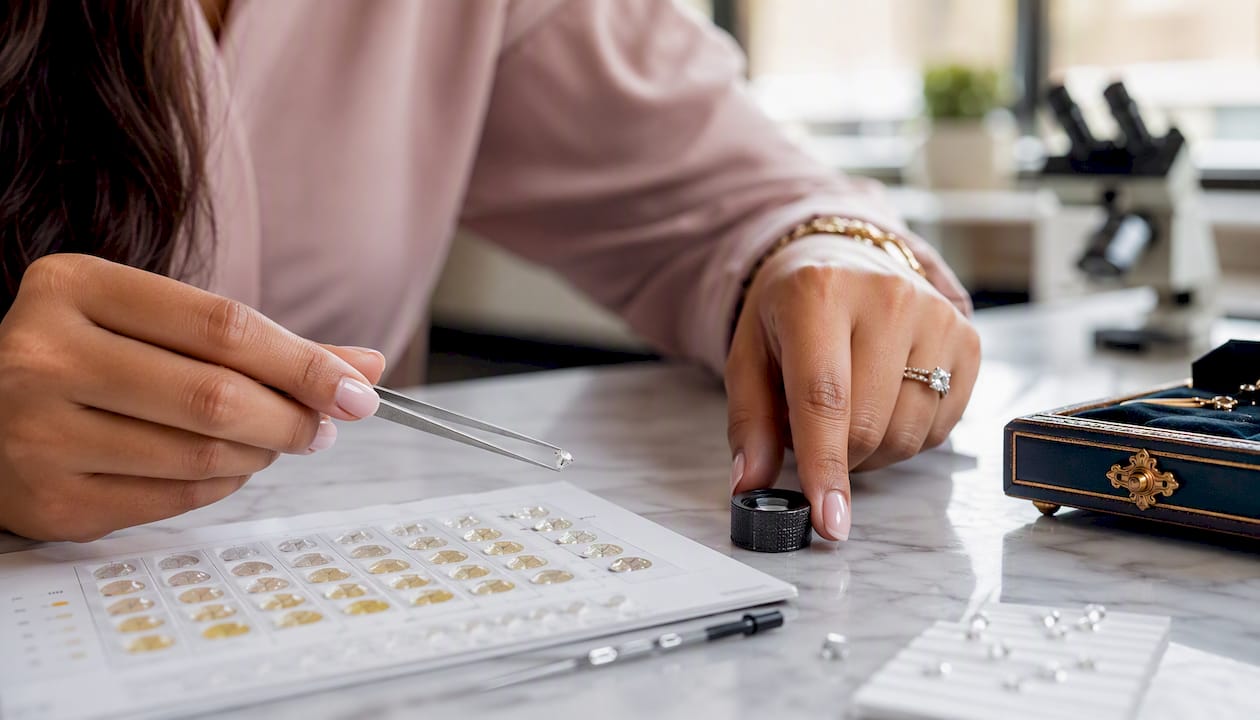
After the inscription, the proportions matter more than the grade label. A stone graded Excellent can still be cut to the edge of the acceptable range. Checking the table diameter against the stated measurements takes about 10 seconds and tells you whether the proportions diagram on the report reflects what’s actually in front of you.
The clarity plot gets a quick cross-check against the stone under magnification. The goal isn’t to re-grade clarity but to confirm the plot’s inclusion map matches the stone’s actual inclusions. If the plot shows a feather near the girdle and you’re mounting the stone in a four-prong setting, that’s a conversation to have before the stone goes into the mounting.
Quick physical checks:
- Loupe the girdle for the laser inscription; confirm it matches the report number
- Check table diameter with calipers against the stated measurements
- Cross-reference the clarity plot with the stone under 10x magnification
- Confirm polish and symmetry grades against the visual appearance of the facets
Long-term considerations: Ask about the return policy and warranty before purchase. A stone that chips during setting because an inclusion was missed in the clarity review is a problem the buyer shouldn’t absorb alone. Belviaggiodesigns’s lifetime warranty covers the setting; ask specifically about re-setting risk if you plan to change mountings later.
Belviaggiodesigns can help you apply this checklist
Knowing the checklist is one thing. Having a jeweler run it for you before you commit is another.
Belviaggiodesigns offers something most online diamond retailers don’t: a team that reviews the report, confirms the laser inscription, and checks setting compatibility before a stone is ever listed. Every certified loose stone comes with the option to request the full report PDF, and the custom design consultation includes a grade-to-setting review so you’re not guessing whether your clarity choice will hold up in a prong setting.
Custom engagement rings, wedding bands, and keepsake pieces are built to order with payment plans available. The lifetime warranty covers craftsmanship, and the team can walk you through the certificate field by field if you want to understand exactly what you’re buying.
Ready to find a verified lab-grown diamond and have it set in a design built for you? Start with Belviaggiodesigns and request a consultation or report review today.
Useful sources and further reading
The most authoritative sources for lab-grown diamond grading policies, report formats, and certificate verification are the labs themselves.
- GIA Laboratory-Grown Diamond Services — GIA’s official page describing the Premium/Standard quality assessment, laser inscription procedure, and report format
- GIA Laboratory-Grown Diamond Services Details — Full service description including the distinct report format and assessment criteria
- GIA Launches Updated Laboratory-Grown Diamond Services — GIA’s press release announcing the October 2025 Premium/Standard rollout with full criteria
- GIA Clarifies New Guidelines for Lab-Grown Diamond Certificates — Rapaport trade coverage with operational details and buyer implications
- GIA Details Updates to Lab-Grown Diamond Grading — JCK editorial with consumer-facing context on the terminology change
- How to Read an IGI Laboratory Grown Diamond Report — IGI’s field-by-field guide to their lab-grown report layout and online verification
- IGI Laboratory-Grown Diamond Report Overview — IGI’s overview of grading methodology and standardized viewing conditions
“The comments section is often the most underused part of a report but can reveal growth method (CVD vs HPHT), treatments, or clarity descriptors that materially affect pricing and future care.” — Lab Diamonds Reviews
FAQ
What is the GIA Premium vs Standard change for lab-grown diamonds?
Starting October 1, 2025, GIA replaced D–Z color nomenclature for lab-grown colorless diamonds with two tiers: Premium (D color, VVS clarity minimum, excellent cut for rounds) and Standard (E–J color, VS clarity, very good cut). Stones below Standard minimums receive no report.
How do I verify a lab-grown diamond certificate is real?
Enter the report number on the issuing lab’s official portal (GIA report check or IGI’s verification page) and confirm the 4Cs and stone description match the printed certificate. Also ask the seller for a photo or video of the laser inscription on the girdle.
Does the growth method (CVD vs HPHT) affect diamond quality?
Both CVD and HPHT stones can achieve top grades; the growth method affects pricing and sometimes long-term stability, but not necessarily visual appearance. Check the comments field on the certificate for the disclosed growth method before buying.
Which lab report is better, GIA or IGI?
Both are widely accepted by U.S. retailers. GIA’s post-2025 Premium/Standard format uses descriptive tiers; IGI continues the full D–Z and FL–I scales with a clarity plot included. The right choice depends on which grading language your retailer and resale market use.
Can Belviaggiodesigns verify a certificate before I buy?
Yes. Belviaggiodesigns confirms laser inscriptions against the lab’s online lookup before listing any stone, and report PDFs are available on request. You can also request a setting compatibility review as part of the custom design consultation.