

TL;DR:
- Ring bands are categorized by shape, material, and decorative features, each influencing appearance, feel, and wear. The most common types include classic, eternity, stackable, contoured, and sculptural bands, each serving distinct purposes and styles. Material choices like gold, platinum, and titanium affect durability and aesthetics, while finishes like polished or matte influence how the ring ages and shows wear.
Ring band types are defined by their shape, profile, material, and decorative features, and each choice directly shapes how a ring looks, feels, and wears over time. Whether you are selecting a wedding band, an engagement ring, or a stackable set, the band style carries as much weight as the center stone. Classic bands, eternity bands, contoured bands, and sculptural styles each serve a different purpose. This guide breaks down the most common types, explains the materials behind them, and gives you the practical knowledge to choose a band that fits your life and your style.
What are the most common ring band types?
Ring bands fall into several distinct categories, and knowing each one helps you make a confident choice. The band style you choose affects daily comfort, how the ring pairs with other pieces, and the symbolism it carries.
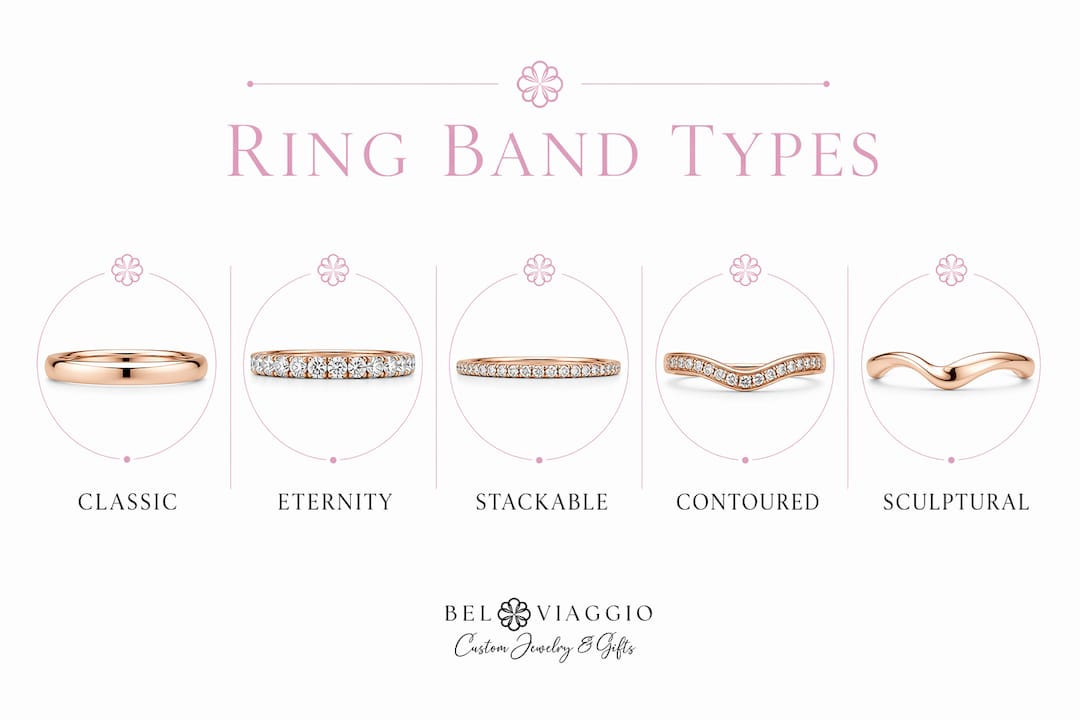
Classic bands
Classic bands are the foundation of wedding jewelry. They come in flat, domed, and rounded profiles, and they work in virtually any metal. Their clean lines make them easy to pair with almost any engagement ring setting. Maintenance is straightforward because there are no prong settings or pavé details to snag or collect debris.
Eternity and half-eternity bands
Eternity bands feature stones set around most or all of the circumference of the ring. Full eternity bands carry stones all the way around. Half-eternity bands place stones only across the top half, which makes resizing easier and reduces cost. Both styles add continuous sparkle and are often chosen to symbolize unending love.
Stackable bands
Stackable bands are designed to be worn in multiples. You can wear one alone or layer several together, mixing widths, metals, and finishes as your collection grows. Stackable styles give you the flexibility to add anniversary bands or milestone pieces over time without replacing your original ring.
Contoured and curved bands
Contoured bands are shaped specifically to fit around an engagement ring. The curve prevents the gap that forms when a straight band sits next to a solitaire or halo setting. This creates a cleaner, more polished look when the two rings are worn together.
Sculptural and statement bands
Sculptural bands are the boldest category. They feature thick profiles, architectural shapes, or surface textures that make the band itself the focal point. Market trends in 2026 show a clear shift toward chunkier, more substantial gold bands with unique settings such as scattered diamonds or polka-dot patterns. This reflects a broader move away from delicate styles toward rings with real visual presence.
Pro Tip: Try a contoured band alongside your engagement ring before buying. The fit gap between a straight band and a shaped setting is more noticeable in person than in photos.
How do materials and finishes influence ring band options?
The metal and finish you choose affect durability, skin sensitivity, weight, and the overall look of the ring. Popular ring band metals include yellow gold, white gold, rose gold, platinum, palladium, and titanium. Each has distinct properties worth understanding before you commit.
Metal properties at a glance
- Yellow gold carries the warmest tone and works well with vintage and classic designs. It is available in 10k, 14k, and 18k, with higher karat gold being softer and richer in color.
- White gold is yellow gold alloyed with white metals and plated with rhodium for a bright, silver-like finish. The rhodium plating wears over time and requires replating every few years.
- Rose gold gets its pink tone from a higher copper content. It is durable and flattering against most skin tones, and it pairs well with warm-toned gemstones like morganite.
- Platinum is the densest and most durable option. It is naturally white, hypoallergenic, and does not require replating. It costs more than gold but holds its finish longer.
- Palladium shares platinum’s white color and hypoallergenic properties at a lower price point. It is lighter than platinum, which some buyers prefer.
- Titanium is extremely lightweight and scratch-resistant. It works well for buyers with active lifestyles, though it cannot be resized easily.
Surface finishes and their visual impact
| Finish | Appearance | Best suited for |
|---|---|---|
| Polished | High shine, mirror-like | Classic, eternity, and contoured bands |
| Brushed | Soft, matte sheen with fine texture | Modern and minimalist styles |
| Matte | Flat, no-glare surface | Sculptural and statement bands |
| Hammered | Organic, textured surface | Rustic, artisan, and mixed-metal designs |
Mixed-metal styles are gaining ground as buyers combine yellow gold with white gold or platinum accents in a single band. The contrast adds visual interest without requiring a gemstone. Engagement ring trends for 2026 show this combination appearing frequently in both bridal and fashion ring categories.
What are the practical considerations when choosing a ring band style?
Choosing a band style is not only about appearance. Comfort, durability, and how the band interacts with your daily routine all matter.
-
Comfort fit vs. flat fit. Comfort-fit bands have a rounded interior profile that slides on and off more easily and reduces pressure on the finger. Flat-fit bands have a straight interior edge. Most buyers who wear their ring daily prefer comfort fit, especially in wider bands.
-
Durability by design. Plain metal bands are the most durable option because there are no settings to catch or loosen. Diamond pavé settings require more care than plain metal bands because small stones can loosen with impact or heavy wear. If you work with your hands, a plain or lightly textured band holds up better than a fully paved style.
-
Matching your engagement ring. A band that pairs well with your engagement ring requires attention to both profile height and metal color. A high-set solitaire often needs a contoured band to sit flush. A bezel-set ring pairs naturally with a flat or slightly domed band.
-
Maintenance requirements. Polished bands show scratches more visibly than brushed or matte finishes. Brushed and hammered finishes hide everyday wear better. Platinum develops a natural patina over time that many buyers find appealing, while white gold requires periodic rhodium replating to maintain its bright finish.
-
Symbolism and personal meaning. Eternity bands traditionally symbolize continuous love and are often given as anniversary gifts. Stackable bands represent growth and milestones. Classic bands carry a timeless, understated meaning that focuses attention on the relationship rather than the ring itself.
Pro Tip: Wear your engagement ring for at least a week before selecting a wedding band. You will quickly learn whether you prefer a band that sits flush or one with a slight gap.
How to build a personalized ring set with stackable and anniversary bands?
The modern approach to bridal jewelry treats the ring set as a collection that grows over time. Stackable bands make this possible without requiring you to replace or retire your original ring.
Stackable bands work because they are designed to sit comfortably alongside other rings without creating pressure points or misalignment. The key is to vary the elements while keeping a unifying thread. Consider these principles when building your set:
- Mix widths intentionally. A thin 1.5mm band next to a 3mm band next to a 4mm band creates visual rhythm. Wearing three bands of the same width looks flat.
- Vary the finish, not the metal. Combining a polished yellow gold band with a hammered yellow gold band adds texture without introducing a color clash.
- Use an anniversary band as an anchor. Adding a meaningful anniversary band to your set on a milestone year gives the collection a personal timeline. Many buyers add a diamond eternity band at five or ten years.
- Keep one cohesive element. Whether that is the metal color, the stone shape, or the finish, one consistent detail ties the stack together visually.
- Consider the total stack height. Three or four bands worn together can create a stack that rides high on the finger. Try the combination in person before committing to the full set.
The shift toward personalized ring sets reflects a broader change in how buyers think about bridal jewelry. A ring set is no longer a fixed, one-time purchase. It is a living collection that reflects where you have been and where you are going.
Key Takeaways
The right ring band type depends on your lifestyle, your existing ring, and the meaning you want the piece to carry.
| Point | Details |
|---|---|
| Band type defines function | Classic, eternity, contoured, and sculptural bands each serve a distinct purpose and aesthetic. |
| Material affects durability | Platinum outlasts white gold plating; titanium resists scratches but cannot be resized. |
| Comfort fit matters daily | Rounded interior bands reduce pressure and are preferred for everyday wear. |
| Stackable bands grow with you | Adding anniversary or milestone bands over time creates a personal, evolving ring collection. |
| Finish hides or shows wear | Brushed and hammered finishes conceal scratches better than high-polish surfaces. |
What I have learned after years of watching buyers choose bands
The most common mistake I see is choosing a band in isolation. Buyers fall in love with a style on its own, then discover it does not sit well next to their engagement ring. The gap between a straight band and a curved solitaire setting looks small in photos but feels significant on the hand.
The second mistake is underestimating how much finish matters over time. A high-polish platinum band looks stunning on day one. After six months of daily wear, it develops fine surface scratches that some people love and others find frustrating. A brushed or hammered finish ages more gracefully for most active wearers.
The trend toward chunkier gold bands is real, and I think it has staying power. Dainty stacking rings had a long run, but buyers are now choosing bands with actual visual weight. A single substantial band often makes more of a statement than three thin ones. That said, the most satisfying ring sets I have seen are the ones built slowly, with intention, over years of marriage. The timeless engagement ring trends that hold up are always the ones rooted in personal meaning rather than what was popular in a given year.
Choose the band that fits your life first. Style follows from there.
— Stacy
Belviaggiodesigns has the band styles worth considering
Belviaggiodesigns specializes in handcrafted, ethically sourced engagement and wedding rings with a strong focus on custom design. Every band style covered in this guide is represented in the collection, from classic plain metal bands to bold statement pieces with unique stone settings.

The black diamond halo engagement ring is one of the most requested styles for buyers who want a sculptural band with serious presence. The green emerald and diamond ring pairs a vivid center stone with an elegant band that works beautifully in a stacked set. For buyers who want something outside the traditional white diamond category, the gemstone ring collection offers a full range of alternative stone options with custom band configurations. Custom design consultations are available for buyers who want a band built around their specific style and lifestyle needs.
FAQ
What are the main ring band types?
The main ring band types are classic, eternity, half-eternity, stackable, contoured, and sculptural bands. Each differs in profile, stone coverage, and how it pairs with other rings.
What is a comfort-fit band?
A comfort-fit band has a rounded interior edge that makes it easier to slide on and off. It reduces pressure on the finger and is preferred for everyday wear, especially in wider widths.
Which ring band material is the most durable?
Platinum is the most durable common ring metal. It is dense, naturally white, and hypoallergenic, and it does not require replating the way white gold does.
How do I choose a band to match my engagement ring?
Match the metal color first, then consider the profile height. High-set or shaped engagement rings pair best with contoured bands that fit flush against the setting without leaving a gap.
What does an eternity band symbolize?
An eternity band symbolizes continuous, unending love because stones run around most or all of the ring’s circumference. It is traditionally given as an anniversary gift or added to a bridal set.
Recommended
- Ring settings explained: types, styles & custom options – Bel Viaggio Designs, LLC
- Custom ring guide: step-by-step ethical luxury (2026) – Bel Viaggio Designs, LLC
- Anniversary Ring How to Pick the Perfect One - Bel Viaggio – Bel Viaggio Designs, LLC
- Take the Engagement Ring Quiz to Find Your Style – Bel Viaggio Designs, LLC